Nakamura Ryutaro, Kurihara Mika, Ogawa Nobuhiro, Kitamura Akihiro, Yamakawa Isamu, Bamba Shigeki, Sanada Mitsuru, Sasaki Masaya, Urushitani Makoto
Department of Neurology, Shiga University of Medical Science, Seta-Tsukinowa-cho, Otsu, Shiga, 520-2192, Japan.
Division of Clinical Nutrition, Shiga University of Medical Science, Seta-Tsukinowa-cho, Otsu, Shiga, 520-2192, Japan.
Sci Rep. 2021 Sep 9;11(1):17943. doi: 10.1038/s41598-021-97196-5.
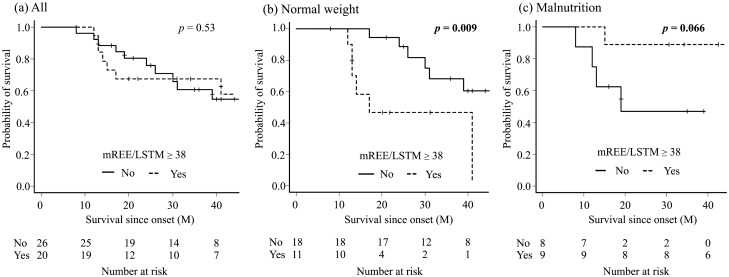
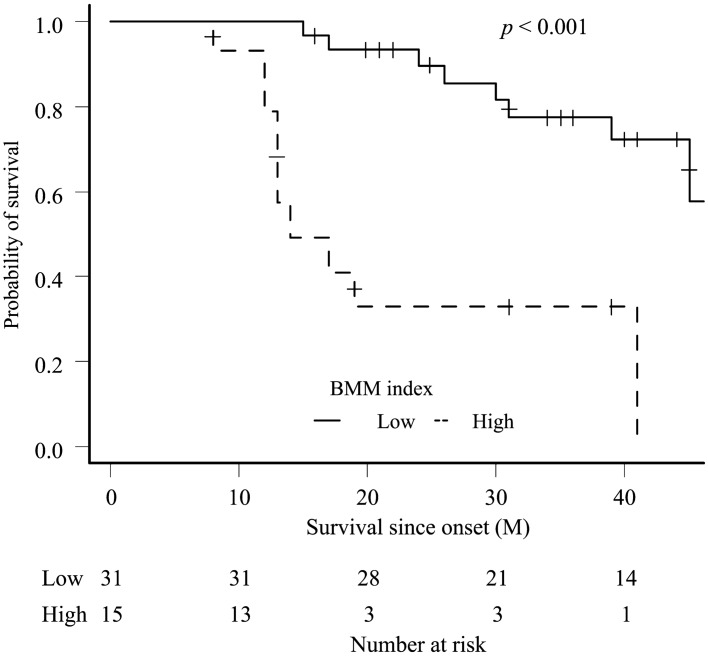
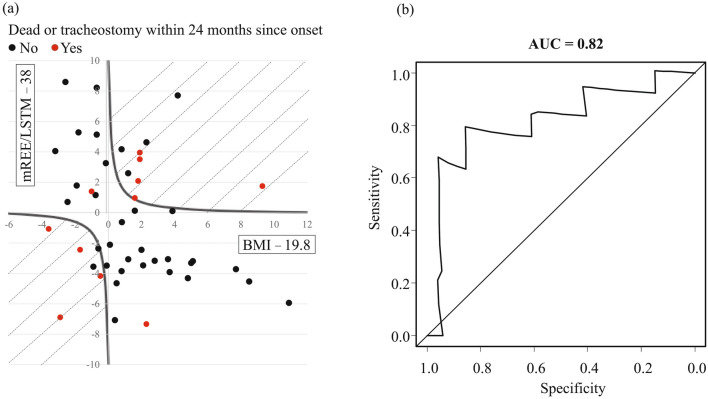
To examine whether hypermetabolism could predict the prognosis of early amyotrophic lateral sclerosis (ALS) patients with differing nutritional profiles. This single-center, retrospective study examined the prognosis of ALS patients with hypermetabolism in relation to their nutritional status at hospitalization. The metabolic state was estimated by the ratio of measured resting energy expenditure (mREE) to lean soft tissue mass (LSTM) (mREE/LSTM), wherein patients with ratios ≥ 38 were defined as hypermetabolic. Malnutrition was defined as %ideal body weight < 0.9. Forty-eight patients were enrolled in this study. The hypermetabolic group had shorter survival in the normal-weight group but more prolonged survival in the malnutrition group. Multiplication of nutritional and metabolic factors, such as [(body mass index (BMI) - 19.8) × (mREE/LSTM - 38)], designated as BMI-muscle metabolism index (BMM index), successfully predicted the prognosis in the group with a high BMM index (≥ 1), which showed shorter survival and a faster rate of weight loss and functional decline. Multivariate analysis using the Cox model showed high BMM index was an independent poor prognostic factor (hazard ratio: 4.05; p = 0.025). Prognostic prediction by hypermetabolism varies depending on the nutritional status in ALS, and the BMM index is a consistent prognostic factor.
为了研究高代谢是否能够预测营养状况不同的早期肌萎缩侧索硬化症(ALS)患者的预后。这项单中心回顾性研究调查了高代谢ALS患者的预后与住院时营养状况的关系。通过测量静息能量消耗(mREE)与瘦软组织质量(LSTM)的比值(mREE/LSTM)来评估代谢状态,其中比值≥38的患者被定义为高代谢。营养不良定义为实际体重占理想体重百分比<0.9。本研究共纳入48例患者。在正常体重组中,高代谢组的生存期较短,但在营养不良组中生存期延长。营养和代谢因素的乘积,如[(体重指数(BMI)-19.8)×(mREE/LSTM-38)],被指定为BMI-肌肉代谢指数(BMM指数),成功地预测了高BMM指数(≥1)组的预后,该组生存期较短,体重减轻和功能衰退速度较快。使用Cox模型进行的多变量分析显示,高BMM指数是一个独立的不良预后因素(风险比:4.05;p=0.025)。高代谢对预后的预测因ALS患者的营养状况而异,BMM指数是一个一致的预后因素。