Eun Jong Hyun, Lee Joon Seok
Department of Fiber System Engineering, Yeungnam University, Gyeongsan, 712-749, Republic of Korea.
Sci Rep. 2021 Sep 9;11(1):18028. doi: 10.1038/s41598-021-97529-4.
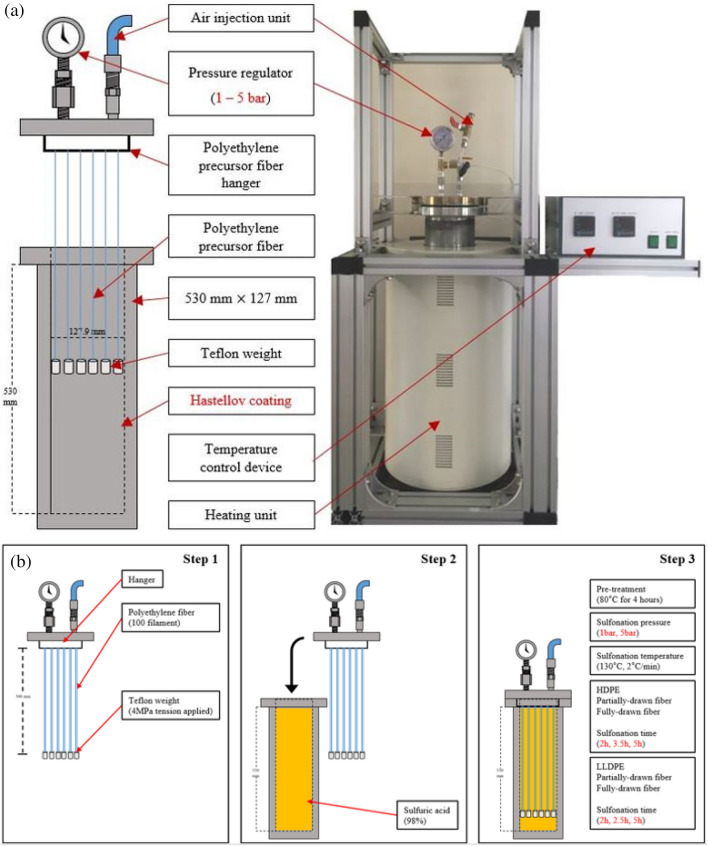
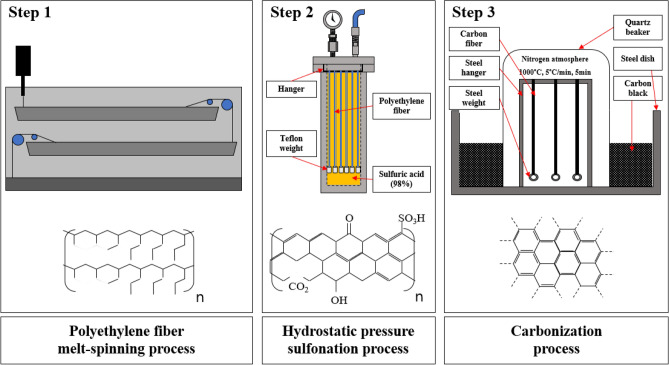
Polyethylene based carbon fibers were studied using high density polyethylene(HDPE) fibers and linear low density polyethylene(LLDPE) fibers with various melt flow index. The draw ratio of the polyethylene fibers and the sulfonation mechanism were investigated under hydrostatic pressures of 1 and 5 bar in the first time. The influence of the melt flow index of polyethylene and types of polyethylene fibers on the sulfonation reaction was studied. Carbon fibers were prepared through the sulfonation of LLDPE fibers possessing side chains with a high melt flow index. The polyethylene fibers, which exhibited thermoplastic properties and plastic behavior, were cross-linked through the sulfonation process. Their thermal properties and mechanical properties changed to thermoset properties and elastic behavior. Although sulfonation was performed under a hydrostatic pressure of 5 bar, it was difficult to convert the highly oriented polyethylene fibers because of their high crystallinity, but partially oriented polyethylene fibers could be converted to carbon fibers. Therefore, the effect of fiber orientation on fiber crosslinking, which has not been reported in previous literature, has been studied in detail, and a new method of hydrostatic pressure sulfonation has been successful in thermally stabilizing polyethylene fiber. Hydrostatic sulfonation was performed using partially oriented LLDPE fibers with a melt flow index of 20 at 130 °C for 2.5 h under a hydrostatic pressure of 5 bar. The resulting fibers were carbonized under the following conditions: 1000 °C, 5 °C/min, and five minutes. Carbon fibers with a tensile strength of 2.03 GPa, a tensile modulus of 143.63 GPa, and an elongation at break of 1.42% were prepared.
使用具有不同熔体流动指数的高密度聚乙烯(HDPE)纤维和线性低密度聚乙烯(LLDPE)纤维对聚乙烯基碳纤维进行了研究。首次研究了在1巴和5巴静水压力下聚乙烯纤维的拉伸比和磺化机理。研究了聚乙烯熔体流动指数和聚乙烯纤维类型对磺化反应的影响。通过对具有高熔体流动指数侧链的LLDPE纤维进行磺化制备碳纤维。表现出热塑性性能和塑性行为的聚乙烯纤维通过磺化过程发生交联。它们的热性能和机械性能转变为热固性性能和弹性行为。尽管磺化是在5巴静水压力下进行的,但由于高度取向的聚乙烯纤维结晶度高,难以将其转化,不过部分取向的聚乙烯纤维可以转化为碳纤维。因此,详细研究了纤维取向对纤维交联的影响,这在以前的文献中尚未报道,并且一种新的静水压力磺化方法成功地使聚乙烯纤维热稳定。使用熔体流动指数为20的部分取向LLDPE纤维在5巴静水压力下于130℃进行2.5小时的静水磺化。所得纤维在以下条件下碳化:1000℃,5℃/分钟,持续五分钟。制备出了拉伸强度为2.03 GPa、拉伸模量为143.63 GPa、断裂伸长率为1.42%的碳纤维。