Matijakovich Douglas, Solomon David, Benitez Carlos L, Huang Hsin-Hui, Poeran Jashvant, Berger Natalie, Lebaschi Amir, Seneviratne Aruna
Department of Orthopaedic Surgery, Mount Sinai Hospital, New York, NY, USA.
Department of Radiology, Mount Sinai West, New York, NY, USA.
JSES Int. 2021 Jul 13;5(5):863-868. doi: 10.1016/j.jseint.2021.05.010. eCollection 2021 Sep.
Perianchor cyst formation (PCF) can occur after arthroscopic rotator cuff repair with poly-L-lactic acid (PLLA) anchors; however, little is known about PCF after all-suture anchor (ASA) use.
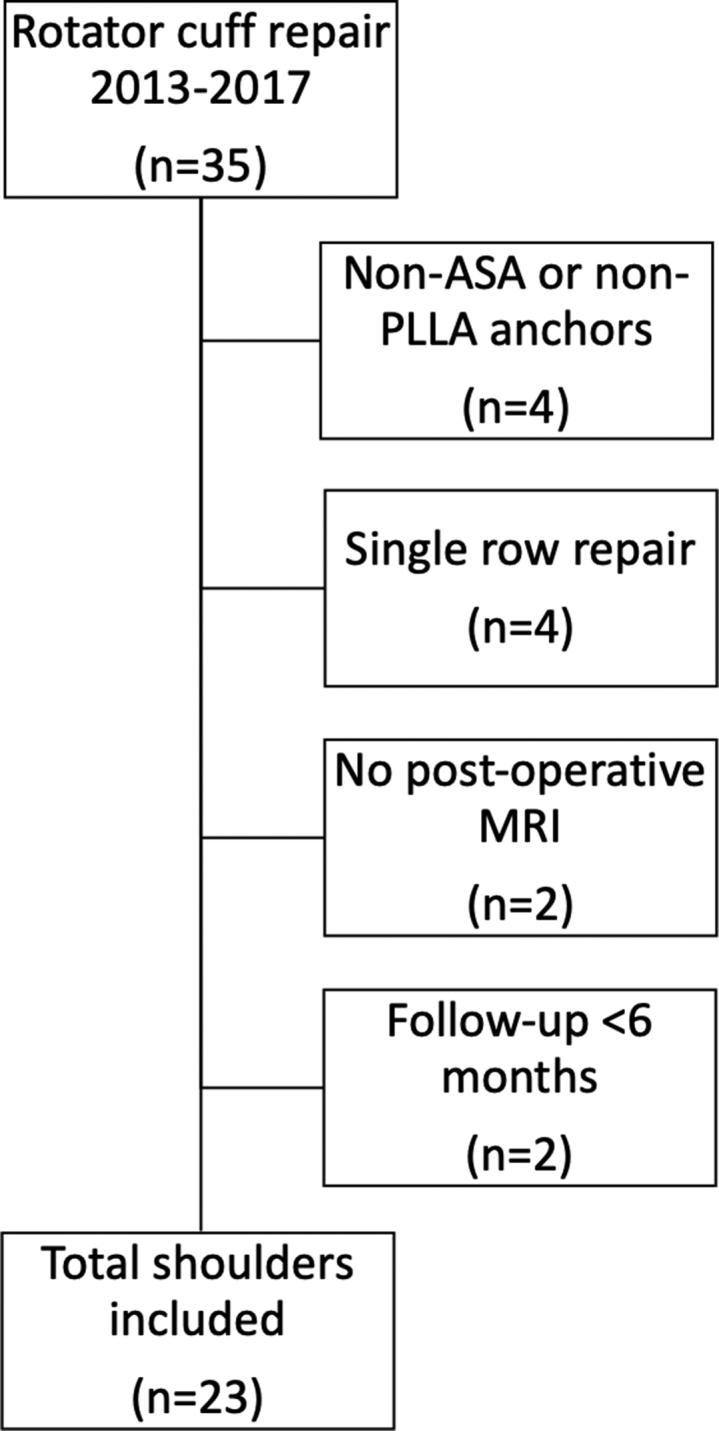
We reviewed patients who underwent double-row arthroscopic rotator cuff repair from 2012 to 2017 with ASAs implanted in the medial row and PLLA anchors in the lateral row. We evaluated PCF (graded on magnetic resonance imaging) and compared physical examination and functional surveys between patients with PCF (WC) and without PCF (WoC) at long-term follow-up.
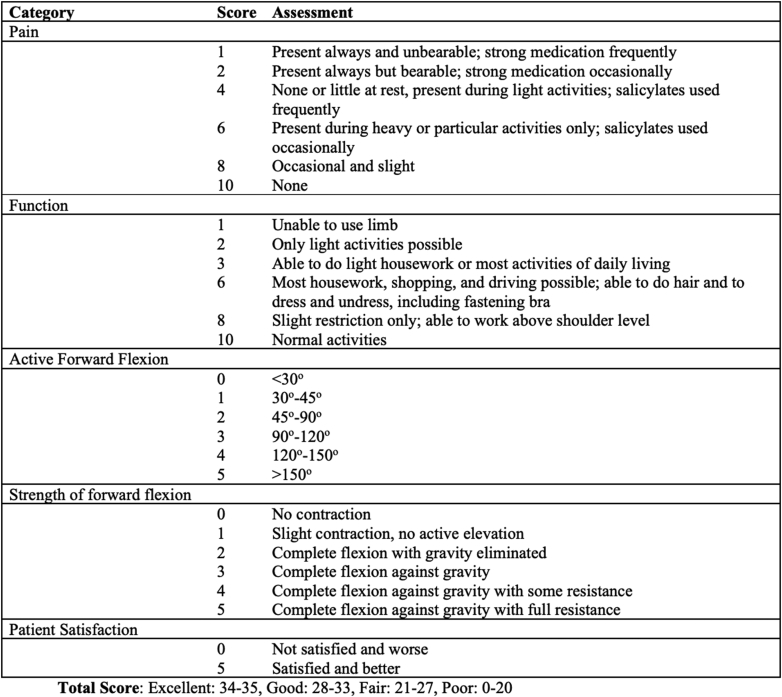
Among twenty-two patients (23 shoulders), 93% of PLLA anchors (vs. 79% ASA) displayed a grade 0 PCF, = .100. No PLLA anchors had a grade 3 or 4 PCF, compared to 11% of ASAs, = .158. At a mean postoperative follow-up time of 113 weeks, there was no significant difference between WC and WoC cohorts with regard to range of motion, rotator cuff strength, American Shoulder and Elbow Surgeons survey scores, or retear rates. However, the WoC cohort had a significantly higher University of California at Los Angeles shoulder survey score at final follow-up (34.3 WoC vs. 30.9 WC, = .024).
No difference was found in PCF between ASAs and PLLA anchors. At long-term follow-up, WoC patients had significantly improved functional outcome scores, based on the University of California at Los Angeles survey, but equivalent range of motion and rotator cuff strength examinations compared with WC patients.
使用聚左旋乳酸(PLLA)锚钉进行关节镜下肩袖修复术后可能会形成关节周围囊肿(PCF);然而,对于使用全缝线锚钉(ASA)后的PCF情况知之甚少。
我们回顾了2012年至2017年接受双排关节镜下肩袖修复的患者,内侧排植入ASA,外侧排植入PLLA锚钉。我们评估了PCF(通过磁共振成像分级),并在长期随访中比较了有PCF(WC)和无PCF(WoC)患者的体格检查和功能调查结果。
在22例患者(23个肩部)中,93%的PLLA锚钉(相比之下79%的ASA)显示为0级PCF,P = 0.100。没有PLLA锚钉出现3级或4级PCF,而ASA为11%,P = 0.158。术后平均随访时间为113周,WC组和WoC组在活动范围、肩袖力量、美国肩肘外科医师协会调查评分或再撕裂率方面没有显著差异。然而,在最终随访时,WoC组的加利福尼亚大学洛杉矶分校肩部调查评分显著更高(WoC组为34.3,WC组为30.9,P = 0.024)。
ASA和PLLA锚钉在PCF方面没有差异。在长期随访中,根据加利福尼亚大学洛杉矶分校的调查,WoC患者的功能结局评分有显著改善,但与WC患者相比,活动范围和肩袖力量检查结果相当。