Department of Psychological Sciences, University of Missouri, 200 South 7th Street, Columbia, MO, 65211, United States.
Department of Psychosomatic Medicine, Central Institute of Mental Health, Medical Faculty Mannheim at Heidelberg University, J5, Mannheim, 68159, Germany.
Drug Alcohol Depend. 2021 Nov 1;228:109021. doi: 10.1016/j.drugalcdep.2021.109021. Epub 2021 Sep 4.
Interpersonal stressors (ISs) are major factors in relapse in alcohol use disorder (AUD) and are theorized to play a role in drinking behaviors. Past work has examined this association using ecological momentary assessment (EMA), but the unique effects of rejections and disagreements on alcohol use are unknown. Research suggests the two ISs functionally differ and may display distinct associations with drinking. Further, these associations may differ in people with borderline personality disorder (BPD), a population reporting frequent IS and co-occurring AUD.
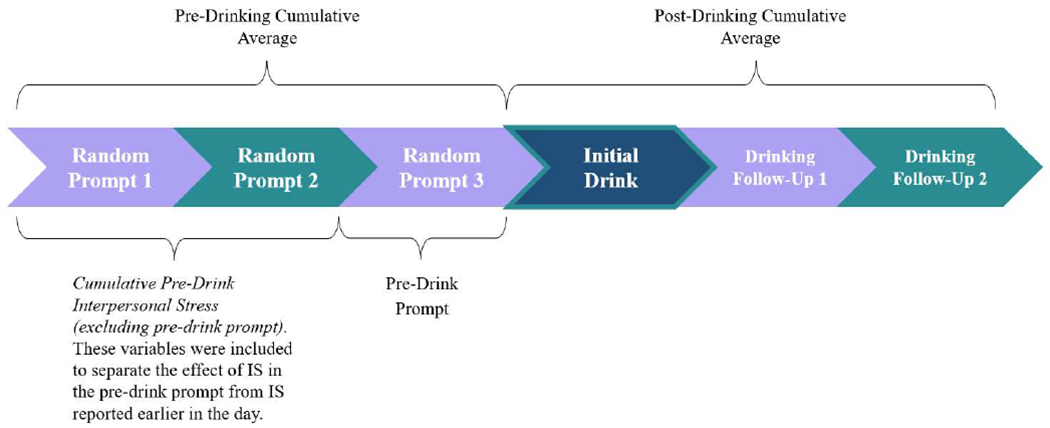
113 drinkers (community: n = 59; BPD: n = 54) reported alcohol use and ISs using EMA for 21 days. Using generalized estimating equations, we expected that rejection and disagreement would predict increased likelihood of drinking each day. We examined both cumulative (throughout each day) and immediate momentary effects of ISs predicting subsequent drinking on that same day. Further, we predicted that these associations would be stronger in individuals with BPD.
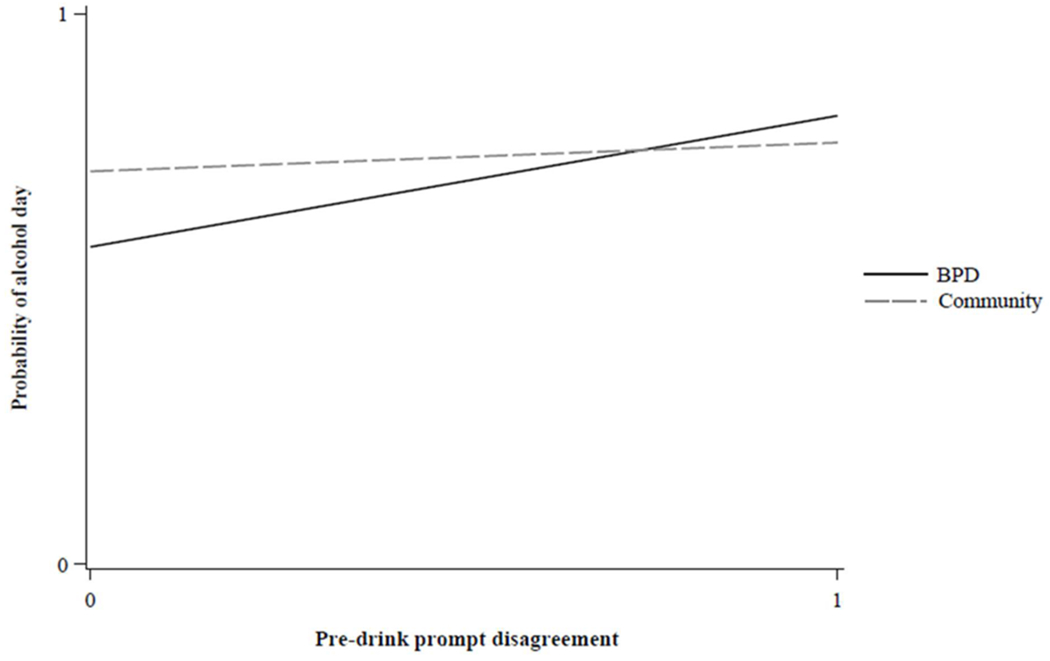
Greater rejections throughout the day were associated with a reduced likelihood of drinking that day (OR = 0.56, 95 % CI:[0.32, 0.97], p < .040). In contrast, disagreements immediately prior to drinking were associated with an increased likelihood of drinking that day (OR = 0.60, 95 % CI:[1.02, 2.50], p = .039). However, the effect of disagreement on drinking was moderated by BPD diagnosis (OR = 2.56, 95 % CI:[1.13, 5.80], p = .025), such that the effect was only present for individuals with BPD.
Assessing ISs as an aggregate predictor may mask potentially opposite effects on alcohol use. Additionally, disagreements may be a risk factor for subsequent alcohol use in BPD.
人际应激源(ISs)是酒精使用障碍(AUD)复发的主要因素,据推测它们在饮酒行为中起作用。过去的工作已经使用生态瞬时评估(EMA)研究了这种关联,但关于拒绝和意见不合对酒精使用的独特影响尚不清楚。研究表明,这两种 ISs 在功能上有所不同,并且可能与饮酒有不同的关联。此外,这些关联在患有边缘型人格障碍(BPD)的人群中可能有所不同,因为该人群报告经常发生 IS 且同时存在 AUD。
113 名饮酒者(社区:n=59;BPD:n=54)使用 EMA 报告了 21 天的饮酒和 IS。使用广义估计方程,我们预计拒绝和意见不合会预测每天饮酒的可能性增加。我们检验了 IS 对同一天随后饮酒的累积(全天)和即时瞬时影响。此外,我们预测这些关联在 BPD 个体中更强。
全天的拒绝感与当天饮酒的可能性降低有关(OR=0.56,95%CI:[0.32,0.97],p<.040)。相比之下,在饮酒之前立即发生的分歧与当天饮酒的可能性增加有关(OR=0.60,95%CI:[1.02,2.50],p=0.039)。然而,BPD 诊断对分歧对饮酒的影响有调节作用(OR=2.56,95%CI:[1.13,5.80],p=0.025),因此这种影响仅存在于 BPD 个体中。
将 ISs 作为综合预测因素评估可能会掩盖对饮酒的潜在相反影响。此外,分歧可能是 BPD 中随后饮酒的一个风险因素。