Zhuo Chuanjun, Xu Yong, Wang Haibo, Fang Tao, Chen Jiayue, Zhou Chunhua, Li Qianchen, Liu Jie, Xu Shuli, Yao Cong, Yang Weiliang, Yang Anqu, Li Bo, Chen Yuhui, Tian Hongjun, Lin Chongguang
Key Laboratory of Multiple Organ Damages of Major Psychoses (MODMP_Lab), Tianjin Fourth Center Hospital, The Fourth Central Hospital Affiliated With Nankai University, The Fourth Central Hospital Affiliated to Tianjin Medical University, Tianjin, China.
Key Laboratory of Real Time Brain Circuit Tracing in Neurology and Psychiatry (RTBNP_Lab), Tianjin Fourth Center Hospital, The Fourth Central Hospital Affiliated With Nankai University, The Fourth Central Hospital Affiliated to Tianjin Medical University, Tianjin, China.
Front Psychiatry. 2021 Aug 26;12:681418. doi: 10.3389/fpsyt.2021.681418. eCollection 2021.
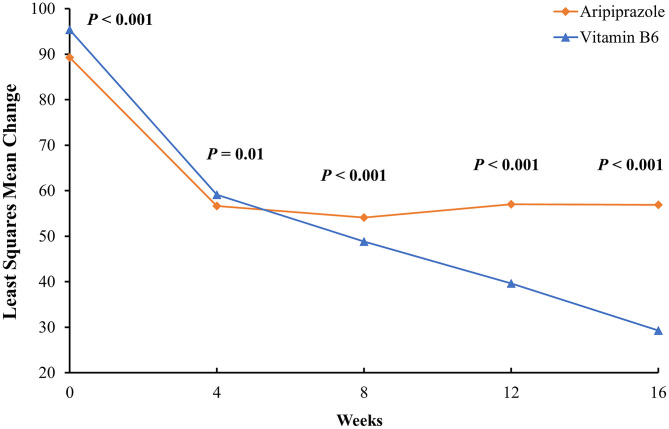
This study aimed to investigate the safety and efficacy of high-dose vitamin B6 (vB6) as an adjunct treatment for antipsychotic-induced hyperprolactinemia (AIHP) in male patients with treatment-resistant schizophrenia (TRS). In this randomized double-blinded controlled study, patients were randomized (1:1) into a control group given aripiprazole (ARI; 10 mg/day; = 100) or an intervention group given vB6 (300 mg/12 h for 16 weeks; = 100). Prolactin levels, psychotic symptoms [Positive and Negative Syndrome Scale (PANSS)], cognitive function [MATRICS Consensus Cognitive Battery (MCCB)], liver function, kidney function, growth hormone level, micronutrient levels, blood lipids, and adverse secondary effects (ASEs)[Treatment Emergent Symptom Scale (TESS) and Barnes-Akathisia scale] were monitored. After a 16-week treatment period, the vB6 group showed a 68.1% reduction in serum prolactin levels (from 95.52 ± 6.30 μg/L to 30.43 ± 18.65 μg/L) while the ARI group showed only a 37.4% reduction (from 89.07 ± 3.59 μg/L to 55.78 ± 7.39 μg/L). During weeks 1-4, both treatments reduced prolactin similarly. Subsequently, the ARI effect plateaued, while the vB6 effect remained robust. The vB6 group showed better alleviation of psychotic symptoms and cognitive impairment. No serious ASEs were observed; ASEs were more frequent in the ARI group. AIHP reduction efficacy of vB6 was associated with baseline prolactin and triglyceride levels, total vB6 dosage, and education level. In conclusion, compared with the ARI group, TRS patients given vB6 showed better attenuation of AIHP, lower ASE scores, and greater improvements in clinical symptoms and cognitive impairments. These results support further consideration of vB6 as a putative treatment for AIHP. ChiCTR1800014755.
本研究旨在探讨大剂量维生素B6(vB6)作为辅助治疗手段,用于治疗男性难治性精神分裂症(TRS)患者抗精神病药物所致高催乳素血症(AIHP)的安全性和有效性。在这项随机双盲对照研究中,患者被随机(1:1)分为对照组,给予阿立哌唑(ARI;10毫克/天;n = 100),或干预组,给予vB6(300毫克/12小时,共16周;n = 100)。监测催乳素水平、精神症状[阳性和阴性症状量表(PANSS)]、认知功能[MATRICS共识认知成套测验(MCCB)]、肝功能、肾功能、生长激素水平、微量营养素水平、血脂以及不良副作用(ASEs)[治疗中出现的症状量表(TESS)和巴恩斯静坐不能量表]。经过16周的治疗期后,vB6组血清催乳素水平降低了68.1%(从95.52±6.30微克/升降至30.43±18.65微克/升),而ARI组仅降低了37.4%(从89.07±3.59微克/升降至55.78±7.39微克/升)。在第1 - 4周期间,两种治疗方法降低催乳素的效果相似。随后,ARI的效果趋于平稳,而vB6的效果依然显著。vB6组在缓解精神症状和认知障碍方面表现更佳。未观察到严重的ASEs;ARI组的ASEs更为常见。vB6降低AIHP的疗效与基线催乳素和甘油三酯水平、vB6总剂量以及教育程度有关。总之,与ARI组相比,接受vB6治疗的TRS患者在减轻AIHP方面表现更佳,ASE评分更低,临床症状和认知障碍改善更大。这些结果支持进一步考虑将vB6作为AIHP的一种假定治疗方法。中国临床试验注册中心注册号:ChiCTR1800014755。