Aleksandrov N M, Petrov S V, Kuptsov D A, Petrov M S
Leading Researcher, Microsurgical Department, Institute of Traumatology and Orthopedics, Privolzhsky Research Medical University, 10/1 Minin and Pozharsky Square, Nizhny Novgorod, 603005, Russia.
Clinical Resident, Institute of Traumatology and Orthopedics, Privolzhsky Research Medical University, 10/1 Minin and Pozharsky Square, Nizhny Novgorod, 603005, Russia.
Sovrem Tekhnologii Med. 2020;12(1):16-22. doi: 10.17691/stm2020.12.1.02.
was to present a clinical and anatomical rationale for transplantation of skin-bone grafts with microvascular anastomoses for treating terminal and segmental defects of the hand and fingers.
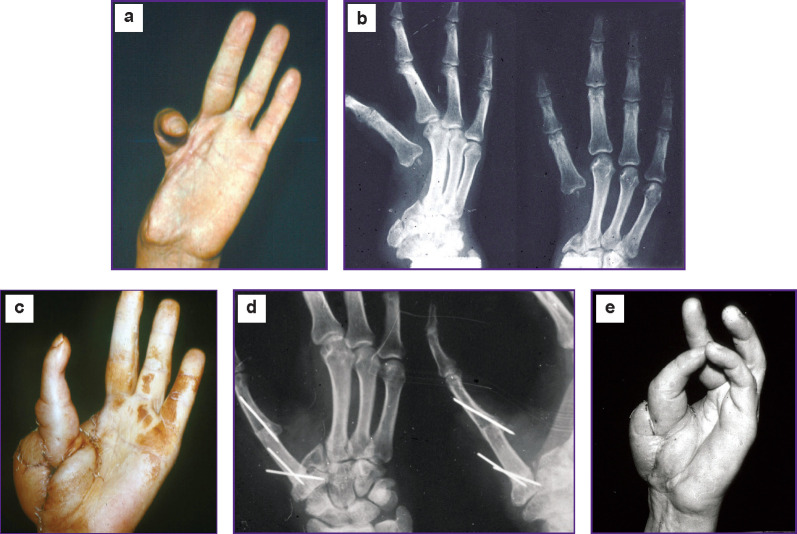
Finger and metacarpal bones were reconstructed in 25 hands of 25 patients by transplanting skin-bone tubular fragments with microvascular anastomoses. Transplants from the second metatarsal bone (n=22) and fibula (n=3) were used. Clinical, radiological, morphological, biomechanical, biophysical, and statistical research methods were used. The developed technology is adjustable to individual vascular anatomy of the foot. The proposed use of non-free skin-fat flaps and skin-bone fragments with microvascular anastomoses has been implemented for reconstructing lost segments.
The engraftment of skin-bone fragments was observed in 25 cases. In two cases, partial necrosis of the transplants was detected. Sufficient resistance of the transplanted bone graft to resorption was noted. According to the X-ray evidence, the length of the finger with the metacarpal bone after surgery was 8.44±0.32 cm, in the short term after surgery - 8.10±0.36 cm, and in the long term - 7.87±0.45 cm, indicating mild resorption. We used an individual approach to the transplant selection, which made it possible to obtain generally good long-term results in 3 patients, and satisfactory results - in 22 patients.
The study showed the feasibility of transplanting skin-bone fragments with microvascular anastomoses for replacing various anatomical defects of the hand and fingers. The proposed modification takes into account the variability of vascular anatomy of the donor region.
目的是为微血管吻合的皮肤-骨移植治疗手部和手指的末端及节段性缺损提供临床和解剖学依据。
对25例患者的25只手进行手指和掌骨重建,采用微血管吻合的皮肤-骨管状移植物。使用了来自第二跖骨(n = 22)和腓骨(n = 3)的移植物。采用临床、放射学、形态学、生物力学、生物物理学和统计学研究方法。所开发的技术可根据足部个体血管解剖结构进行调整。已实施使用带微血管吻合的非游离皮肤-脂肪瓣和皮肤-骨碎片来重建缺失节段。
25例均观察到皮肤-骨碎片存活。2例检测到移植物部分坏死。注意到移植骨移植物对吸收有足够的抵抗力。根据X线证据,术后带掌骨的手指长度为8.44±0.32 cm,术后短期内为8.10±0.36 cm,长期为7.87±0.45 cm,表明有轻度吸收。我们采用个体方法选择移植物,使得3例患者总体获得良好的长期结果,22例患者获得满意结果。
该研究表明微血管吻合的皮肤-骨碎片移植用于替代手部和手指各种解剖缺损的可行性。所提出的改良方法考虑了供区血管解剖结构的变异性。