• 文献检索
  • 文档翻译
  • 深度研究
  • 学术资讯
  • Suppr Zotero 插件Zotero 插件
  • 邀请有礼
  • 套餐&价格
  • 历史记录
应用&插件
Suppr Zotero 插件Zotero 插件浏览器插件Mac 客户端Windows 客户端微信小程序
定价
高级版会员购买积分包购买API积分包
服务
文献检索文档翻译深度研究API 文档MCP 服务
关于我们
关于 Suppr公司介绍联系我们用户协议隐私条款
关注我们

Suppr 超能文献

核心技术专利:CN118964589B侵权必究
粤ICP备2023148730 号-1Suppr @ 2026

文献检索

告别复杂PubMed语法,用中文像聊天一样搜索,搜遍4000万医学文献。AI智能推荐,让科研检索更轻松。

立即免费搜索

文件翻译

保留排版,准确专业,支持PDF/Word/PPT等文件格式,支持 12+语言互译。

免费翻译文档

深度研究

AI帮你快速写综述,25分钟生成高质量综述,智能提取关键信息,辅助科研写作。

立即免费体验

情绪障碍经颅磁刺激后轻躁狂/躁狂转换:一项系统评价和荟萃分析。

Hypomanic/manic switch after transcranial magnetic stimulation in mood disorders: A systematic review and meta-analysis.

作者信息

Miuli Andrea, Sepede Gianna, Stigliano Gianfranco, Mosca Alessio, Di Carlo Francesco, d'Andrea Giacomo, Lalli Aliseo, Spano Maria Chiara, Pettorruso Mauro, Martinotti Giovanni, di Giannantonio Massimo

机构信息

Department of Neuroscience, Imaging and Clinical Sciences, "G. d'Annunzio" University of Chieti, Chieti 66100, Italy.

Department of Psychiatry Affective Neuropsychiatry, Sahlgrenska University Hospital, Göteborg 40530, Sweden.

出版信息

World J Psychiatry. 2021 Aug 19;11(8):477-490. doi: 10.5498/wjp.v11.i8.477.

DOI:10.5498/wjp.v11.i8.477
PMID:34513609
原文链接:https://pmc.ncbi.nlm.nih.gov/articles/PMC8394688/
Abstract

BACKGROUND

Nowadays there is an increasing use of transcranial magnetic stimulation (TMS) both in neurological and psychiatric fields. After Food and Drug Administration approval of TMS for the therapy of treatment-resistant depression, TMS has been widely used in the context of mood disorders (MD). However, growing reports regarding the possibility of developing hypomanic/manic switch (HMS) have generated concern regarding its use in MDs.

AIM

To investigate the actual risk of developing HMS due to TMS in the treatment of MD.

METHODS

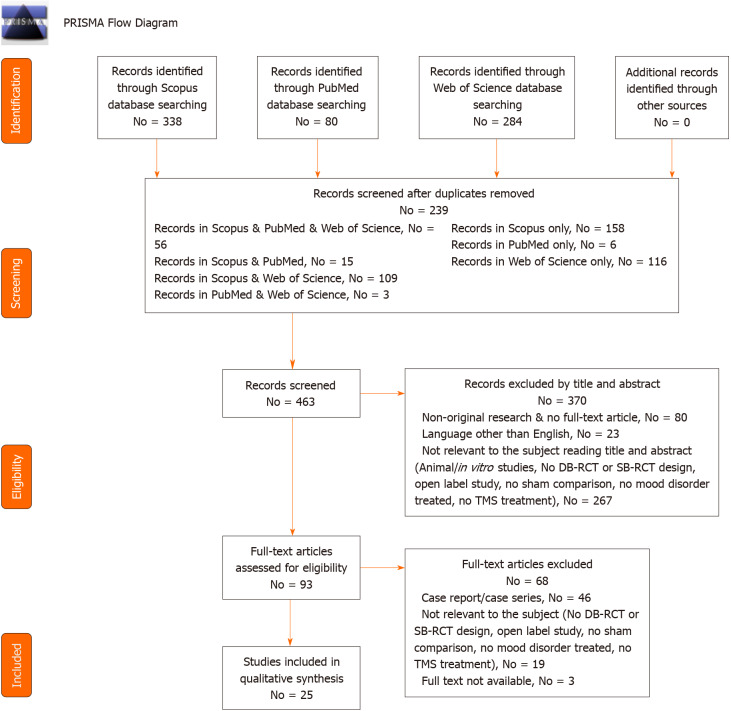
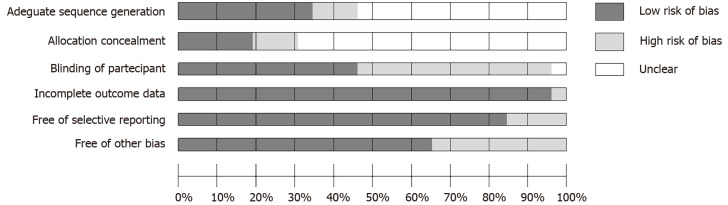
We led our research on PubMed, Scopus and Web of Science on March 22, 2020, in accordance to the PRISMA guidelines for systematic review. Only double blind/single blind studies, written in English and focused on the TMS treatment of MD, were included. A meta-analysis of repetitive TMS protocol studies including HMS was conducted using RevMan 5.4 software. The assessment of Risk of Bias was done using Cochrane risk of bias tool. This protocol was registered on PROSPERO with the CRD42020175811 code.

RESULTS

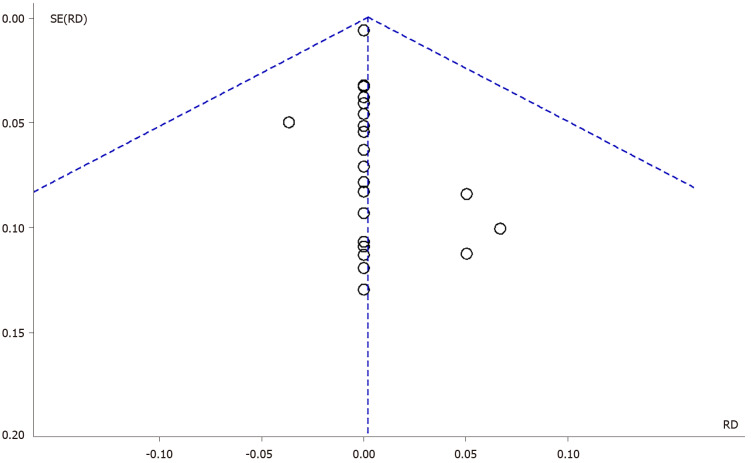
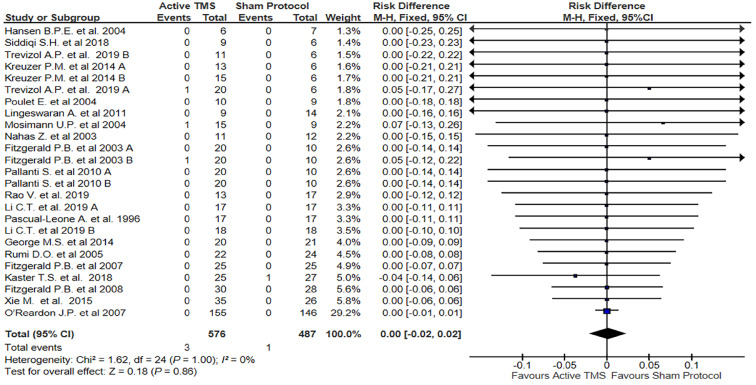
Twenty-five studies were included in our meta-analysis: Twenty-one double blind randomized controlled trials (RCT) and four single blind-RCT (no. of subjects involved in active stimulation = 576; no. of subjects involved in sham protocol = 487). The most frequently treated pathology was major depressive episode/major depressive disorder, followed by resistant depression, bipolar depression and other MD. The majority of the studies used a repetitive TMS protocol, and the left dorsolateral prefrontal cortex was the main target area. Side effects were reported in eight studies and HMS (described as greater energy, insomnia, irritability, anxiety, suicidal attempt) in four studies. When comparing active TMS sham treatment, the risk of developing HMS was not significantly different between conditions.

CONCLUSION

Applying the most usual protocols and the appropriate precautionary measures, TMS seems not to be related to HMS development.

摘要

背景

如今,经颅磁刺激(TMS)在神经科和精神科领域的应用越来越广泛。在美国食品药品监督管理局批准TMS用于治疗难治性抑郁症后,TMS已在情绪障碍(MD)的治疗中广泛应用。然而,越来越多关于发生轻躁狂/躁狂转换(HMS)可能性的报告引发了人们对其在MD治疗中应用的担忧。

目的

探讨MD治疗中TMS导致HMS的实际风险。

方法

我们于2020年3月22日按照系统评价的PRISMA指南在PubMed、Scopus和Web of Science上开展研究。仅纳入以英文撰写、聚焦于MD的TMS治疗的双盲/单盲研究。使用RevMan 5.4软件对包括HMS的重复TMS方案研究进行荟萃分析。使用Cochrane偏倚风险工具进行偏倚风险评估。该方案已在PROSPERO上注册,注册号为CRD42020175811。

结果

25项研究纳入我们的荟萃分析:21项双盲随机对照试验(RCT)和4项单盲RCT(接受主动刺激的受试者数量 = 576;接受假刺激方案的受试者数量 = 487)。最常治疗的疾病是重度抑郁发作/重度抑郁症,其次是难治性抑郁症、双相抑郁症和其他MD。大多数研究使用重复TMS方案,左侧背外侧前额叶皮质是主要靶区。8项研究报告了副作用,4项研究报告了HMS(表现为精力更充沛、失眠、易怒、焦虑、自杀企图)。比较主动TMS与假刺激治疗时,不同治疗条件下发生HMS的风险无显著差异。

结论

应用最常用的方案并采取适当的预防措施,TMS似乎与HMS的发生无关。
https://cdn.ncbi.nlm.nih.gov/pmc/blobs/e482/8394688/037cfd9f2b7b/WJP-11-477-g004.jpg
https://cdn.ncbi.nlm.nih.gov/pmc/blobs/e482/8394688/931be3854265/WJP-11-477-g001.jpg
https://cdn.ncbi.nlm.nih.gov/pmc/blobs/e482/8394688/320c512efc8d/WJP-11-477-g002.jpg
https://cdn.ncbi.nlm.nih.gov/pmc/blobs/e482/8394688/206fa37155b6/WJP-11-477-g003.jpg
https://cdn.ncbi.nlm.nih.gov/pmc/blobs/e482/8394688/037cfd9f2b7b/WJP-11-477-g004.jpg
https://cdn.ncbi.nlm.nih.gov/pmc/blobs/e482/8394688/931be3854265/WJP-11-477-g001.jpg
https://cdn.ncbi.nlm.nih.gov/pmc/blobs/e482/8394688/320c512efc8d/WJP-11-477-g002.jpg
https://cdn.ncbi.nlm.nih.gov/pmc/blobs/e482/8394688/206fa37155b6/WJP-11-477-g003.jpg
https://cdn.ncbi.nlm.nih.gov/pmc/blobs/e482/8394688/037cfd9f2b7b/WJP-11-477-g004.jpg

相似文献

1
Hypomanic/manic switch after transcranial magnetic stimulation in mood disorders: A systematic review and meta-analysis.情绪障碍经颅磁刺激后轻躁狂/躁狂转换:一项系统评价和荟萃分析。
World J Psychiatry. 2021 Aug 19;11(8):477-490. doi: 10.5498/wjp.v11.i8.477.
2
Effects of repetitive transcranial magnetic stimulation of the left dorsolateral prefrontal cortex on symptom domains in neuropsychiatric disorders: a systematic review and cross-diagnostic meta-analysis.左侧背外侧前额叶皮质重复经颅磁刺激对神经精神疾病症状领域的影响:一项系统评价和跨诊断荟萃分析。
Lancet Psychiatry. 2023 Apr;10(4):252-259. doi: 10.1016/S2215-0366(23)00026-3. Epub 2023 Mar 7.
3
[Antipsychotics in bipolar disorders].[双相情感障碍中的抗精神病药物]
Encephale. 2004 Sep-Oct;30(5):417-24. doi: 10.1016/s0013-7006(04)95456-5.
4
Comparing the efficacies of transcranial magnetic stimulation treatments using different targeting methods in major depressive disorder: protocol for a network meta-analysis.比较不同靶向方法的经颅磁刺激治疗在重度抑郁症中的疗效:网络荟萃分析方案。
BMJ Open. 2023 Dec 12;13(12):e075525. doi: 10.1136/bmjopen-2023-075525.
5
Controversy: Repetitive transcranial magnetic stimulation or transcranial direct current stimulation shows efficacy in treating psychiatric diseases (depression, mania, schizophrenia, obsessive-complusive disorder, panic, posttraumatic stress disorder).争议:重复经颅磁刺激或经颅直流电刺激在治疗精神疾病(抑郁症、躁狂症、精神分裂症、强迫症、惊恐症、创伤后应激障碍)方面显示出疗效。
Brain Stimul. 2009 Jan;2(1):14-21. doi: 10.1016/j.brs.2008.06.001. Epub 2008 Jun 27.
6
Transcranial magnetic stimulation in the treatment of depression: a double-blind, placebo-controlled trial.经颅磁刺激治疗抑郁症:一项双盲、安慰剂对照试验。
Arch Gen Psychiatry. 2003 Oct;60(10):1002-8. doi: 10.1001/archpsyc.60.9.1002.
7
The Efficacy and Safety of Transcranial Magnetic Stimulation in Treatment-Resistant Bipolar Depression.经颅磁刺激治疗抵抗性双相抑郁的疗效和安全性。
Psychiatr Danub. 2022 Summer;34(2):236-244. doi: 10.24869/psyd.2022.236.
8
Safety of transcranial magnetic stimulation in unipolar depression: A systematic review and meta-analysis of randomized-controlled trials.经颅磁刺激治疗单相抑郁的安全性:一项随机对照试验的系统评价和荟萃分析。
J Affect Disord. 2022 Mar 15;301:400-425. doi: 10.1016/j.jad.2022.01.047. Epub 2022 Jan 13.
9
[Affective disorders and repetitive transcranial magnetic stimulation: Therapeutic innovations].[情感障碍与重复经颅磁刺激:治疗创新]
Encephale. 2010 Dec;36 Suppl 6:S197-201. doi: 10.1016/S0013-7006(10)70057-9.
10
Accelerated TMS for Depression: A systematic review and meta-analysis.加速经颅磁刺激治疗抑郁症:系统评价和荟萃分析。
Psychiatry Res. 2019 Mar;273:770-781. doi: 10.1016/j.psychres.2018.12.041. Epub 2018 Dec 7.

引用本文的文献

1
Neuromodulation Strategies in Lifelong Bipolar Disorder: A Narrative Review.终身双相情感障碍的神经调节策略:一项叙述性综述
Behav Sci (Basel). 2024 Dec 8;14(12):1176. doi: 10.3390/bs14121176.
2
Mania triggered by intermittent theta burst stimulation-A case study.间歇性theta爆发刺激引发的躁狂症——一项病例研究。
Indian J Psychiatry. 2023 Sep;65(9):980-982. doi: 10.4103/indianjpsychiatry.indianjpsychiatry_438_23. Epub 2023 Sep 5.
3
Investigating the Role of Maintenance TMS Protocols for Major Depression: Systematic Review and Future Perspectives for Personalized Interventions.

本文引用的文献

1
Safety and tolerability of transcranial magnetic and direct current stimulation in children: Prospective single center evidence from 3.5 million stimulations.经颅磁刺激和直流电刺激在儿童中的安全性和耐受性:来自 350 万次刺激的前瞻性单中心证据。
Brain Stimul. 2020 May-Jun;13(3):565-575. doi: 10.1016/j.brs.2019.12.025. Epub 2019 Dec 30.
2
Transcranial magnetic stimulation to reduce suicidality - A review and naturalistic outcomes.经颅磁刺激降低自杀倾向——一项综述及自然主义结果
J Psychiatr Res. 2020 Jun;125:106-112. doi: 10.1016/j.jpsychires.2020.03.016. Epub 2020 Mar 28.
3
A Review of Antidepressant-Associated Hypomania in Those Diagnosed with Unipolar Depression-Risk Factors, Conceptual Models, and Management.
探讨维持性重复经颅磁刺激方案在重度抑郁症中的作用:系统评价及个性化干预的未来展望
J Pers Med. 2023 Apr 21;13(4):697. doi: 10.3390/jpm13040697.
单相抑郁障碍患者抗抑郁药相关轻躁狂的研究述评——风险因素、概念模型与管理
Curr Psychiatry Rep. 2020 Mar 26;22(4):20. doi: 10.1007/s11920-020-01143-6.
4
Efficacy and Safety of Deep Transcranial Magnetic Stimulation in Office Workers with Treatment-Resistant Depression: A Randomized, Double-Blind, Sham-Controlled Trial.难治性抑郁症患者接受深部经颅磁刺激治疗的疗效和安全性:一项随机、双盲、假刺激对照试验。
Neuropsychobiology. 2020;79(3):208-213. doi: 10.1159/000505405. Epub 2020 Jan 17.
5
Twice-daily neuronavigated intermittent theta burst stimulation for bipolar depression: A Randomized Sham-Controlled Pilot Study.每日两次神经导航间歇性 theta 爆发刺激治疗双相抑郁:一项随机假刺激对照的初步研究。
Neurophysiol Clin. 2019 Nov;49(5):371-375. doi: 10.1016/j.neucli.2019.10.002. Epub 2019 Nov 21.
6
Multiple Sessions of High-Frequency Repetitive Transcranial Magnetic Stimulation as a Potential Treatment for Gambling Addiction: A 3-Month, Feasibility Study.高频重复经颅磁刺激治疗作为一种潜在的赌博成瘾治疗方法的 3 个月可行性研究。
Eur Addict Res. 2020;26(1):52-56. doi: 10.1159/000504169. Epub 2019 Oct 30.
7
Clinical applications of transcranial magnetic stimulation in bipolar disorder.经颅磁刺激在双相障碍中的临床应用。
Brain Behav. 2019 Oct;9(10):e01419. doi: 10.1002/brb3.1419. Epub 2019 Sep 30.
8
Antidepressant Efficacy of Prolonged Intermittent Theta Burst Stimulation Monotherapy for Recurrent Depression and Comparison of Methods for Coil Positioning: A Randomized, Double-Blind, Sham-Controlled Study.重复经颅磁刺激治疗复发性抑郁症的疗效及线圈定位方法比较:一项随机、双盲、假刺激对照研究。
Biol Psychiatry. 2020 Mar 1;87(5):443-450. doi: 10.1016/j.biopsych.2019.07.031. Epub 2019 Aug 9.
9
Efficacy of repetitive transcranial magnetic stimulation in treatment-resistant depression: the evidence thus far.重复经颅磁刺激治疗难治性抑郁症的疗效:目前的证据。
Gen Psychiatr. 2019 Aug 12;32(4):e100074. doi: 10.1136/gpsych-2019-100074. eCollection 2019.
10
rTMS Reduces Psychopathological Burden and Cocaine Consumption in Treatment-Seeking Subjects With Cocaine Use Disorder: An Open Label, Feasibility Study.重复经颅磁刺激可减轻可卡因使用障碍患者寻求治疗者的精神病理负担并减少可卡因使用:一项开放标签的可行性研究。
Front Psychiatry. 2019 Sep 5;10:621. doi: 10.3389/fpsyt.2019.00621. eCollection 2019.