AP-HP, Hôpital Bichat, Département Epidémiologie Biostatistiques et Recherche Clinique, F-75018 Paris, France; INSERM, Centre d'Investigations cliniques-Epidémiologie Clinique 1425, Hôpital Bichat, F-75018 Paris, France.
AP-HP, Hôpital Bichat, Département Epidémiologie Biostatistiques et Recherche Clinique, F-75018 Paris, France; INSERM, Centre d'Investigations cliniques-Epidémiologie Clinique 1425, Hôpital Bichat, F-75018 Paris, France.
Int J Infect Dis. 2021 Nov;112:247-253. doi: 10.1016/j.ijid.2021.09.011. Epub 2021 Sep 11.
Few studies have reported clinical COVID-19 sequelae six months (M6) after hospital discharge, but none has studied symptom severity.
Prevalence and severity of 7 symptoms were estimated until M6 using the self-administered influenza severity scale in COVID-19 hospitalized patients enrolled in the French COVID cohort. Factors associated with severity were assessed by logistic regression. Anxiety, depression and health-related quality of life (HRQL) were also assessed.
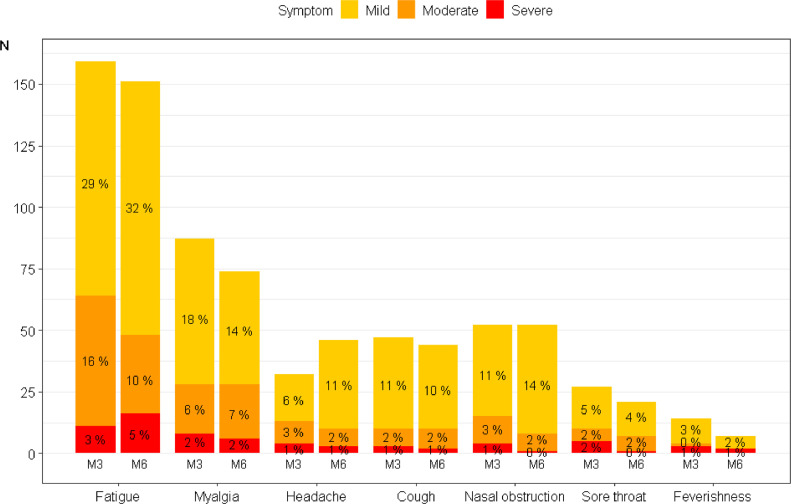
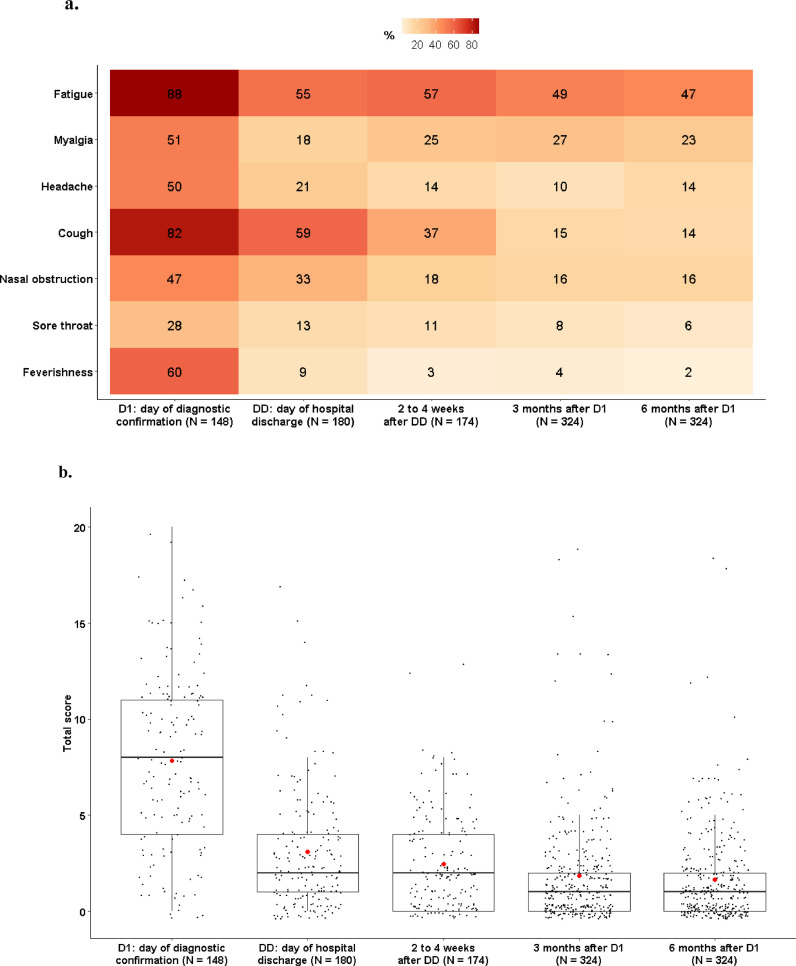
At M6, among the 324 patients (median age 61 years, 63% men, 19% admitted to intensive care during the acute phase), 187/324 (58%) reported at least one symptom, mostly fatigue (47%) and myalgia (23%). Symptom severity was scored, at most, mild in 125 (67%), moderate in 44 (23%) and severe in 18 (10%). Female gender was the sole factor associated with moderate/severe symptom reporting (OR = 1.98, 95%CI=1.13-3.47). Among the 225 patients with psychological assessment, 24 (11%) had anxiety, 18 (8%) depressive symptoms, and their physical HRQL was significantly poorer than the general population (p=0.0005).
Even if 58% of patients reported ≥1 symptom at M6, less than 7% rated any symptom as severe. Assessing symptoms severity could be helpful to identify patients requiring appropriate medical care. Women may require special attention.
很少有研究报告出院后 6 个月(M6)时 COVID-19 的临床后遗症,但没有研究症状严重程度。
在 COVID-19 住院患者中使用自我管理的流感严重程度量表,在法国 COVID 队列中评估 7 种症状在 M6 时的患病率和严重程度。通过逻辑回归评估严重程度的相关因素。还评估了焦虑、抑郁和健康相关生活质量(HRQL)。
在 M6 时,324 名患者(中位年龄 61 岁,63%为男性,19%在急性期入住重症监护病房)中,187/324(58%)报告了至少一种症状,主要是疲劳(47%)和肌痛(23%)。症状严重程度评分最高为轻度 125 例(67%),中度 44 例(23%),重度 18 例(10%)。女性是报告中度/重度症状的唯一相关因素(OR=1.98,95%CI=1.13-3.47)。在 225 名接受心理评估的患者中,24 名(11%)有焦虑,18 名(8%)有抑郁症状,他们的身体 HRQL 明显不如一般人群(p=0.0005)。
即使 58%的患者在 M6 时报告了≥1 种症状,但不到 7%的患者认为任何症状都严重。评估症状严重程度可能有助于识别需要适当医疗护理的患者。女性可能需要特别关注。