Weis Luiza N, Tolaney Sara M, Barrios Carlos H, Barroso-Sousa Romualdo
Instituto de Ensino e Pesquisa Hospital Sírio-Libanês, São Paulo-SP, Brazil.
Department of Medical Oncology, Dana-Farber Cancer Institute, Boston, MA, USA.
NPJ Breast Cancer. 2021 Sep 13;7(1):120. doi: 10.1038/s41523-021-00328-3.
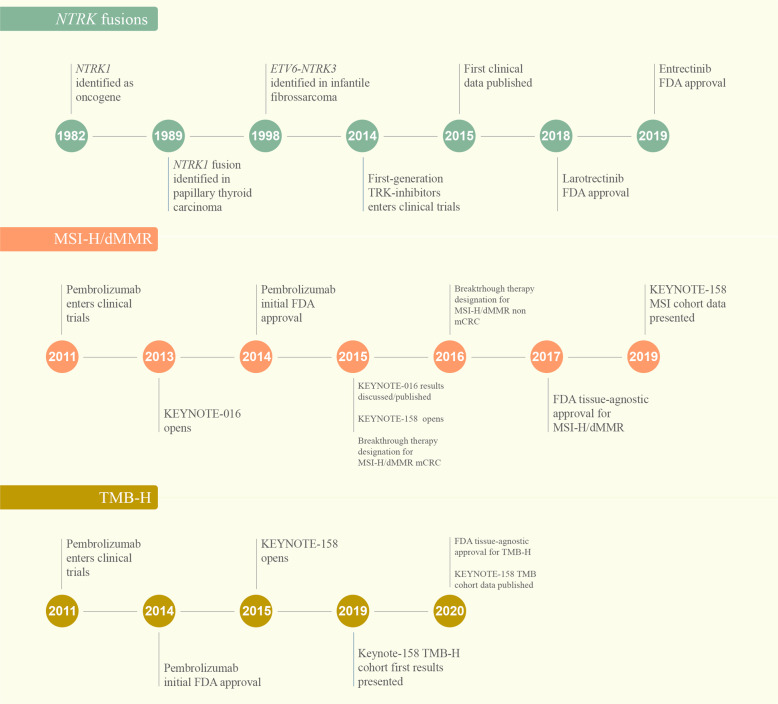
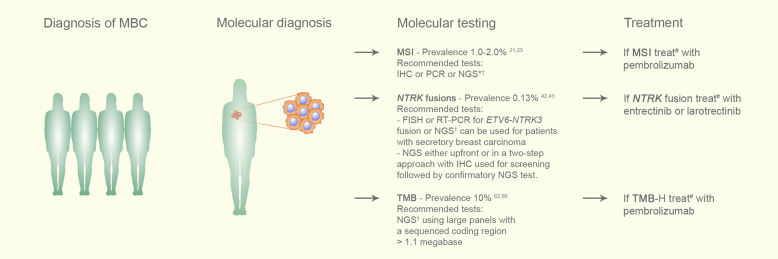
Precision medicine has provided new perspectives in oncology, yielding research on the use of targeted therapies across different tumor types, regardless of their site of origin, a concept known as tissue-agnostic indication. Since 2017, the Food and Drug Administration (FDA) has approved the use of three different agents for tumor-agnostic treatment: pembrolizumab (for patients with microsatellite instability or high tumor mutational burden) and larotrectinib and entrectinib (both for use in patients harboring tumors with NTRK fusions). Importantly, the genomic alterations targeted by these agents are uncommon or rare in breast cancer, and little information exists regarding their efficacy in advanced breast cancer. In this review, we discuss the prevalence of these targets in breast cancer, their detection methods, the clinical characteristics of patients whose tumors have these alterations, and available data regarding the efficacy of these agents in breast cancer.
精准医学为肿瘤学提供了新的视角,催生了针对不同肿瘤类型使用靶向疗法的研究,无论肿瘤起源部位如何,这一概念被称为组织agnostic适应症。自2017年以来,美国食品药品监督管理局(FDA)已批准使用三种不同药物进行肿瘤agnostic治疗:帕博利珠单抗(用于微卫星不稳定或肿瘤突变负荷高的患者)以及拉罗替尼和恩曲替尼(均用于患有NTRK融合肿瘤的患者)。重要的是,这些药物所靶向的基因组改变在乳腺癌中并不常见或罕见,关于它们在晚期乳腺癌中的疗效的信息也很少。在本综述中,我们讨论了这些靶点在乳腺癌中的患病率、检测方法、肿瘤具有这些改变的患者的临床特征,以及关于这些药物在乳腺癌中疗效的现有数据。