Zhuang Xiuxiu, Huang Luping, Gu Yixiao, Wang Lu, Zhang Rong, Zhang Minyuan, Li Fei, Shi Yiyi, Mo Yunchang, Dai Qinxue, Wei Chaoyi, Wang Junlu
Department of Anesthesiology, The First Affiliated Hospital of Wenzhou Medical University, Wenzhou City, Zhejiang Province, China.
Department of Anesthesiology, The First Affiliated Hospital, Zhejiang University, Hangzhou City, Zhejiang Province, China.
Arch Med Sci. 2019 May 15;17(5):1388-1399. doi: 10.5114/aoms.2019.85202. eCollection 2021.
The aim of the study was to study the role of the anterior cingulate cortex (ACC)-dorsal midbrain striatum (DMS) in neuropathic pain in mice.
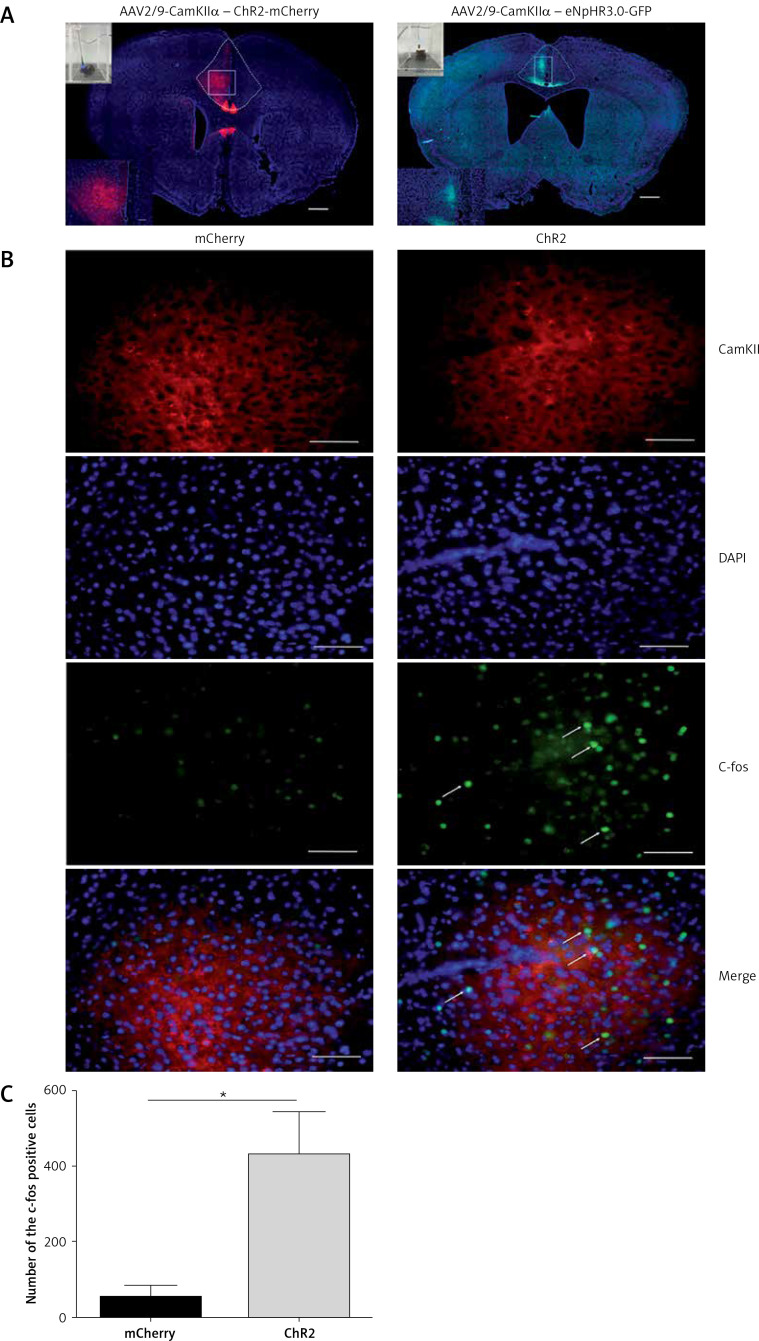
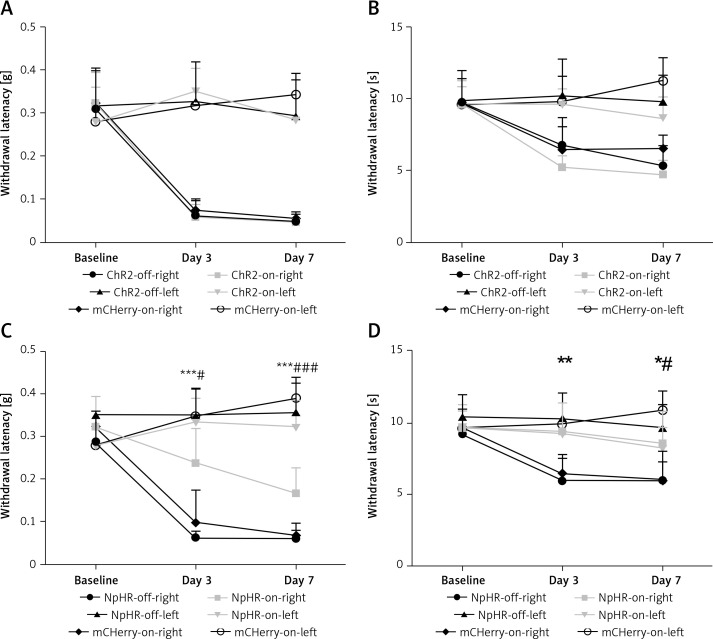
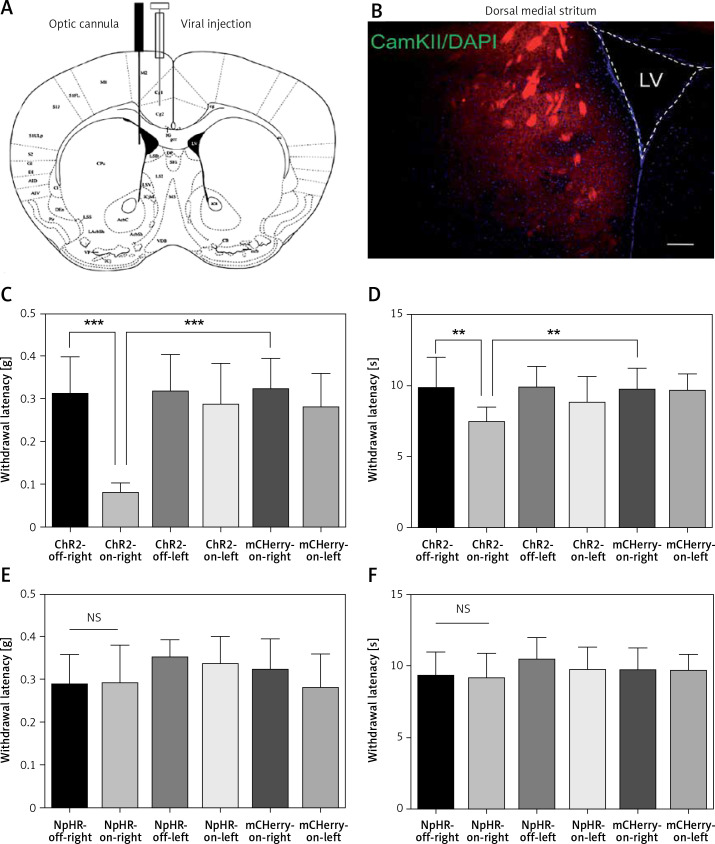
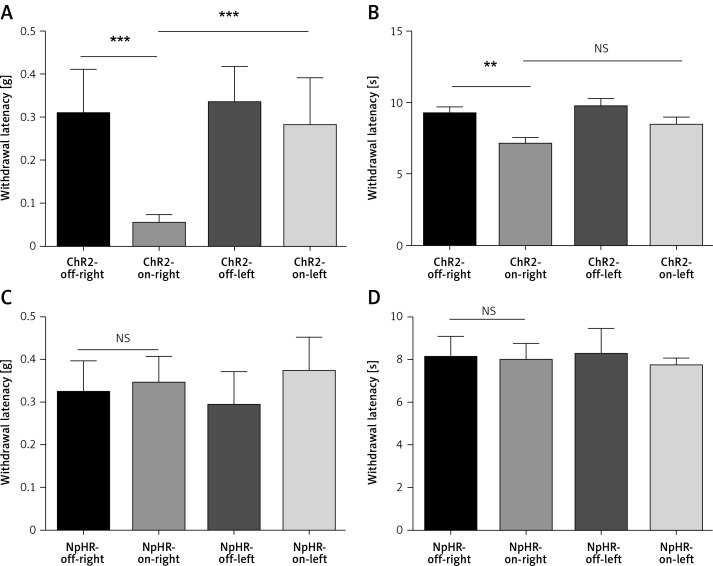
Optogenetics has been increasingly used in neuroscience research to selectively and precisely control the activity of a defined group of central neurons to determine their roles in behavioral functions in animals. The most important opsins are blue-sensitive ChR2 and yellow-sensitive NpHR. Calcium-calmodulin dependent protein kinase Iiα (CaMKIIα) is mostly expressed in the pyramidal excitatory neurons. Mice were injected with AAV2/9-CamKII-ChR2-mCherry, AAV2/9-CamKII-eNpHR3.0-GFP or AAV2/9-CamKII-mCherry virus in the ACC region, and the optical fiber implantation was performed in the ACC or DMS region. Mice were then followed up for 2 to 8 weeks and behavioral tests were carried out in the presence or absence of the blue/yellow light (473 nm/589 nm). Pain behavioral tests with or without the blue/yellow light at the same time were performed on the third and the seventh day after the chronic constriction injury of sciatic nerve model (CCI) was established. The pain thresholds of left and right hind limbs of mice in all groups were measured.
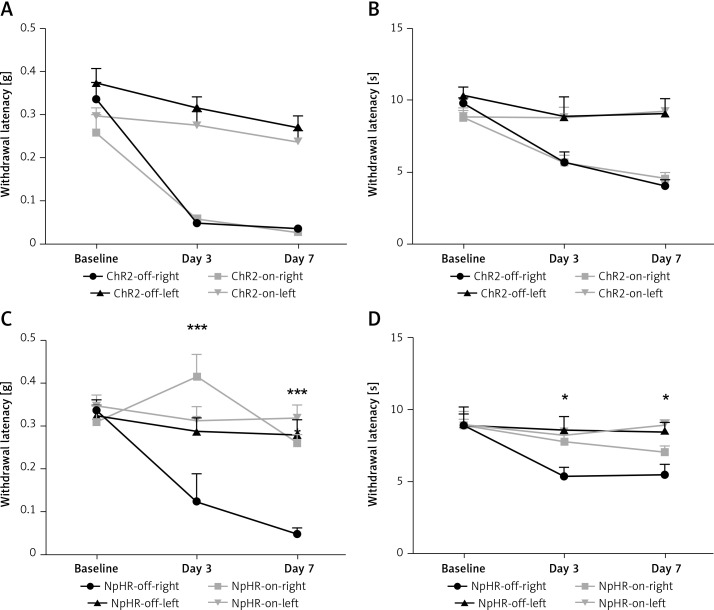
No matter whether activating the neurons in ACC or DMS, compared with normal mice in the ChR2-off-right group, and the mCherry-on-right group, the thermal pain threshold and mechanical pain threshold of the normal mice in the ChR2-on-right group were significantly lower. When inhibiting the neurons in the ACC or DMS, on day 3 and day 7 after CCI operation, the thermal pain threshold and mechanical pain threshold of the CCI mice of the NpHR-on-right group were significantly higher compared with the NpHR-off-right and mCherry-on-right groups.
The anterior cingulate cortex-dorsal midbrain striatum may be involved in the regulation of neuropathic pain in mice.
本研究旨在探讨前扣带回皮质(ACC)-背侧中脑纹状体(DMS)在小鼠神经性疼痛中的作用。
光遗传学在神经科学研究中越来越多地被用于选择性和精确地控制特定一组中枢神经元的活动,以确定它们在动物行为功能中的作用。最重要的视蛋白是对蓝光敏感的ChR2和对黄光敏感的NpHR。钙/钙调蛋白依赖性蛋白激酶Iiα(CaMKIIα)主要在锥体兴奋性神经元中表达。将小鼠在ACC区域注射AAV2/9-CamKII-ChR2-mCherry、AAV2/9-CamKII-eNpHR3.0-GFP或AAV2/9-CamKII-mCherry病毒,并在ACC或DMS区域进行光纤植入。然后对小鼠进行2至8周的随访,并在有或没有蓝光/黄光(473nm/589nm)的情况下进行行为测试。在坐骨神经慢性压迫损伤模型(CCI)建立后的第三天和第七天,同时进行有或没有蓝光/黄光的疼痛行为测试。测量所有组小鼠左右后肢的疼痛阈值。
无论激活ACC还是DMS中的神经元,与ChR2关闭右侧组和mCherry开启右侧组的正常小鼠相比,ChR2开启右侧组的正常小鼠的热痛阈值和机械痛阈值均显著降低。当抑制ACC或DMS中的神经元时,在CCI手术后的第3天和第7天,与NpHR关闭右侧组和mCherry开启右侧组相比,NpHR开启右侧组的CCI小鼠的热痛阈值和机械痛阈值显著更高。
前扣带回皮质-背侧中脑纹状体可能参与小鼠神经性疼痛的调节。