Development Strategy and Governance Division, International Food Policy Research Institute (IFPRI), Addis Ababa, Ethiopia.
Economics Department, State University of New York at Albany, Albany, New York, USA.
Matern Child Nutr. 2024 Jul;20 Suppl 5(Suppl 5):e13247. doi: 10.1111/mcn.13247. Epub 2021 Sep 15.
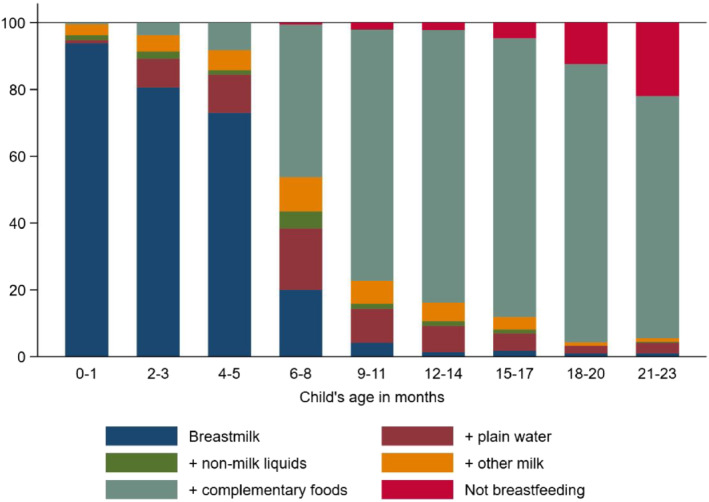
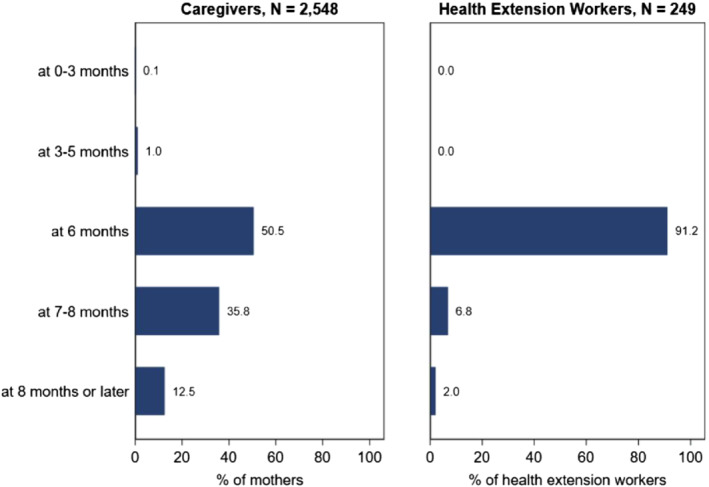
Age-appropriate breastfeeding and introduction to complementary foods can shape child feeding practices, ensure adequate energy and nutrient intake and prevent linear growth faltering. This study aimed to assess mothers' and health workers' knowledge of timely introduction to complementary foods and evaluate the relationship between delays in complementary feeding and subsequent linear growth. We conducted two rounds of surveys (March/August 2017) among 249 health workers (n = 249) and caregivers (n = 2635) of children 6-23 months of age. We collected information about socio-demographic characteristics, knowledge and practice related to timely introduction to complementary foods. The study was conducted in households from the Productive Safety Net Programme (PSNP) districts, in four highland regions of Ethiopia. Delays in the introduction to complementary feeding were widespread with 53% of children 6-8 months of age not consuming solid, semisolid or soft foods in the past 24 h. After controlling for child, caregiver and household characteristics, children not introduced to complementary foods by 6-8 months had a 0.48 SD lower length-for-age z-score at 12-15 months. Caregivers' knowledge was strongly and inversely correlated with untimely introduction of complementary foods in logistic regressions (OR = 0.55, p < 0.01). In turn, local health extension worker's knowledge was strongly correlated with caregiver's knowledge. Consequently, frequent and timely visits by health extension workers emphasising not only on what to feed but also when and how to feed a child are needed. Innovative ways of increasing reach, intensity and frequency of nutrition messaging by using the PSNP interactions as an additional point of contact would need to be explored further.
适时引入补充食品和母乳喂养可以塑造儿童喂养习惯,确保摄入充足的能量和营养,并防止线性生长迟缓。本研究旨在评估母亲和卫生工作者对适时引入补充食品的知识,并评估补充喂养延迟与随后线性生长之间的关系。我们在埃塞俄比亚四个高地地区的生产安全网计划(PSNP)区对 249 名卫生工作者(n=249)和 2635 名儿童 6-23 个月大的照顾者进行了两轮调查(2017 年 3 月/8 月)。我们收集了有关及时引入补充食品的社会人口统计学特征、知识和实践方面的信息。延迟引入补充喂养的情况很普遍,53%的 6-8 个月大的儿童在过去 24 小时内没有食用固体、半固体或软食。在控制了儿童、照顾者和家庭特征后,6-8 个月大时未引入补充食品的儿童在 12-15 个月时的身长年龄 z 评分低 0.48 个标准差。在逻辑回归中,照顾者的知识与补充食品引入不及时呈强烈负相关(OR=0.55,p<0.01)。反过来,当地卫生推广工作者的知识与照顾者的知识呈强烈相关。因此,需要卫生推广工作者频繁、及时地访问,不仅强调喂养什么,还要强调如何以及何时喂养孩子。需要进一步探索创新的方法,通过利用 PSNP 互动作为额外的接触点,增加营养信息的覆盖面、强度和频率。