Moselli Marta, Casini Maria Pia, Frattini Camilla, Williams Riccardo
Department of Clinical and Dynamic Psychology, Sapienza University of Rome, Rome, Italy.
Child Neuropsychiatry Unit, Department of Neuroscience, I.R.C.C.S. Children Hospital Bambino Gesù, Rome, Italy.
Child Psychiatry Hum Dev. 2023 Apr;54(2):290-311. doi: 10.1007/s10578-021-01239-x. Epub 2021 Sep 15.
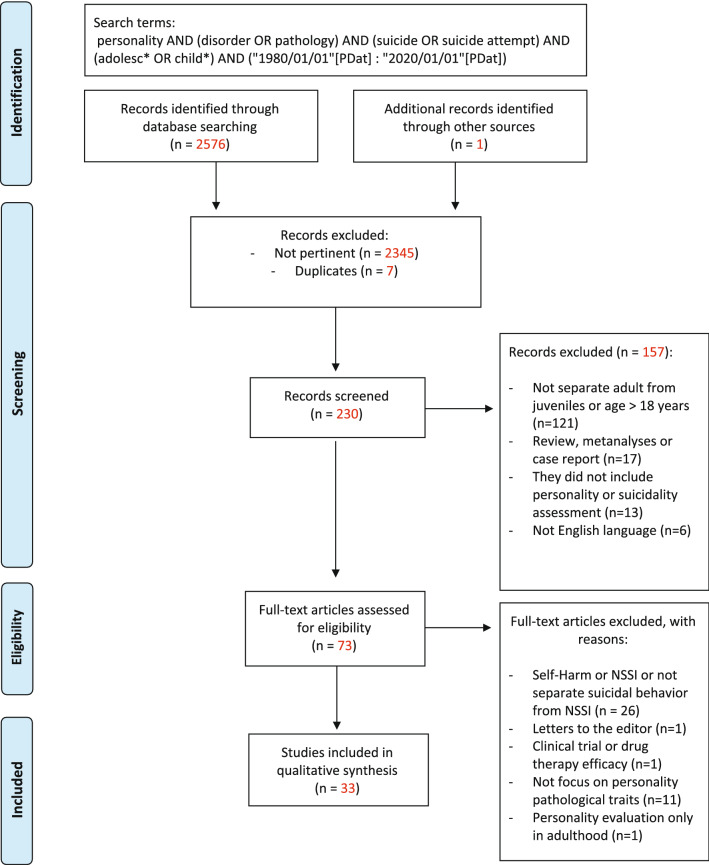
This work presents a review of research papers examining the role of emerging personality pathology in suicidal ideation and behaviours in adolescence. Initially, 226 studies were selected in line with PRISMA guidelines, and 33 articles were finally included in this review. The data show percentages of any personality disorder diagnosis ranging from 19.5 to 22.8% in suicide attempters, while in autopsy studies, the rate of personality disorder diagnosis varied between 29.6 and 42.1%. The overwhelming majority of the studies focus on the role of borderline personality disorder (BPD) in suicidal behaviours, also highlighting its predictive role at a longitudinal level. Furthermore, the literature review shows that personality traits supposed to underlie BPD, such as affective instability, impulsivity and identity diffusion, have specific predictive links with suicidal conduct. Other personality pathology dimensions, such as aggressiveness, sadism and perfectionism that are associated with other personality disorders, namely, antisocial and narcissistic personality disorders, have also shown a significant mediating role for suicidal risk. Overall, these results seem to parallel the role of personality pathology in predicting suicide in adulthood and point to the relevance of assessing the presence of emerging patterns of personality disorders for the clinical management of suicidal risk in adolescence.
这项工作对研究新兴人格病理学在青少年自杀意念和行为中的作用的研究论文进行了综述。最初,根据PRISMA指南筛选出226项研究,最终33篇文章被纳入本综述。数据显示,自杀未遂者中任何人格障碍诊断的百分比在19.5%至22.8%之间,而在尸检研究中,人格障碍诊断率在29.6%至42.1%之间。绝大多数研究关注边缘性人格障碍(BPD)在自杀行为中的作用,同时也强调了其在纵向层面的预测作用。此外,文献综述表明,被认为是BPD基础的人格特质,如情感不稳定、冲动和身份认同扩散,与自杀行为有特定的预测联系。与其他人格障碍(即反社会和自恋型人格障碍)相关的其他人格病理学维度,如攻击性、虐待狂和完美主义,也显示出对自杀风险有显著的中介作用。总体而言,这些结果似乎与人格病理学在预测成年人自杀中的作用相似,并指出评估新兴人格障碍模式的存在对于青少年自杀风险的临床管理具有相关性。