Ralph Lauren Centre for Breast Cancer Research, Royal Marsden Hospital, Fulham Road, London, SW3 6JJ, UK.
The Breast Cancer Now Toby Robins Research Centre, The Institute of Cancer Research, Fulham Road, London, SW3 6JB, UK.
Breast Cancer Res Treat. 2021 Nov;190(2):295-305. doi: 10.1007/s10549-021-06377-3. Epub 2021 Sep 15.
Changes occur in the expression of oestrogen-regulated and proliferation-associated genes in oestrogen receptor (ER)-positive breast tumours during the menstrual cycle. We investigated if Oncotype® DX recurrence score (RS), Prosigna® (ROR) and EndoPredict® (EP/EPclin) prognostic tests, which include some of these genes, vary according to the time in the menstrual cycle when they are measured.
Pairs of test scores were derived from 30 ER-positive/human epidermal growth factor receptor-2-negative tumours sampled at two different points of the menstrual cycle. Menstrual cycle windows were prospectively defined as either W1 (days 1-6 and 27-35; low oestrogen and low progesterone) or W2 (days 7-26; high oestrogen and high or low progesterone).
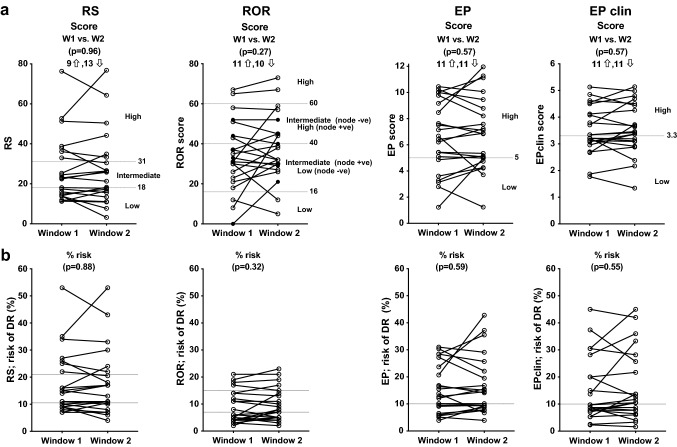
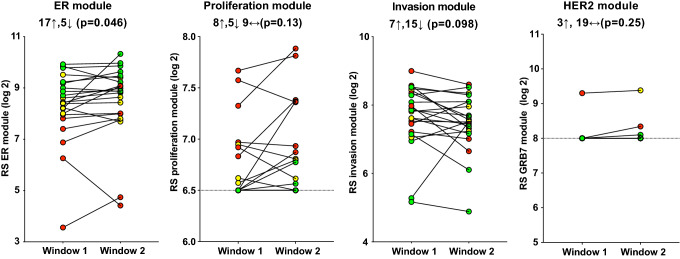
The invasion module score of RS was lower (- 10.9%; p = 0.098), whereas the ER (+ 16.6%; p = 0.046) and proliferation (+ 7.3%; p = 0.13) module scores were higher in W2. PGR expression was significantly increased in W2 (+ 81.4%; p = 0.0029). Despite this, mean scores were not significantly different between W1 and W2 for any of the tests and the two measurements showed high correlation (r = 0.72-0.93). However, variability between the two measurements led to tumours being assigned to different risk categories in the following proportion of cases: RS 22.7%, ROR 27.3%, EP 13.6% and EPclin 13.6%.
There are significant changes during the menstrual cycle in the expression of some of the genes and gene module scores comprising the RS, ROR and EP/EPclin scores. These did not affect any of the prognostic scores in a systematic fashion, but there was substantial variability in paired measurements.
在雌激素受体(ER)阳性乳腺癌肿瘤中,雌激素调节和增殖相关基因的表达在月经周期中会发生变化。我们研究了 Oncotype® DX 复发评分(RS)、Prosigna®(ROR)和 EndoPredict®(EP/EPclin)预后检测,这些检测包括其中一些基因,它们的检测结果是否会因检测时所处的月经周期时间而有所不同。
从 30 例 ER 阳性/人表皮生长因子受体-2 阴性肿瘤中获取了两组检测评分,这两组评分是在月经周期的两个不同时间点采集的。前瞻性地将月经周期窗口定义为 W1(第 1-6 天和第 27-35 天;雌激素和孕激素水平低)或 W2(第 7-26 天;雌激素和孕激素水平高或低)。
RS 的侵袭模块评分较低(-10.9%;p=0.098),而 W2 时 ER(+16.6%;p=0.046)和增殖(+7.3%;p=0.13)模块评分较高。尽管如此,W1 和 W2 之间的任何检测的平均评分均无显著差异,且两种测量方法高度相关(r=0.72-0.93)。然而,两次测量之间的差异导致肿瘤在以下比例的病例中被分配到不同的风险类别:RS 为 22.7%、ROR 为 27.3%、EP 为 13.6%和 EPclin 为 13.6%。
在月经周期中,一些构成 RS、ROR 和 EP/EPclin 评分的基因和基因模块评分的表达会发生显著变化。这些变化并没有以系统的方式影响任何预后评分,但在配对测量中存在很大的变异性。