Department of Nephrology, Hitachi General Hospital, 2-1-1 Jonan-cho, Hitachi, Ibaraki, 317-0077, Japan.
Department of Nephrology, Faculty of Medicine, University of Tsukuba, 1-1-1 Tennodai, Tsukuba, Ibaraki, 305-8575, Japan.
CEN Case Rep. 2022 May;11(2):166-170. doi: 10.1007/s13730-021-00646-2. Epub 2021 Sep 15.
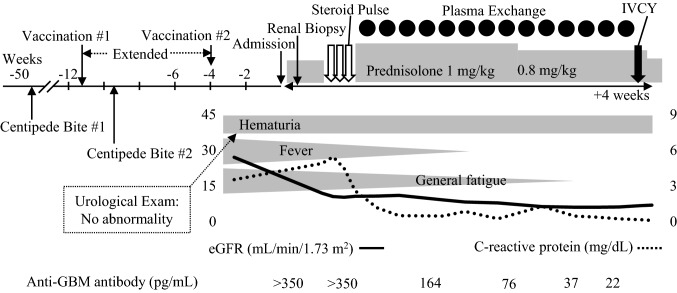
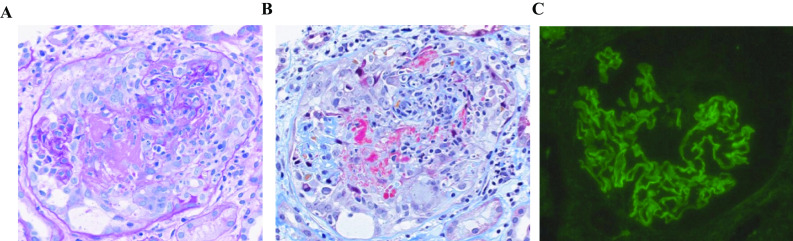
A case of newly developed anti-glomerular basement membrane (GBM) glomerulonephritis (GN) following centipede bites and COVID-19 vaccination is presented. A 70-year-old woman presented for investigation of mild fever, generalized fatigue, and macroscopic hematuria with no past history of renal disease. One year earlier, she had been bitten by a centipede. Based on the governmental policy, she was given the first COVID-19 vaccination, and the second injection was planned 3 weeks later. Accidentally, she was again bitten by a centipede, and the injured site had swollen severely. Based on a physician's judgment, the interval between vaccinations was extended to 8 weeks. One week after the second vaccination, macroscopic hematuria occurred suddenly, coincident with mild fever. Her serum anti-GBM titer was above the upper limit. There was no pulmonary involvement. Renal pathology showed anti-GBM GN, and she was treated with corticosteroid pulse therapy followed by sequential plasmapheresis. She had advanced renal dysfunction, but was independent of dialysis therapy during the one month of the remission induction therapy phase, and she is being treated with immunosuppressant therapy. Both vaccination and animal bites skew towards Th1 immunity, a key mechanism involved in the development of necrotizing GN evoked by anti-GBM antibody. Though there is no direct evidence for causality linking centipede bites, vaccination, and anti-GBM GN, the risk of anti-GBM GN appears to be increased by excessively induced Th1 immunity.
现报告一例新发生的抗肾小球基底膜(GBM)肾小球肾炎(GN),该患者在蜈蚣咬伤和 COVID-19 疫苗接种后出现。一名 70 岁女性因轻度发热、全身乏力和肉眼血尿就诊,既往无肾脏病史。一年前,她被蜈蚣咬伤。根据政府政策,她接种了第一剂 COVID-19 疫苗,第二剂计划在 3 周后接种。不幸的是,她又被蜈蚣咬伤,受伤部位严重肿胀。根据医生的判断,疫苗接种间隔延长至 8 周。第二次接种后一周,突然出现肉眼血尿,伴有轻度发热。她的血清抗 GBM 滴度超过上限。无肺部受累。肾脏病理显示抗 GBM GN,给予皮质类固醇脉冲治疗,随后序贯血浆置换。她肾功能严重受损,但在缓解诱导治疗阶段的一个月内无需透析治疗,目前正在接受免疫抑制治疗。疫苗接种和动物咬伤都偏向于 Th1 免疫,这是抗 GBM 抗体引起的坏死性 GN 发展的关键机制。虽然没有直接证据表明蜈蚣咬伤、疫苗接种和抗 GBM GN 之间存在因果关系,但过度诱导的 Th1 免疫似乎会增加抗 GBM GN 的风险。