Division of Neurology and Developmental Neuroscience, Department of Pediatrics, Baylor College of Medicine, Houston, Texas, 77030, USA.
Texas Children's Hospital, Houston, Texas, 77030, USA.
Ann Clin Transl Neurol. 2021 Oct;8(10):2052-2058. doi: 10.1002/acn3.51454. Epub 2021 Sep 15.
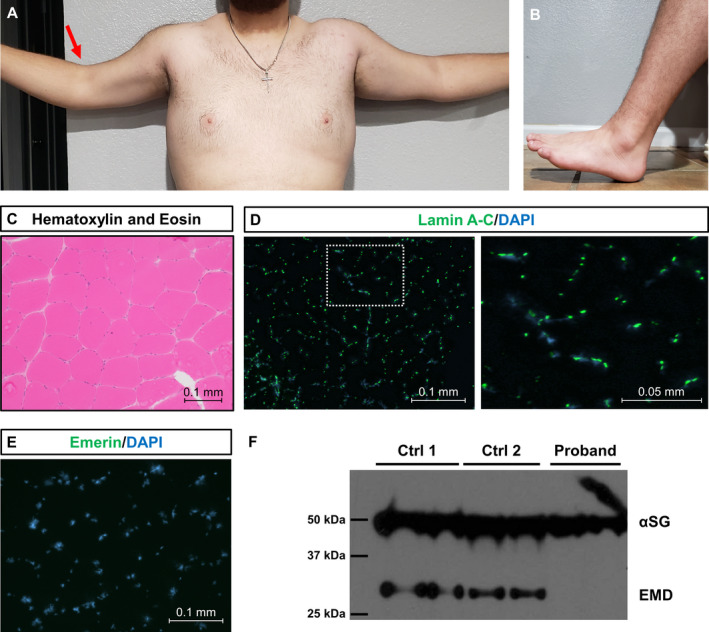
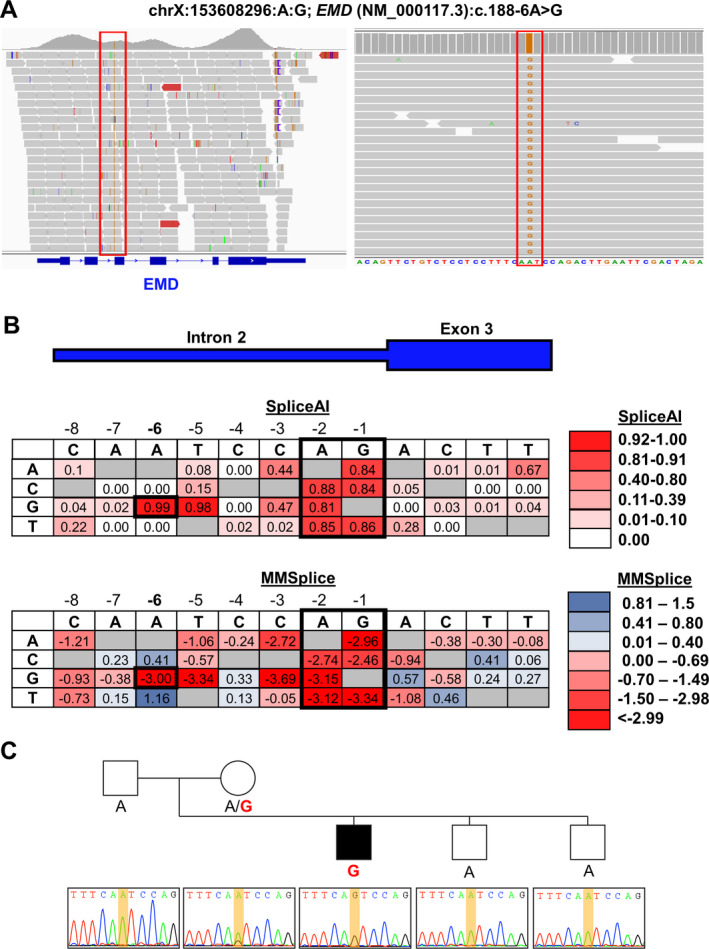
Exome sequencing (ES) has revolutionized rare disease management, yet only ~25%-30% of patients receive a molecular diagnosis. A limiting factor is the quality of available phenotypic data. Here, we describe how deep clinicopathological phenotyping yielded a molecular diagnosis for a 19-year-old proband with muscular dystrophy and negative clinical ES. Deep phenotypic analysis identified two critical data points: (1) the absence of emerin protein in muscle biopsy and (2) clinical features consistent with Emery-Dreifuss muscular dystrophy. Sequencing data analysis uncovered an ultra-rare, intronic variant in EMD, the gene encoding emerin. The variant, NM_000117.3: c.188-6A > G, is predicted to impact splicing by in silico tools. This case thus illustrates how better integration of clinicopathologic data into ES analysis can enhance diagnostic yield with implications for clinical practice.
外显子组测序 (ES) 彻底改变了罕见病的管理方式,但只有约 25%-30%的患者能获得分子诊断。一个限制因素是现有表型数据的质量。在这里,我们描述了如何通过深入的临床病理表型分析,为一名 19 岁的肌肉萎缩症患者和阴性临床 ES 患者做出分子诊断。深入的表型分析确定了两个关键数据点:(1) 肌肉活检中不存在 emerin 蛋白,以及 (2) 符合 Emery-Dreifuss 肌肉萎缩症的临床特征。测序数据分析发现了一个超罕见的、内含子中的 EMD 基因突变,该基因编码 emerin。该变异,NM_000117.3:c.188-6A > G,据预测会通过计算机工具影响剪接。因此,该病例说明了如何将临床病理数据更好地整合到 ES 分析中,可以提高诊断率,并对临床实践具有重要意义。