Chen Xu, Tang Yi, Chen Shen, Ling Wenhua, Wang Qing
Department of Toxicology, School of Public Health, Sun Yat-sen University, Guangzhou, People's Republic of China.
Department of Nutrition, School of Public Health, Sun Yat-Sen University, Guangzhou, People's Republic of China.
Endocr Connect. 2021 Oct 13;10(10):1315-1325. doi: 10.1530/EC-21-0353.
Non-alcoholic fatty liver disease (NAFLD) has become a common chronic liver disease in the world. Simple steatosis (SS) is the early phase of NAFLD. However, the molecular mechanisms underlying the development of steatosis have not yet been fully elucidated.
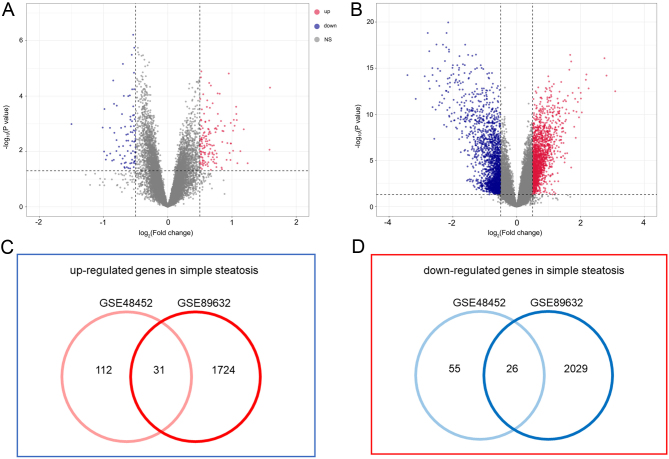
Two public datasets (GSE48452 and GSE89632) through the Gene Expression Omnibus (GEO) database were used to identify differentially expressed genes (DEGs) in the development of steatosis. A total of 72 participants including 38 normal histological controls and 34 SS patients were included in this study. Gene ontology (GO), Kyoto Encyclopedia of Genes and Genomes (KEGG), and protein-protein interaction (PPI) network analysis were performed to explore the function of DEGs. The results were further confirmed in high-fat diet (HFD)-fed mice and oleate-treated HepG2 cells.
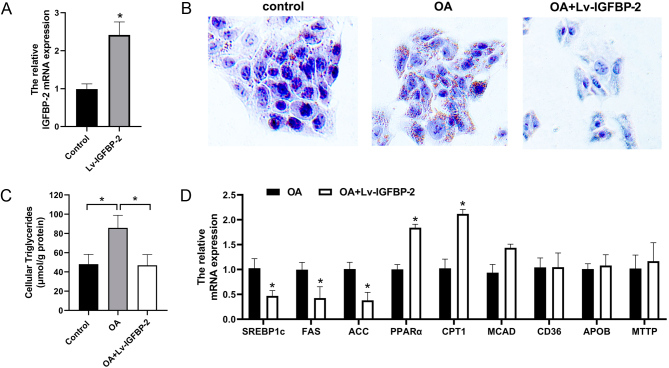
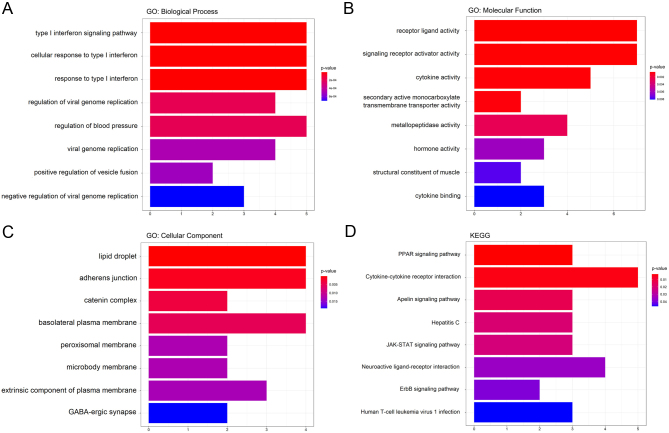
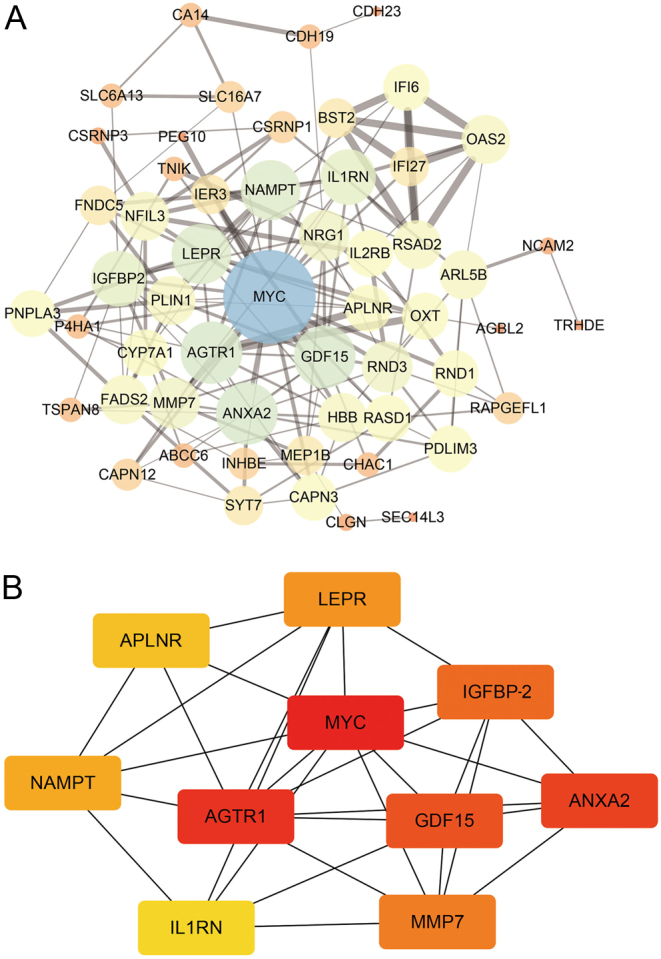
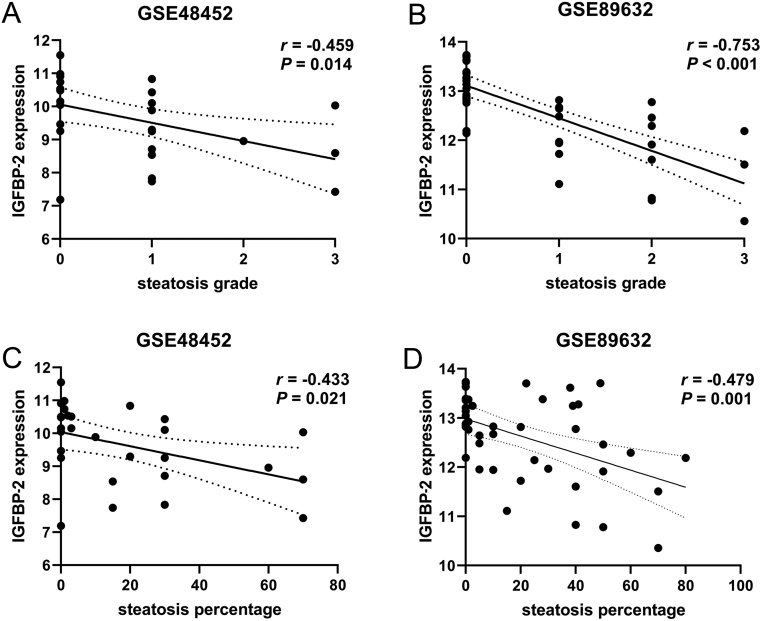
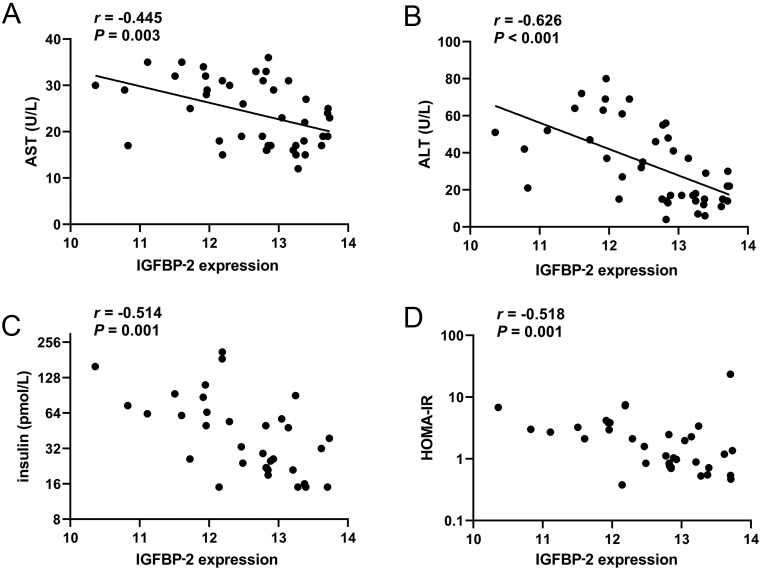
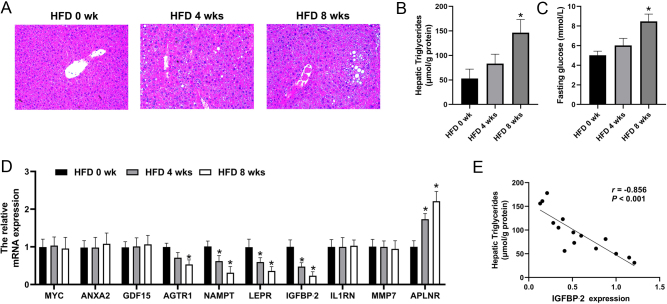
Total 57 DEGs including 31 up- and 26 down-regulated genes between SS patients and healthy controls were determined. GO and KEGG analysis showed that most of the DEGs were enriched in the ligand-receptor signaling pathways. PPI network construction was used to identify the hub genes of the DEGs. MYC, ANXA2, GDF15, AGTR1, NAMPT, LEPR, IGFBP-2, IL1RN, MMP7, and APLNR were identified as hub genes, and IGFBP-2 expression was found to be reversely associated with hepatic steatosis, fasting insulin, HOMA-IR index, and ALT levels. In HFD-fed mice, hepatic IGFBP-2 was also downregulated and negatively associated with hepatic triglyceride (TG) levels. Moreover, overexpression of IGFBP-2 ameliorated the oleate induced accumulation of TGs in hepatocytes.
This study identified novel gene signatures in the hepatic steatosis and will provide new understanding and molecular clues of hepatic steatosis.
非酒精性脂肪性肝病(NAFLD)已成为全球常见的慢性肝病。单纯性脂肪肝(SS)是NAFLD的早期阶段。然而,脂肪肝发生发展的分子机制尚未完全阐明。
通过基因表达综合数据库(GEO)使用两个公开数据集(GSE48452和GSE89632)来鉴定脂肪肝发生过程中的差异表达基因(DEGs)。本研究共纳入72名参与者,包括38名组织学正常对照者和34名SS患者。进行基因本体论(GO)、京都基因与基因组百科全书(KEGG)以及蛋白质-蛋白质相互作用(PPI)网络分析以探究DEGs的功能。在高脂饮食(HFD)喂养的小鼠和油酸处理的HepG2细胞中进一步验证结果。
确定了SS患者与健康对照者之间共有57个DEGs,其中31个上调基因和26个下调基因。GO和KEGG分析表明,大多数DEGs富集于配体-受体信号通路。使用PPI网络构建来鉴定DEGs的枢纽基因。MYC、ANXA2、GDF15、AGTR1、NAMPT、LEPR、IGFBP-2、IL1RN、MMP7和APLNR被鉴定为枢纽基因,并且发现IGFBP-2表达与肝脂肪变性、空腹胰岛素、HOMA-IR指数和ALT水平呈负相关。在HFD喂养的小鼠中,肝脏IGFBP-2也下调,并且与肝脏甘油三酯(TG)水平呈负相关。此外,IGFBP-2的过表达改善了油酸诱导的肝细胞内TG积累。
本研究在肝脂肪变性中鉴定出了新的基因特征,将为肝脂肪变性提供新的认识和分子线索。