Programa de Pós-Graduação em Genética e Biologia Molecular (PPGBM), Universidade Federal do Rio Grande do Sul (UFRGS), Porto Alegre, Rio Grande do Sul, Brazil.
Laboratório de Medicina Genômica, Centro de Pesquisa Experimental, Hospital de Clínicas de Porto Alegre (HCPA), Porto Alegre, Rio Grande do Sul, Brazil.
PLoS One. 2021 Sep 16;16(9):e0251639. doi: 10.1371/journal.pone.0251639. eCollection 2021.
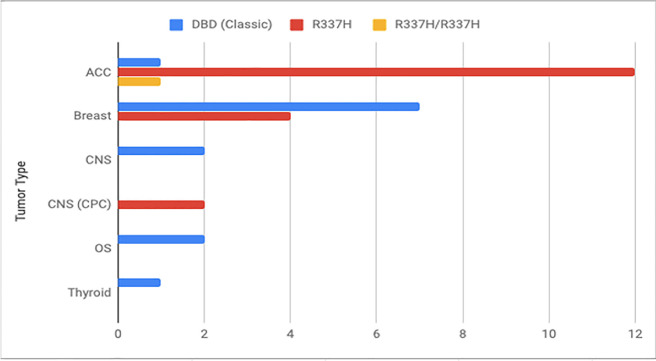
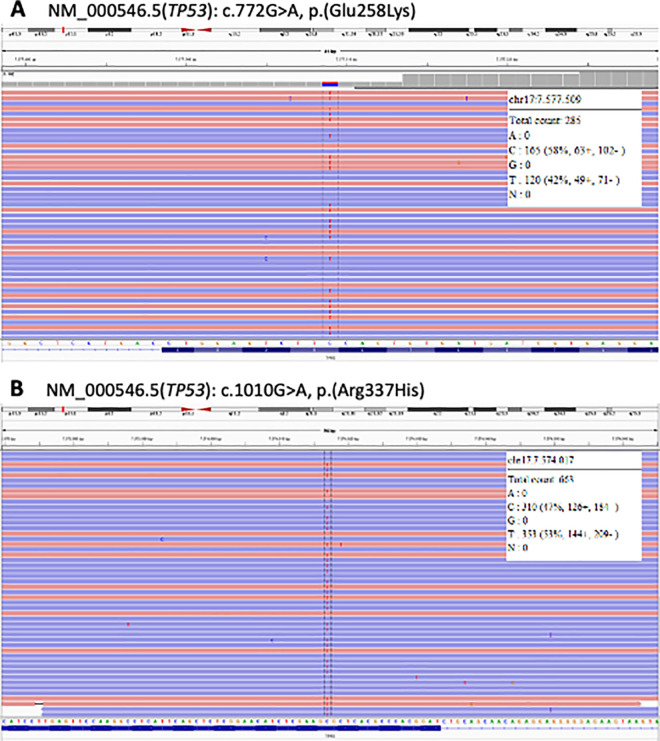
Li-Fraumeni syndrome (LFS) is an autosomal dominant cancer predisposition syndrome caused by pathogenic germline variants in the TP53 gene, characterized by a predisposition to the development of a broad spectrum of tumors at an early age. The core tumors related to LFS are bone and soft tissue sarcomas, premenopausal breast cancer, brain tumors, adrenocortical carcinomas (ACC), and leukemias. The revised Chompret criteria has been widely used to establish clinical suspicion and support TP53 germline variant testing and LFS diagnosis. Information on TP53 germline pathogenic variant (PV) prevalence when using Chompret criteria in South America and especially in Brazil is scarce. Therefore, the aim of this study was to characterize patients that fulfilled these specific criteria in southern Brazil, a region known for its high population frequency of a founder TP53 variant c.1010G>A (p.Arg337His), as known as R337H. TP53 germline testing of 191 cancer-affected and independent probands with LFS phenotype identified a heterozygous pathogenic/likely pathogenic variant in 26 (13.6%) probands, both in the DNA binding domain (group A) and in the oligomerization domain (group B) of the gene. Of the 26 carriers, 18 (69.23%) were R337H heterozygotes. Median age at diagnosis of the first tumor in groups A and B differed significantly in this cohort: 22 and 2 years, respectively (P = 0.009). The present study shows the clinical heterogeneity of LFS, highlights particularities of the R337H variant and underscores the need for larger collaborative studies to better define LFS prevalence, clinical spectrum and penetrance of different germline TP53 pathogenic variants.
李-佛美尼综合征(Li-Fraumeni syndrome,LFS)是一种常染色体显性遗传的癌症易感性综合征,由 TP53 基因的致病性种系变异引起,其特征是在年轻时易患广泛的肿瘤。与 LFS 相关的核心肿瘤是骨肉瘤和软组织肉瘤、绝经前乳腺癌、脑肿瘤、肾上腺皮质癌(adrenocortical carcinomas,ACC)和白血病。修订后的 Chompret 标准已被广泛用于建立临床怀疑,并支持 TP53 种系变异检测和 LFS 诊断。在南美洲,特别是在巴西,使用 Chompret 标准时 TP53 种系致病性变异(pathogenic variant,PV)的流行率信息较少。因此,本研究的目的是描述在巴西南部符合这些特定标准的患者情况,该地区以高频率携带 TP53 基因 c.1010G>A(p.Arg337His)的一种创始变异(称为 R337H)而闻名。对 191 名具有 LFS 表型的癌症患者进行 TP53 种系检测,发现 26 名(13.6%)患者存在杂合致病性/可能致病性变异,均位于基因的 DNA 结合域(A 组)和寡聚化域(B 组)。在 26 名携带者中,18 名(69.23%)为 R337H 杂合子。该队列中 A 组和 B 组的首发肿瘤诊断中位年龄存在显著差异:分别为 22 岁和 2 岁(P = 0.009)。本研究显示了 LFS 的临床异质性,突出了 R337H 变异的特点,并强调需要更大规模的合作研究来更好地定义 LFS 的流行率、不同 TP53 种系致病性变异的临床谱和外显率。