Department of Geology and Millennium Nucleus for Metal Tracing Along Subduction, FCFM, Universidad de Chile, Plaza Ercilla 803, Santiago, Chile.
Andean Geothermal Center of Excellence (CEGA), FCFM, Universidad de Chile, Plaza Ercilla 803, Santiago, Chile.
Sci Rep. 2021 Sep 16;11(1):18424. doi: 10.1038/s41598-021-97883-3.
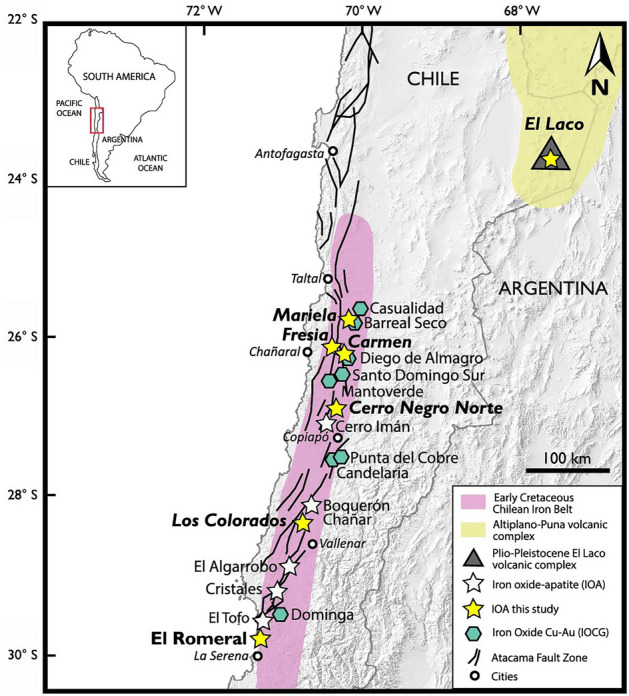
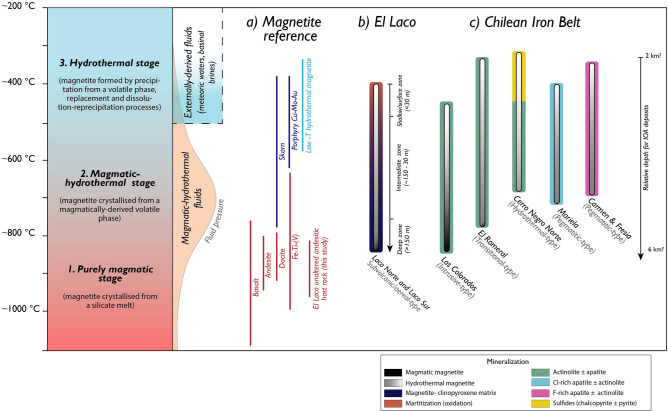
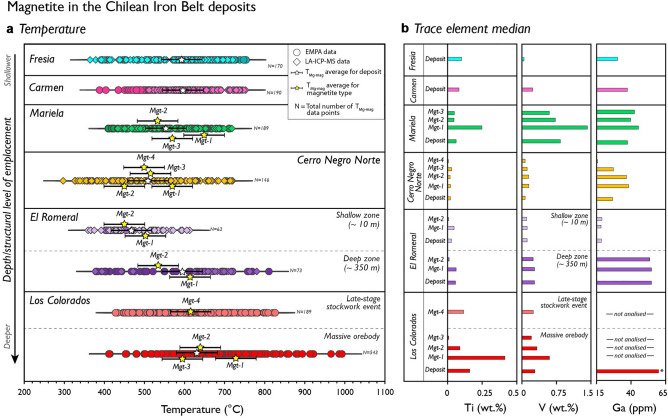
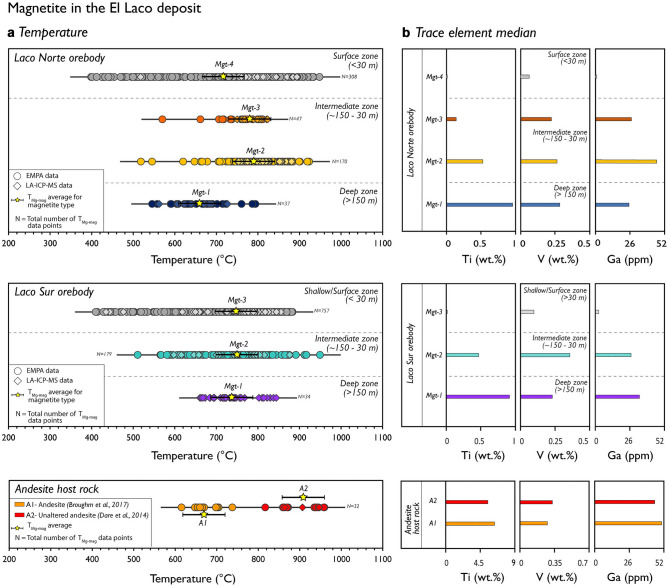
Magnetite is the main constituent of iron oxide-apatite (IOA) deposits, which are a globally important source of Fe and other elements such as P and REE, critical for modern technologies. Geochemical studies of magnetite from IOA deposits have provided key insights into the ore-forming processes and source of mineralizing fluids. However, to date, only qualitative estimations have been obtained for one of the key controlling physico-chemical parameters, i.e., the temperature of magnetite formation. Here we reconstruct the thermal evolution of Andean IOA deposits by using magnetite thermometry. Our study comprised a > 3000 point geochemical dataset of magnetite from several IOA deposits within the Early Cretaceous Chilean Iron Belt, as well as from the Pliocene El Laco IOA deposit in the Chilean Altiplano. Thermometry data reveal that the deposits formed under a wide range of temperatures, from purely magmatic (~ 1000 to 800 °C), to late magmatic or magmatic-hydrothermal (~ 800 to 600 °C), to purely hydrothermal (< 600 °C) conditions. Magnetite cooling trends are consistent with genetic models invoking a combined igneous and magmatic-hydrothermal origin that involve Fe-rich fluids sourced from intermediate silicate magmas. The data demonstrate the potential of magnetite thermometry to better constrain the thermal evolution of IOA systems worldwide, and help refine the geological models used to find new resources.
磁铁矿是氧化铁磷灰石(IOA)矿床的主要成分,是全球重要的铁和磷、稀土元素等元素的来源,对现代技术至关重要。对 IOA 矿床中的磁铁矿进行地球化学研究,为成矿过程和矿化流体的来源提供了关键的见解。然而,迄今为止,对于关键控制物理化学参数之一,即磁铁矿形成的温度,仅进行了定性估计。在这里,我们通过使用磁铁矿测温法来重建安第斯 IOA 矿床的热演化。我们的研究包括来自智利早白垩世铁矿带的几个 IOA 矿床以及智利高原上新世的 El Laco IOA 矿床的超过 3000 个磁铁矿的地球化学数据集。测温数据显示,矿床形成于广泛的温度范围内,从纯岩浆(1000 至 800°C),到晚岩浆或岩浆热液(800 至 600°C),再到纯热液(<600°C)条件。磁铁矿冷却趋势与遗传模型一致,这些模型涉及来自中间硅酸盐熔体的富铁流体,并涉及火成和岩浆热液的综合作用。这些数据表明,磁铁矿测温法具有更好地约束全球 IOA 系统热演化的潜力,并有助于改进用于寻找新资源的地质模型。