Zhang Bo, Chen Xiang, Gan Yu, Li Bing-Sheng, Wang Kang-Ning, He Yao
Department of Urology, Xiangya Hospital, Central South University, Changsha, China.
Ann Transl Med. 2021 Aug;9(15):1246. doi: 10.21037/atm-21-3296.
Benign prostatic hyperplasia (BPH) is a common urological condition in aging men. While dihydroartemisinin (DHA) exhibits a wide range of pharmacological activities, to date, there have been no studies examining the effects of DHA on BPH.
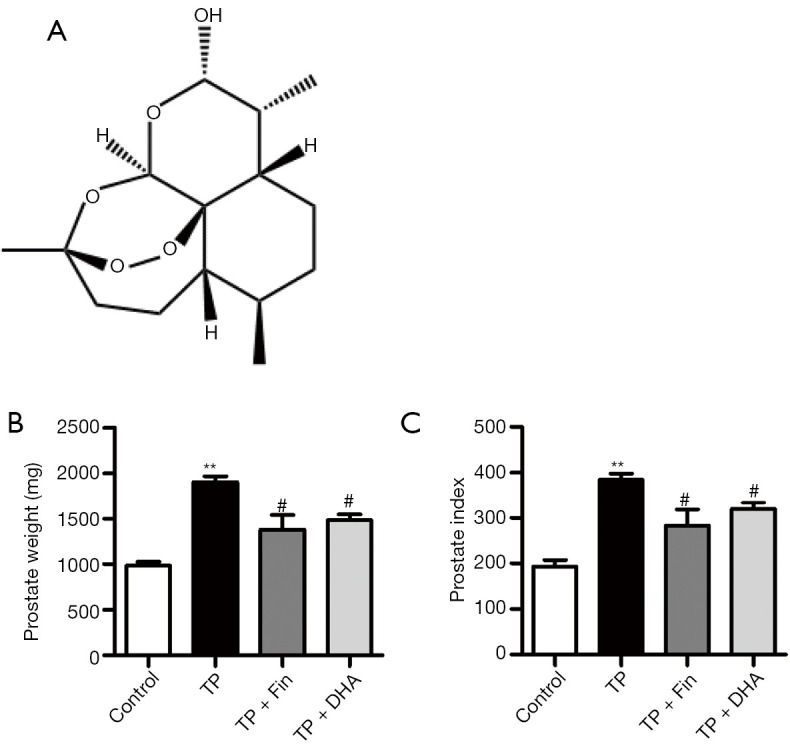
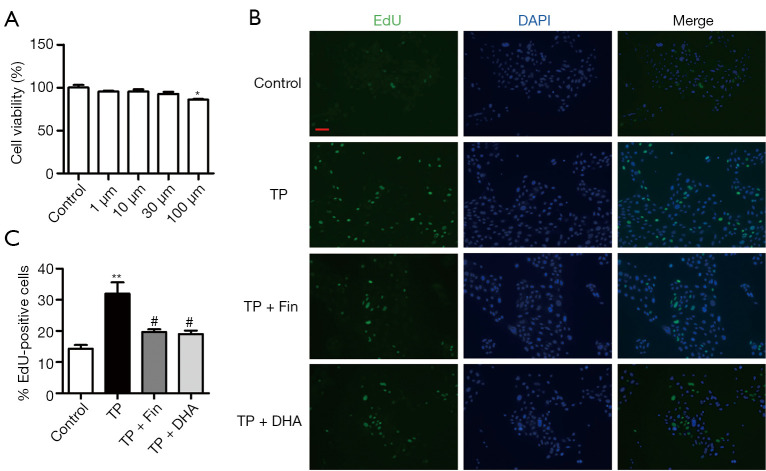
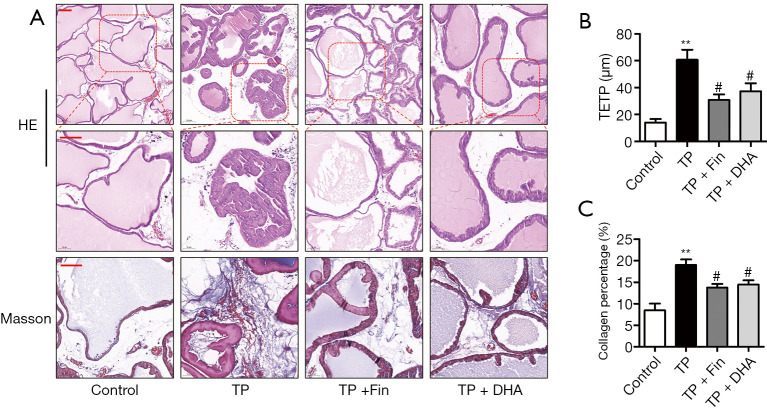
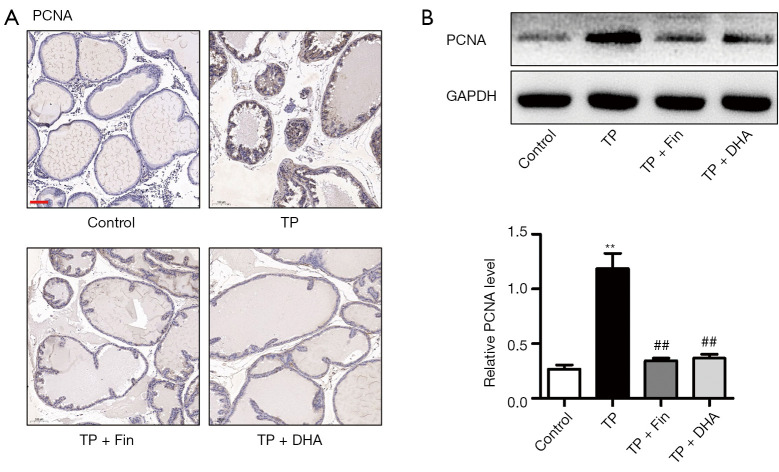
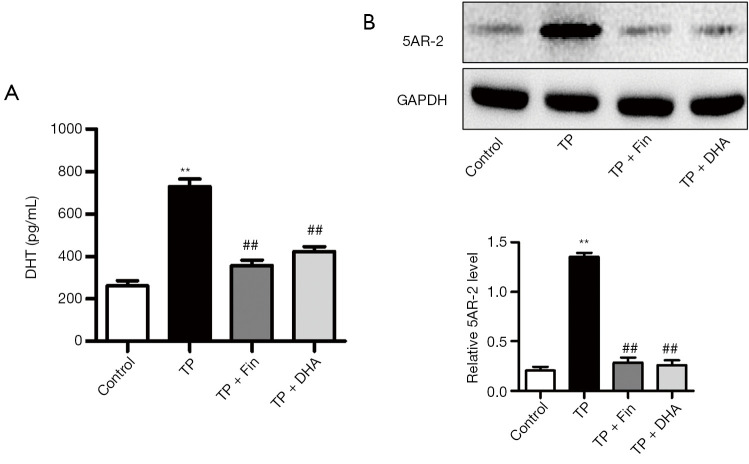
An BPH model was constructed in rats via daily subcutaneous injection of testosterone propionate (TP) for 28 consecutive days. Rats were randomly distributed into four groups and treated as follows: (I) control; (II) TP treatment; (III) TP and finasteride treatment (positive control); and (IV) TP and DHA treatment. At the end of the experiment, rats were sacrificed and the prostate weight, prostate index, thickness of the epithelium, collagen deposition, serum dihydrotestosterone (DHT) levels, 5α-reductase 2 (5AR-2) expression, and proliferating cell nuclear antigen (PCNA) levels in the prostate were examined. Normal human prostatic epithelial RWPE-1 cells were used in experiments to further investigate the anti-proliferative effects of DHA.
TP increased the prostate weight and prostate index in rats, and this effect was reduced with DHA treatment. In addition, DHA attenuated the morphological changes and collagen deposition in the prostate tissue induced by TP. Furthermore, DHA reduced the expression of PCNA, serum DHT, and prostatic 5AR-2 in rats with TP-induced BPH. analysis revealed that DHA significantly inhibited the proliferation of TP-treated RWPE-1 cells.
DHA significantly inhibited the development of BPH by suppressing serum DHT levels, prostatic 5AR-2 expression, and the proliferation of benign prostatic epithelial cells. Thus, DHA is a novel medicinal agent with potential therapeutic efficacy in the treatment of patients with BPH.
良性前列腺增生(BPH)是老年男性常见的泌尿系统疾病。虽然双氢青蒿素(DHA)具有广泛的药理活性,但迄今为止,尚无研究探讨DHA对BPH的影响。
通过连续28天每日皮下注射丙酸睾酮(TP)在大鼠中构建BPH模型。将大鼠随机分为四组并进行如下处理:(I)对照组;(II)TP治疗组;(III)TP和非那雄胺治疗组(阳性对照组);以及(IV)TP和DHA治疗组。实验结束时,处死大鼠并检测前列腺重量、前列腺指数、上皮厚度、胶原沉积、血清双氢睾酮(DHT)水平、5α-还原酶2(5AR-2)表达以及前列腺中增殖细胞核抗原(PCNA)水平。在实验中使用正常人前列腺上皮RWPE-1细胞进一步研究DHA的抗增殖作用。
TP增加了大鼠的前列腺重量和前列腺指数,而DHA治疗可减轻这种作用。此外,DHA减轻了TP诱导的前列腺组织形态学变化和胶原沉积。此外,DHA降低了TP诱导的BPH大鼠中PCNA、血清DHT和前列腺5AR-2的表达。分析显示,DHA显著抑制了TP处理的RWPE-1细胞的增殖。
DHA通过抑制血清DHT水平、前列腺5AR-2表达和良性前列腺上皮细胞的增殖,显著抑制了BPH的发展。因此,DHA是一种在治疗BPH患者方面具有潜在治疗效果的新型药物。