Zeng Xin, Zhou Xuan, Tan Xue-Rui, Chen Ye-Qun
Department of Geriatrics, The First Affiliated Hospital of Shantou University Medical College, Shantou, China.
Department of Internal Medicine, Fujian Medical University Xiamen Humanity Hospital, Xiamen, China.
Ann Transl Med. 2021 Aug;9(16):1345. doi: 10.21037/atm-21-3511.
The level of blood lipid is closely related to prognosis in cardiovascular diseases. This study aims to analyze the effect of serum low-density lipoprotein cholesterol (LDL-C) levels on the long-term mortality in acute aortic dissection (AAD). A lower admission LDL-C level is associated with an increased risk of long-term mortality in AAD.
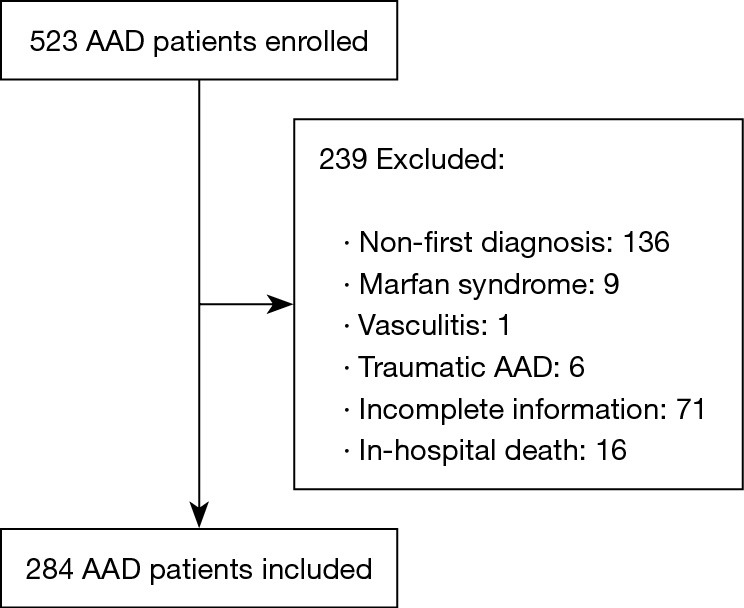
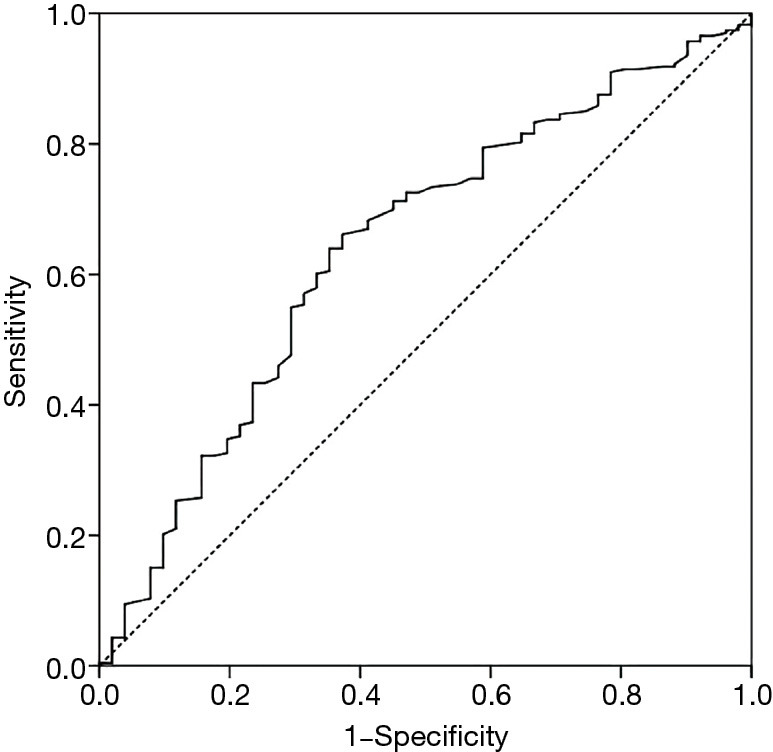
We analyzed the data of 284 patients with AAD admitted to the First Affiliated Hospital of Shantou University Medical College from February 2016 to September 2019. Patients were followed up post-discharge. All patients were divided into either an LDL-C low-level group or an LDL-C high-level group according to the optimal cut-off point obtained by the receiver operating characteristic (ROC) curve. The endpoint outcome was long-term mortality in AAD. A survival analysis and Cox proportional hazards model were used.
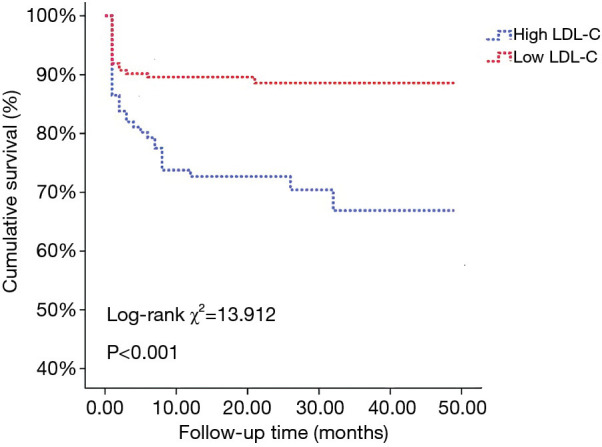
According to the Youden index, the optimal cut-off point for LDL-C was 2.755 mmol/L. The Kaplan-Meier survival analysis curves showed that the long-term mortality of the LDL-C low-level group (<2.755 mmol/L) was significantly higher than that of the LDL-C high-level group (≥2.755 mmol/L) (log-rank χ=13.912, P<0.001). After multivariate Cox regression analysis, LDL-C <2.755 mmol/L was still significantly associated with long-term mortality in AAD (HR=3.287, 95% CI: 1.637-6.600, P=0.001). In addition, cystatin C was also an independent risk factor for the long-term prognosis of AAD (HR=1.253, 95% CI: 1.057-1.486, P=0.009).
A lower admission LDL-C level may be associated with an increased risk of long-term mortality in AAD.
血脂水平与心血管疾病的预后密切相关。本研究旨在分析血清低密度脂蛋白胆固醇(LDL-C)水平对急性主动脉夹层(AAD)长期死亡率的影响。较低的入院LDL-C水平与AAD长期死亡风险增加相关。
我们分析了2016年2月至2019年9月在汕头大学医学院第一附属医院收治的284例AAD患者的数据。患者出院后进行随访。根据受试者工作特征(ROC)曲线获得的最佳截断点,将所有患者分为LDL-C低水平组或LDL-C高水平组。终点结局为AAD的长期死亡率。采用生存分析和Cox比例风险模型。
根据约登指数,LDL-C的最佳截断点为2.755 mmol/L。Kaplan-Meier生存分析曲线显示,LDL-C低水平组(<2.755 mmol/L)的长期死亡率显著高于LDL-C高水平组(≥2.755 mmol/L)(对数秩χ=13.912,P<0.001)。多因素Cox回归分析后,LDL-C<2.755 mmol/L仍与AAD的长期死亡率显著相关(HR=3.287,95%CI:1.637-6.600,P=0.001)。此外,胱抑素C也是AAD长期预后的独立危险因素(HR=1.253,95%CI:1.057-1.486,P=0.009)。
较低的入院LDL-C水平可能与AAD长期死亡风险增加相关。