Stölzl Dora, Weidinger Stephan, Drerup Katharina
Department of Dermatology, Venereology and Allergology, UKSH, Campus Kiel.
Allergol Select. 2021 Aug 27;5:265-273. doi: 10.5414/ALX02259E. eCollection 2021.
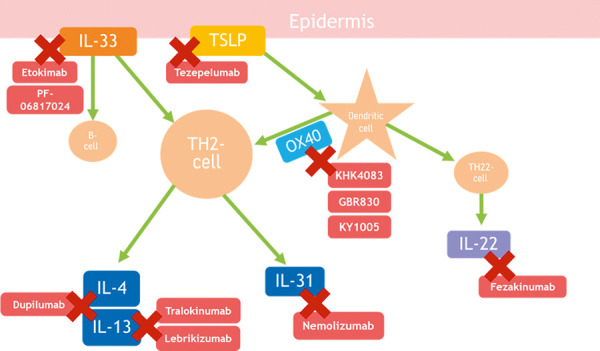
The era of biologics for the treatment of moderate-to-severe atopic dermatitis (AD) began in 2017 with the approval of dupilumab, a monoclonal antibody that binds to the α-subunit of the interleukin IL-4 receptor. Until then, only conventional immunosuppressants were available for systemic treatment, of which only cyclosporine is approved for the treatment of severe AD. In the meantime, the therapeutic landscape of AD has been changing rapidly, and additional biologics have been developed which target IL-13, the IL-31 receptor, OX40, and OX40L, among others. Many of these substances have already shown promising results in phase 1, 2, and in some cases also phase 3 trials. In June 2021, tralokinumab, an IL-13 antibody, has been approved in Europe for the treatment of moderate-to-severe AD in adults. In addition to antibody-based therapies, "small molecules" that, e.g., inhibit Janus kinases enrich the armamentarium of systemic AD therapies. With all these agents, not only will many more targeted therapies become available, but also will the complex and heterogeneous pathophysiological processes of this disease be better understood.
治疗中重度特应性皮炎(AD)的生物制剂时代始于2017年,当时度普利尤单抗获批,这是一种与白细胞介素IL-4受体α亚基结合的单克隆抗体。在此之前,全身治疗仅可使用传统免疫抑制剂,其中只有环孢素被批准用于治疗重度AD。与此同时,AD的治疗格局迅速变化,已开发出其他生物制剂,其靶点包括IL-13、IL-31受体、OX40和OX40L等。这些物质中的许多已在1期、2期试验中,在某些情况下也在3期试验中显示出有前景的结果。2021年6月,IL-13抗体曲罗芦单抗在欧洲获批用于治疗成人中重度AD。除了基于抗体的疗法外,例如抑制Janus激酶的“小分子”也丰富了全身AD治疗的手段。有了所有这些药物,不仅会有更多的靶向治疗可供使用,而且这种疾病复杂且异质性的病理生理过程也将得到更好的理解。