• 文献检索
  • 文档翻译
  • 深度研究
  • 学术资讯
  • Suppr Zotero 插件Zotero 插件
  • 邀请有礼
  • 套餐&价格
  • 历史记录
应用&插件
Suppr Zotero 插件Zotero 插件浏览器插件Mac 客户端Windows 客户端微信小程序
定价
高级版会员购买积分包购买API积分包
服务
文献检索文档翻译深度研究API 文档MCP 服务
关于我们
关于 Suppr公司介绍联系我们用户协议隐私条款
关注我们

Suppr 超能文献

核心技术专利:CN118964589B侵权必究
粤ICP备2023148730 号-1Suppr @ 2026

文献检索

告别复杂PubMed语法,用中文像聊天一样搜索,搜遍4000万医学文献。AI智能推荐,让科研检索更轻松。

立即免费搜索

文件翻译

保留排版,准确专业,支持PDF/Word/PPT等文件格式,支持 12+语言互译。

免费翻译文档

深度研究

AI帮你快速写综述,25分钟生成高质量综述,智能提取关键信息,辅助科研写作。

立即免费体验

在未知领域中产生洞见:危重症患者数据实时学习——实施者报告。

Generating insights in uncharted territories: real-time learning from data in critically ill patients-an implementer report.

机构信息

Department of Adult Intensive Care, Erasmus MC University Medical Center, Rotterdam, The Netherlands.

Department of Adult Intensive Care, Erasmus MC University Medical Center, Rotterdam, The Netherlands

出版信息

BMJ Health Care Inform. 2021 Sep;28(1). doi: 10.1136/bmjhci-2021-100447.

DOI:10.1136/bmjhci-2021-100447
PMID:34535448
原文链接:https://pmc.ncbi.nlm.nih.gov/articles/PMC8450955/
Abstract

In the current situation, clinical patient data are often siloed in multiple hospital information systems. Especially in the intensive care unit (ICU), large volumes of clinical data are routinely collected through continuous patient monitoring. Although these data often contain useful information for clinical decision making, they are not frequently used to improve quality of care. During, but also after, pressing times, data-driven methods can be used to mine treatment patterns from clinical data to determine the best treatment options from a hospitals own clinical data. In this implementer report, we describe how we implemented a data infrastructure that enabled us to learn in real time from consecutive COVID-19 ICU admissions. In addition, we explain our step-by-step multidisciplinary approach to establish such a data infrastructure. By sharing our steps and approach, we aim to inspire others, in and outside ICU walls, to make more efficient use of data at hand, now and in the future.

摘要

在当前情况下,临床患者数据通常在多个医院信息系统中被隔离。特别是在重症监护病房(ICU),通过对患者的连续监测,通常会定期收集大量的临床数据。尽管这些数据通常包含对临床决策有用的信息,但它们并不经常用于提高护理质量。在紧急时期,也可以在之后,使用数据驱动的方法从临床数据中挖掘治疗模式,以确定从医院自身临床数据中获得最佳治疗方案。在本实施者报告中,我们描述了如何实施数据基础架构,从而能够实时从连续的 COVID-19 ICU 入院患者中学习。此外,我们还解释了我们建立这种数据基础架构的多学科逐步方法。通过分享我们的步骤和方法,我们希望激励 ICU 内外的其他人,现在和将来更有效地利用手头的数据。
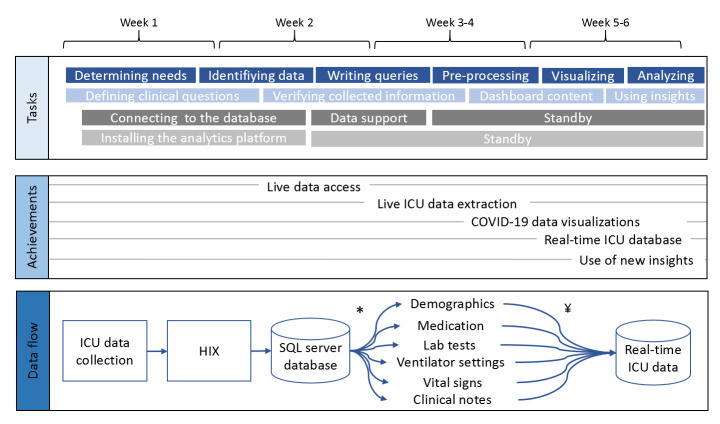
https://cdn.ncbi.nlm.nih.gov/pmc/blobs/f9c6/8450955/08e48c537567/bmjhci-2021-100447f01.jpg

相似文献

1
Generating insights in uncharted territories: real-time learning from data in critically ill patients-an implementer report.在未知领域中产生洞见:危重症患者数据实时学习——实施者报告。
BMJ Health Care Inform. 2021 Sep;28(1). doi: 10.1136/bmjhci-2021-100447.
2
The effectiveness of interventions to meet family needs of critically ill patients in an adult intensive care unit: a systematic review update.成人重症监护病房中满足重症患者家庭需求的干预措施的有效性:系统评价更新
JBI Database System Rev Implement Rep. 2016 Mar;14(3):181-234. doi: 10.11124/JBISRIR-2016-2477.
3
The modified NUTRIC score can be used for nutritional risk assessment as well as prognosis prediction in critically ill COVID-19 patients.改良的 NUTRIC 评分可用于危重症 COVID-19 患者的营养风险评估和预后预测。
Clin Nutr. 2021 Feb;40(2):534-541. doi: 10.1016/j.clnu.2020.05.051. Epub 2020 Jun 5.
4
Predicting Discharge Destination of Critically Ill Patients Using Machine Learning.使用机器学习预测危重症患者的出院去向。
IEEE J Biomed Health Inform. 2021 Mar;25(3):827-837. doi: 10.1109/JBHI.2020.2995836. Epub 2021 Mar 5.
5
Critical Care Network in the State of Qatar.卡塔尔国重症监护网络。
Qatar Med J. 2019 Nov 7;2019(2):2. doi: 10.5339/qmj.2019.qccc.2. eCollection 2019.
6
Surgical intensive care - current and future challenges?外科重症监护——当前及未来的挑战?
Qatar Med J. 2020 Jan 13;2019(2):3. doi: 10.5339/qmj.2019.qccc.3. eCollection 2019.
7
Baseline Characteristics and Outcomes of 1591 Patients Infected With SARS-CoV-2 Admitted to ICUs of the Lombardy Region, Italy.意大利伦巴第地区 1591 名 ICU 收治的 SARS-CoV-2 感染患者的基线特征和结局。
JAMA. 2020 Apr 28;323(16):1574-1581. doi: 10.1001/jama.2020.5394.
8
Clinical Characteristics and Prognostic Factors for Intensive Care Unit Admission of Patients With COVID-19: Retrospective Study Using Machine Learning and Natural Language Processing.新型冠状病毒肺炎患者入住重症监护病房的临床特征及预后因素:运用机器学习和自然语言处理的回顾性研究
J Med Internet Res. 2020 Oct 28;22(10):e21801. doi: 10.2196/21801.
9
Improvements in Patient Monitoring in the Intensive Care Unit: Survey Study.重症监护病房患者监测的改进:调查研究
J Med Internet Res. 2020 Jun 19;22(6):e19091. doi: 10.2196/19091.
10
The Effect of Intensive Care Unit Admission Patterns on Mortality-based Critical Care Performance Measures.重症监护病房收治模式对基于死亡率的重症监护绩效指标的影响。
Ann Am Thorac Soc. 2016 Jun;13(6):877-86. doi: 10.1513/AnnalsATS.201509-645OC.

引用本文的文献

1
Developing, implementing and governing artificial intelligence in medicine: a step-by-step approach to prevent an artificial intelligence winter.在医学中开发、实施和治理人工智能:预防人工智能寒冬的逐步方法。
BMJ Health Care Inform. 2022 Feb;29(1). doi: 10.1136/bmjhci-2021-100495.

本文引用的文献

1
Moving from bytes to bedside: a systematic review on the use of artificial intelligence in the intensive care unit.从字节到床边:人工智能在重症监护病房中的应用的系统评价。
Intensive Care Med. 2021 Jul;47(7):750-760. doi: 10.1007/s00134-021-06446-7. Epub 2021 Jun 5.
2
Sharing ICU Patient Data Responsibly Under the Society of Critical Care Medicine/European Society of Intensive Care Medicine Joint Data Science Collaboration: The Amsterdam University Medical Centers Database (AmsterdamUMCdb) Example.在重症医学学会/欧洲危重病医学学会联合数据科学协作下负责任地共享 ICU 患者数据:阿姆斯特丹大学医学中心数据库(AmsterdamUMCdb)示例。
Crit Care Med. 2021 Jun 1;49(6):e563-e577. doi: 10.1097/CCM.0000000000004916.
3
How the COVID-19 pandemic will change the future of critical care.
COVID-19 大流行将如何改变重症监护的未来。
Intensive Care Med. 2021 Mar;47(3):282-291. doi: 10.1007/s00134-021-06352-y. Epub 2021 Feb 22.
4
Large-scale ICU data sharing for global collaboration: the first 1633 critically ill COVID-19 patients in the Dutch Data Warehouse.用于全球合作的大规模重症监护病房数据共享:荷兰数据仓库中的首批1633例危重新冠肺炎患者
Intensive Care Med. 2021 Apr;47(4):478-481. doi: 10.1007/s00134-021-06361-x. Epub 2021 Feb 17.
5
Apples and oranges: international comparisons of COVID-19 observational studies in ICUs.风马牛不相及:重症监护病房中新冠肺炎观察性研究的国际比较
Lancet Respir Med. 2020 Oct;8(10):952-953. doi: 10.1016/S2213-2600(20)30368-4. Epub 2020 Aug 21.
6
Progressive respiratory failure in COVID-19: a hypothesis.新型冠状病毒肺炎(COVID-19)中的进行性呼吸衰竭:一种假说。
Lancet Infect Dis. 2020 Dec;20(12):1365. doi: 10.1016/S1473-3099(20)30366-2. Epub 2020 Apr 29.
7
Incidence of thrombotic complications in critically ill ICU patients with COVID-19.COVID-19 重症监护病房危重症患者的血栓并发症发生率。
Thromb Res. 2020 Jul;191:145-147. doi: 10.1016/j.thromres.2020.04.013. Epub 2020 Apr 10.
8
Big hopes for big data.对大数据寄予厚望。
Nat Med. 2020 Jan;26(1):1. doi: 10.1038/s41591-019-0740-8.