Department of Intensive Care Unit, Zhejiang Provincial People's Hospital (People's Hospital of Hangzhou Medicine College), Hangzhou 310014, China.
Department of Key Laboratory of Tumor Molecular Diagnosis and Individualized Medicine of Zhejiang Province, Hangzhou 310014, China.
Mediators Inflamm. 2021 Sep 8;2021:7890288. doi: 10.1155/2021/7890288. eCollection 2021.
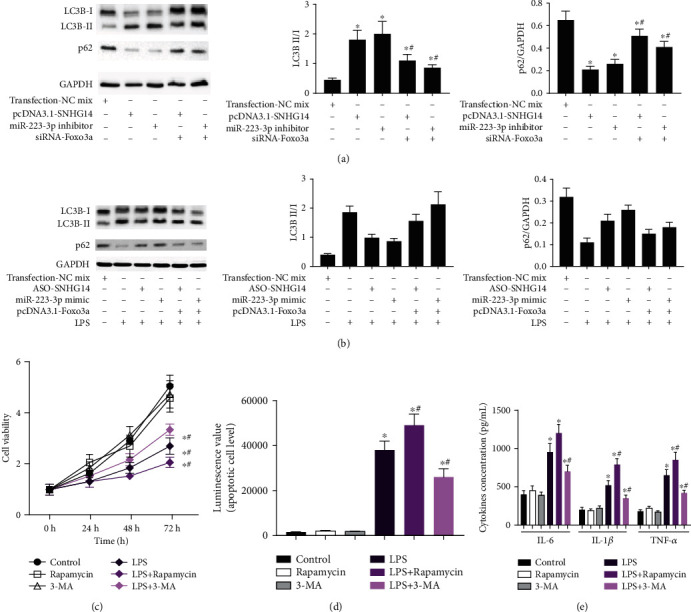
lncRNAs play important roles in lipopolysaccharide- (LPS-) induced acute lung injury. But the mechanism still needs further research. In the present study, we investigate the functional role of the lncRNA-SNHG14/miR-223-3p/Foxo3a pathway in LPS-induced ALI and tried to confirm its regulatory effect on autophagy. Transcriptomic profile changes were identified by RNA-seq in LPS-treated alveolar type II epithelial cells. The expression changes of lncRNA-SNHG14/miR-223-3p/Foxo3a were confirmed using qRT-PCR and west blot. The binding relationship of lncRNA-SNHG14/miR-223-3p/and miR-223-3p/Foxo3a was verified using dual-luciferase reporter, RNA immunoprecipitation, and RNA pull-down assays. Using gain-of-function or loss-of-function approaches, the effect of lncRNA-SNHG14/miR-223-3p/Foxo3a was investigated in LPS-induced acute lung injury mice model and in . Increasing of lncRNA-SNHG14 and Foxo3a with reducing miR-223-3p was found in LPS-treated A549 cells and lung tissue collected from the LPS-induced ALI model. lncRNA-SNHG14 inhibited miR-223-3p but promoted Foxo3a expression as a ceRNA. Artificially changes of lncRNA-SNHG14/miR-223-3p/Foxo3a pathway promoted or protected cell injury from LPS and in . Autophagy activity could be influenced by lncRNA-SNHG14/miR-223-3p/Foxo3a pathway in cells with or without LPS treatment. In conclusion, aberrant expression changes of lncRNA-SNHG14 participated alveolar type II epithelial cell injury and acute lung injury induced by LPS through regulating autophagy. One underlying mechanism is that lncRNA-SNHG14 regulated autophagy by controlling miR-223-3p/Foxo3a as a ceRNA. It suggested that lncRNA-SNHG14 may serve as a potential therapeutic target for patients with sepsis-induced ALI.
lncRNAs 在脂多糖(LPS)诱导的急性肺损伤中发挥重要作用。但其机制仍需要进一步研究。在本研究中,我们研究了 lncRNA-SNHG14/miR-223-3p/Foxo3a 通路在 LPS 诱导的 ALI 中的功能作用,并试图证实其对自噬的调节作用。通过 LPS 处理的肺泡 II 型上皮细胞的 RNA-seq 鉴定转录组谱变化。使用 qRT-PCR 和 Western blot 验证 lncRNA-SNHG14/miR-223-3p/Foxo3a 的表达变化。使用双荧光素酶报告、RNA 免疫沉淀和 RNA 下拉实验验证 lncRNA-SNHG14/miR-223-3p/和 miR-223-3p/Foxo3a 的结合关系。通过增益或失活功能方法,研究了 lncRNA-SNHG14/miR-223-3p/Foxo3a 在 LPS 诱导的急性肺损伤小鼠模型中的作用和 LPS 诱导的 ALI 模型中。在 LPS 处理的 A549 细胞和 LPS 诱导的 ALI 模型中肺组织中发现 lncRNA-SNHG14 和 Foxo3a 增加,miR-223-3p 减少。lncRNA-SNHG14 作为 ceRNA 抑制 miR-223-3p,但促进 Foxo3a 表达。lncRNA-SNHG14/miR-223-3p/Foxo3a 通路的人工改变促进或保护细胞免受 LPS 的损伤。在有或没有 LPS 处理的细胞中,自噬活性可以受到 lncRNA-SNHG14/miR-223-3p/Foxo3a 通路的影响。总之,异常表达的 lncRNA-SNHG14 通过调节自噬参与 LPS 诱导的肺泡 II 型上皮细胞损伤和急性肺损伤。其潜在机制之一是 lncRNA-SNHG14 通过作为 ceRNA 控制 miR-223-3p/Foxo3a 来调节自噬。这表明 lncRNA-SNHG14 可能作为脓毒症诱导的 ALI 患者的潜在治疗靶点。