Liu Yingchao, Hao Chanjuan, Li Kechun, Hu Xuyun, Gao Hengmiao, Zeng Jiansheng, Guo Ruolan, Liu Jun, Guo Jun, Li Zheng, Qi Zhan, Jia Xinlei, Li Wei, Qian Suyun
Pediatric Intensive Care Unit, Beijing Children's Hospital, Capital Medical University, National Center for Children's Health, Beijing, China.
Research Unit of Critical Infection in Children, Chinese Academy of Medical Sciences (2019RU016), Beijing, China.
Front Genet. 2021 Sep 1;12:677699. doi: 10.3389/fgene.2021.677699. eCollection 2021.
Whole exome sequencing (WES) has been widely used to detect genetic disorders in critically ill children. Relevant data are lacking in pediatric intensive care units (PICUs) of China. This study aimed to investigate the spectrum of monogenic disorders, the diagnostic yield and clinical utility of WES from a PICU in a large children's hospital of China.
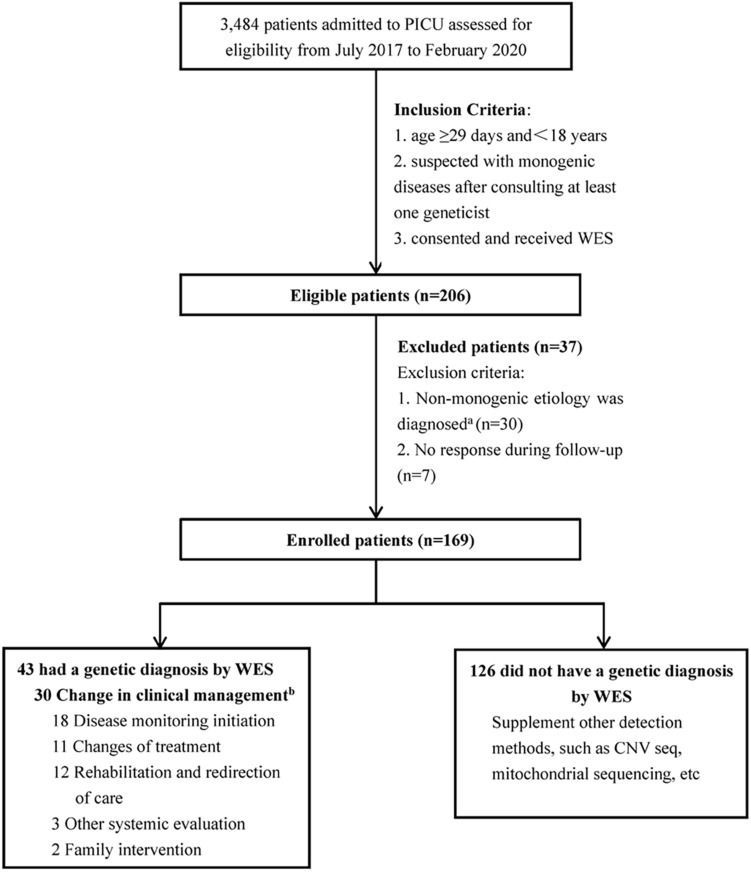
From July 2017 to February 2020, WES was performed in 169 critically ill children with suspected monogenic diseases in the PICU of Beijing Children's Hospital. The clinical features, human phenotype ontology (HPO) terms, and assessment of clinical impact were analyzed.
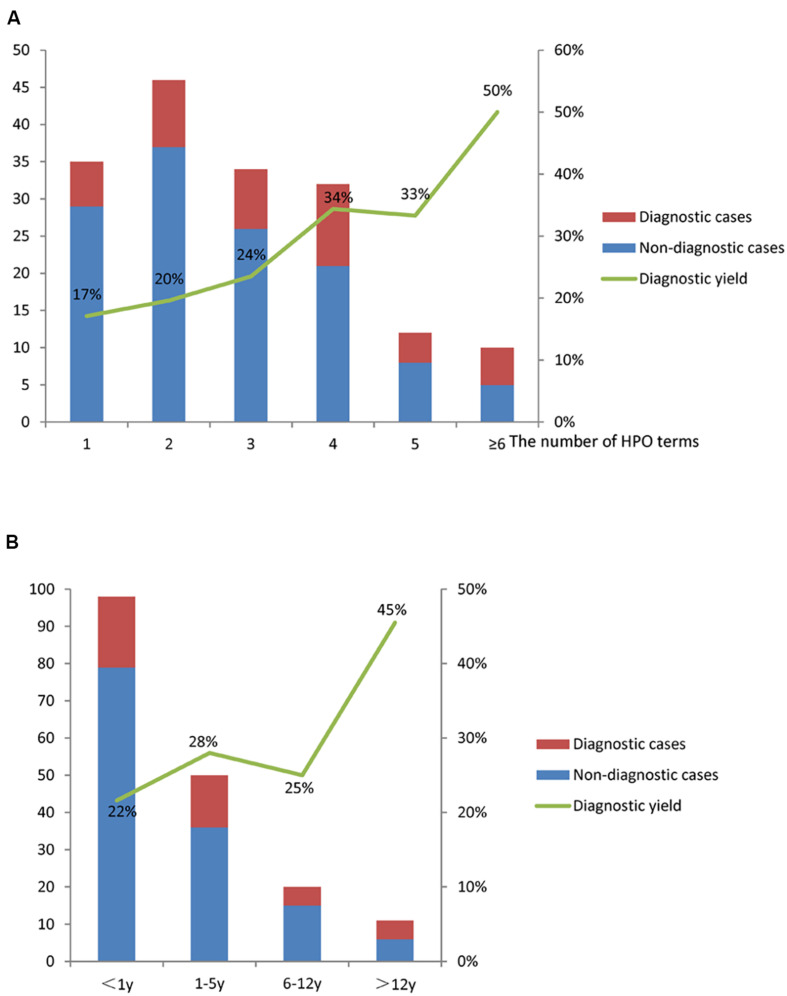
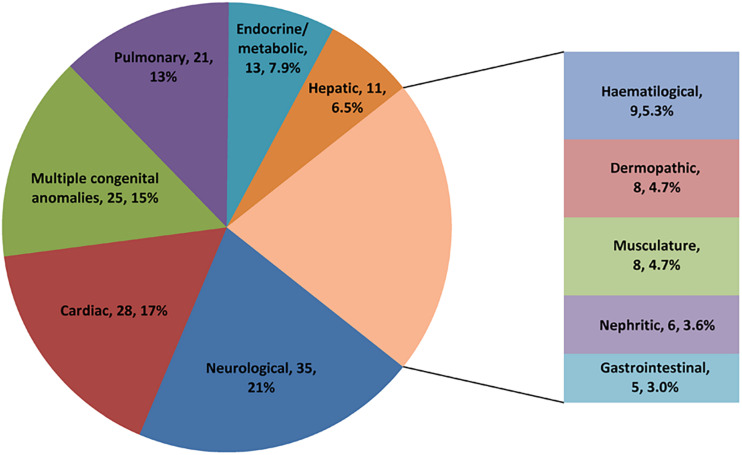
The media age of the enrolled children was 10.5 months (range, 1 month to 14.8 years). After WES, a total of 43 patients (25%) were diagnosed with monogenic disorders. The most common categories of diseases were metabolic disease (33%), neuromuscular disease (19%), and multiple deformities (14%). The diagnosis yield of children with "metabolism/homeostasis disorder" and "growth delay" or "ocular anomalies" was higher than that of children without these features. In addition, the diagnosis rate increased when more features were observed in children. The results of WES had an impact on the treatment for 30 cases (70%): (1) change of treatment ( = 11), (2) disease monitoring initiation ( = 18), (3) other systemic evaluation ( = 3), (4) family intervention ( = 2), and (5) rehabilitation and redirection of care toward palliative care ( = 12).
WES can be used as an effective diagnostic tool in the PICU of China and has an important impact on the treatment of patients with suspected monogenic conditions.
全外显子组测序(WES)已广泛应用于危重症儿童遗传疾病的检测。中国儿科重症监护病房(PICU)缺乏相关数据。本研究旨在调查中国一家大型儿童医院PICU中,单基因疾病的谱系、WES的诊断率及临床应用价值。
2017年7月至2020年2月,对北京儿童医院PICU中169例疑似单基因疾病的危重症儿童进行WES检测。分析其临床特征、人类表型本体论(HPO)术语及临床影响评估。
入组儿童的中位年龄为10.5个月(范围1个月至14.8岁)。WES检测后,共43例患者(25%)被诊断为单基因疾病。最常见的疾病类别为代谢性疾病(33%)、神经肌肉疾病(19%)和多发畸形(14%)。有“代谢/内稳态紊乱”及“生长发育迟缓”或“眼部异常”特征的儿童诊断率高于无这些特征的儿童。此外,儿童观察到的特征越多,诊断率越高。WES结果对30例患者(70%)的治疗产生了影响:(1)改变治疗方案(n = 11),(2)开始疾病监测(n = 18),(3)其他系统评估(n = 3),(4)家庭干预(n = 2),(5)康复及将护理方向转向姑息治疗(n = 12)。
WES可作为中国PICU有效的诊断工具,对疑似单基因疾病患者的治疗具有重要影响。