Salem Hytham S, Huston Laura J, Zajichek Alexander, McCarty Eric C, Vidal Armando F, Bravman Jonathan T, Spindler Kurt P, Frank Rachel M, Amendola Annunziato, Andrish Jack T, Brophy Robert H, Jones Morgan H, Kaeding Christopher C, Marx Robert G, Matava Matthew J, Parker Richard D, Wolcott Michelle L, Wolf Brian R, Wright Rick W
CU Sports Medicine, Boulder, Colorado, USA.
Department of Orthopaedics and Rehabilitation, Vanderbilt University Medical Center, Nashville, Tennessee, USA.
Orthop J Sports Med. 2021 Sep 14;9(9):23259671211033584. doi: 10.1177/23259671211033584. eCollection 2021 Sep.
When meniscal repair is performed during anterior cruciate ligament (ACL) reconstruction (ACLR), the effect of ACL graft type on meniscal repair outcomes is unclear.
The authors hypothesized that meniscal repairs would fail at the lowest rate when concomitant ACLR was performed with bone--patellar tendon--bone (BTB) autograft.
Cohort study; Level of evidence, 3.
Patients who underwent meniscal repair at primary ACLR were identified from a longitudinal, prospective cohort. Meniscal repair failures, defined as any subsequent surgical procedure addressing the meniscus, were identified. A logistic regression model was built to assess the association of graft type, patient-specific factors, baseline Marx activity rating score, and meniscal repair location (medial or lateral) with repair failure at 6-year follow-up.
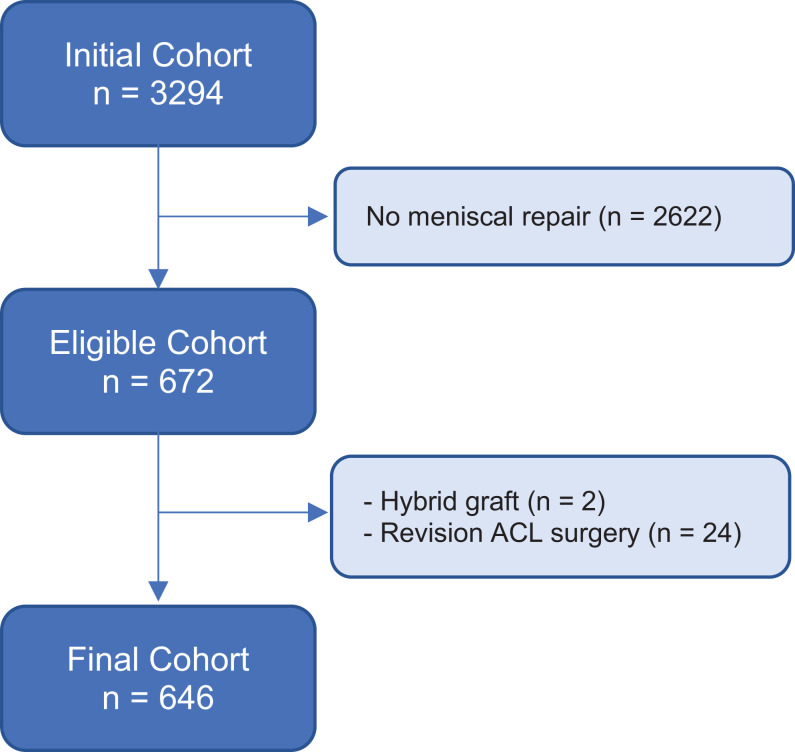
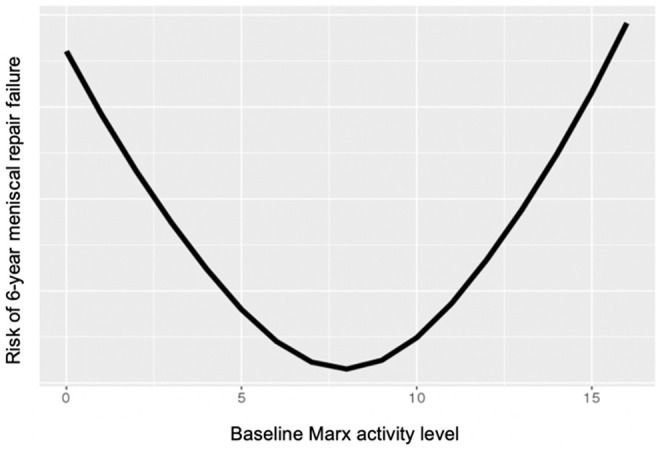
A total of 646 patients were included. Grafts used included BTB autograft (55.7%), soft tissue autograft (33.9%), and various allografts (10.4%). We identified 101 patients (15.6%) with a documented meniscal repair failure. Failure occurred in 74 of 420 (17.6%) isolated medial meniscal repairs, 15 of 187 (8%) isolated lateral meniscal repairs, and 12 of 39 (30.7%) of combined medial and lateral meniscal repairs. Meniscal repair failure occurred in 13.9% of patients with BTB autografts, 17.4% of patients with soft tissue autografts, and 19.4% of patients with allografts. The odds of failure within 6 years of index surgery were increased more than 2-fold with allograft versus BTB autograft (odds ratio = 2.34 [95% confidence interval, 1.12-4.92]; = .02). There was a trend toward increased meniscal repair failures with soft tissue versus BTB autografts (odds ratio = 1.41 [95% confidence interval, 0.87-2.30]; = .17). The odds of failure were 68% higher with medial versus lateral repairs ( < .001). There was a significant relationship between baseline Marx activity level and the risk of subsequent meniscal repair failure; patients with either very low (0-1 points) or very high (15-16 points) baseline activity levels were at the highest risk ( = .004).
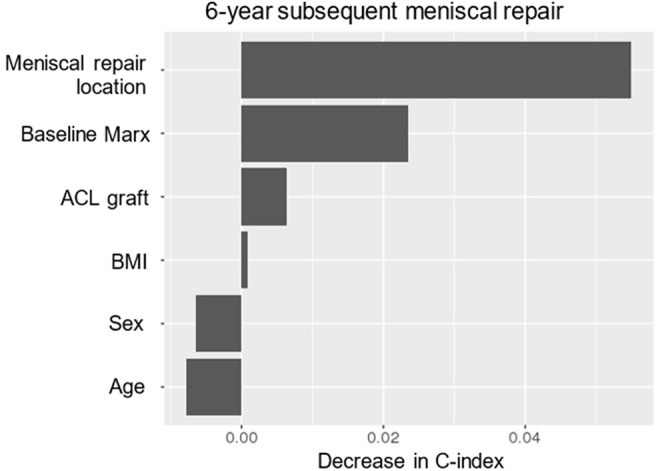
Meniscal repair location (medial vs lateral) and baseline activity level were the main drivers of meniscal repair outcomes. Graft type was ranked third, demonstrating that meniscal repairs performed with allograft were 2.3 times more likely to fail compared with BTB autograft. There was no significant difference in failure rates between BTB versus soft tissue autografts.
NCT00463099 (ClinicalTrials.gov identifier).
在前交叉韧带(ACL)重建(ACLR)过程中进行半月板修复时,ACL移植物类型对半月板修复结果的影响尚不清楚。
作者假设,当同时进行ACLR并使用骨 - 髌腱 - 骨(BTB)自体移植物时,半月板修复失败率最低。
队列研究;证据等级,3级。
从一个纵向、前瞻性队列中识别出在初次ACLR时接受半月板修复的患者。确定半月板修复失败情况,定义为随后任何针对半月板的外科手术。建立逻辑回归模型,以评估移植物类型、患者特异性因素、基线马克思活动评分以及半月板修复位置(内侧或外侧)与6年随访时修复失败的相关性。
共纳入646例患者。使用的移植物包括BTB自体移植物(55.7%)、软组织自体移植物(33.9%)和各种同种异体移植物(10.4%)。我们确定了101例(15.6%)有记录的半月板修复失败患者。420例孤立内侧半月板修复中有74例(17.6%)失败,187例孤立外侧半月板修复中有15例(8%)失败,内侧和外侧半月板联合修复的39例中有12例(30.7%)失败。BTB自体移植物患者中半月板修复失败率为13.9%,软组织自体移植物患者中为17.4%,同种异体移植物患者中为19.4%。与BTB自体移植物相比,同种异体移植物在初次手术后6年内失败的几率增加了2倍多(优势比 = 2.34 [95%置信区间,1.12 - 4.92];P = 0.02)。软组织自体移植物与BTB自体移植物相比,半月板修复失败有增加的趋势(优势比 = 1.41 [95%置信区间,0.87 - 2.30];P = 0.17)。内侧修复与外侧修复相比,失败几率高68%(P < 0.001)。基线马克思活动水平与随后半月板修复失败风险之间存在显著关系;基线活动水平非常低(0 - 1分)或非常高(15 - 16分)的患者风险最高(P = 0.004)。
半月板修复位置(内侧与外侧)和基线活动水平是半月板修复结果的主要驱动因素。移植物类型排名第三,表明与BTB自体移植物相比,使用同种异体移植物进行半月板修复失败的可能性高2.3倍。BTB自体移植物与软组织自体移植物之间的失败率无显著差异。
NCT00463099(ClinicalTrials.gov标识符)