Department of Laboratory and Transfusion Medicine, Hospital of University of Occupational and Environmental Health, School of Medicine, Kitakyushu, Japan.
Second Department of Internal Medicine, University of Occupational and Environmental Health, School of Medicine, Kitakyushu, Japan.
PLoS One. 2021 Sep 20;16(9):e0257668. doi: 10.1371/journal.pone.0257668. eCollection 2021.
Adverse reactions are more common after the second injection of messenger RNA vaccines such as Pfizer/BioNTech's BNT162b2. We hypothesized that the degree and severity of reactogenicity after the second injection reflects the magnitude of antibody production against the SARS CoV-2 virus spike protein (spike IgG).
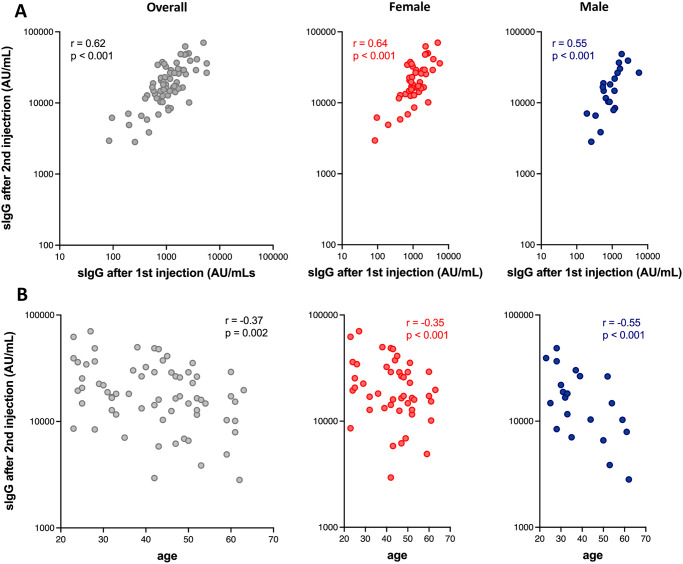
Blood samples were obtained from 67 Japanese healthcare workers three weeks after the first injection and two weeks after the second injection of the BNT162b2 vaccine to measure spike IgG levels. Using questionnaires, we calculated an adverse event (AE) score (0-11) for each participant. The geometric mean of spike IgG titers increased from 1,047 antibody units (AU/mL) (95% confidence interval (95% CI): 855-1282 AU/mL) after the first injection to 17,378 AU/mL (95% CI: 14,622-20,663 AU/mL) after the second injection. The median AE score increased from 2 to 5. Spike IgG levels after the second injection were negatively correlated with age and positively correlated with spike IgG after the first injection. AE scores after the second injection were not significantly associated with log-transformed spike IgG after the second injection, when adjusted for age, sex, AE score after the first injection, and log-transformed spike IgG after the first injection.
Although the sample size was relatively small, reactogenicity after the second injection may not accurately reflect antibody production.
信使 RNA 疫苗(如辉瑞/生物科技的 BNT162b2)接种第二针后,不良反应更为常见。我们假设第二针后反应性的程度和严重程度反映了针对 SARS CoV-2 病毒刺突蛋白(刺突 IgG)产生抗体的大小。
在接种 BNT162b2 疫苗第一针后三周和第二针后两周,从 67 名日本医护人员中采集血样,以测量刺突 IgG 水平。我们使用问卷为每位参与者计算不良事件(AE)评分(0-11)。刺突 IgG 滴度的几何平均值从第一针后的 1047 抗体单位(AU/mL)(95%置信区间(95%CI):855-1282 AU/mL)增加到第二针后的 17378 AU/mL(95%CI:14622-20663 AU/mL)。AE 评分中位数从 2 增加到 5。第二针后的刺突 IgG 水平与年龄呈负相关,与第一针后的刺突 IgG 水平呈正相关。当调整年龄、性别、第一针后的 AE 评分和第一针后的 log 转换刺突 IgG 后,第二针后的 AE 评分与第二针后的 log 转换刺突 IgG 无显著相关性。
尽管样本量相对较小,但第二针后的反应性可能不能准确反映抗体产生情况。