Institut Gustave Roussy, Department of Medical Oncology, Thoracic Oncology Unit, Villejuif, France.
Shuang Ho Hospital, Taipei Medical University, Taipei, Taiwan.
ESMO Open. 2021 Oct;6(5):100271. doi: 10.1016/j.esmoop.2021.100271. Epub 2021 Sep 17.
The phase III FLAURA2 (NCT04035486) study will evaluate efficacy and safety of first-line osimertinib with platinum-pemetrexed chemotherapy versus osimertinib monotherapy in epidermal growth factor receptor mutation-positive (EGFRm) advanced/metastatic non-small-cell lung cancer (NSCLC). The safety run-in, reported here, assessed the safety and tolerability of osimertinib with chemotherapy prior to the randomized phase III evaluation.
Patients (≥18 years; Japan: ≥20 years) with EGFRm locally advanced/metastatic NSCLC received oral osimertinib 80 mg once daily (QD), with either intravenous (IV) cisplatin 75 mg/m or IV carboplatin target area under the curve 5, plus pemetrexed 500 mg/m every 3 weeks (Q3W) for four cycles. Maintenance was osimertinib 80 mg QD with pemetrexed 500 mg/m Q3W until progression/discontinuation. The primary objective was to evaluate safety and tolerability of the osimertinib-chemotherapy combination.
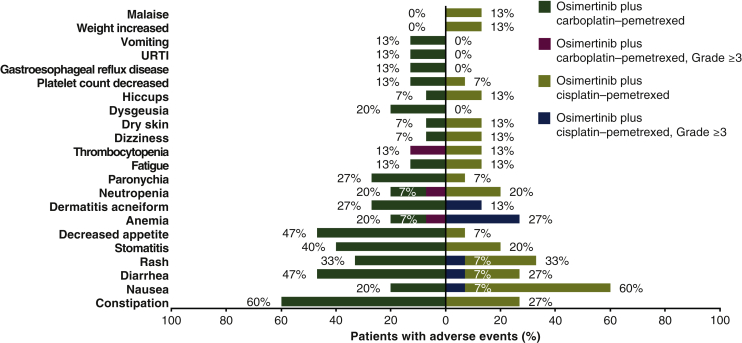
Thirty patients (15 per group) received treatment [Asian, 73%; female, 63%; median age (range) 61 (45-84) years]. Adverse events (AEs) were reported by 27 patients (90%): osimertinib-carboplatin-pemetrexed, 100%; osimertinib-cisplatin-pemetrexed, 80%. Most common AEs were constipation (60%) with osimertinib-carboplatin-pemetrexed and nausea (60%) with osimertinib-cisplatin-pemetrexed. In both groups, 20% of patients reported serious AEs. No specific pattern of AEs leading to dose modifications/discontinuations was observed; one patient discontinued all study treatments including osimertinib due to pneumonitis (study-specific discontinuation criterion). Hematologic toxicities were as expected and manageable.
Osimertinib-chemotherapy combination had a manageable safety and tolerability profile in EGFRm advanced/metastatic NSCLC, supporting further assessment in the FLAURA2 randomized phase.
III 期 FLAURA2(NCT04035486)研究将评估一线奥希替尼联合铂类培美曲塞化疗与奥希替尼单药治疗表皮生长因子受体突变阳性(EGFRm)晚期/转移性非小细胞肺癌(NSCLC)的疗效和安全性。这里报告的安全导入期评估了奥希替尼联合化疗在前瞻性 III 期评估之前的安全性和耐受性。
局部晚期/转移性 EGFRm NSCLC 患者(≥18 岁;日本:≥20 岁)接受口服奥希替尼 80 mg 每日一次(QD),联合静脉(IV)顺铂 75 mg/m2 或 IV 卡铂目标区域曲线下面积 5,加培美曲塞 500 mg/m2 每 3 周(Q3W)共 4 个周期。维持治疗为奥希替尼 80 mg QD 联合培美曲塞 500 mg/m2 Q3W,直至疾病进展/停药。主要目的是评估奥希替尼-化疗联合的安全性和耐受性。
30 例患者(每组 15 例)接受了治疗[亚洲人,73%;女性,63%;中位年龄(范围)61(45-84)岁]。27 例(90%)患者报告了不良事件(AE):奥希替尼-卡铂-培美曲塞组,100%;奥希替尼-顺铂-培美曲塞组,80%。最常见的 AE 是便秘(60%)与奥希替尼-卡铂-培美曲塞组和恶心(60%)与奥希替尼-顺铂-培美曲塞组。两组均有 20%的患者报告了严重 AE。未观察到导致剂量调整/停药的特定 AE 模式;1 例患者因肺炎(研究特异性停药标准)停止了所有研究治疗,包括奥希替尼。血液学毒性与预期相符且可管理。
奥希替尼联合化疗在 EGFRm 晚期/转移性 NSCLC 中具有可管理的安全性和耐受性,支持在 FLAURA2 随机 III 期研究中进一步评估。