University of Arizona Health Sciences, Health Sciences Innovation Building, 9Th Floor SVP Suite,1670 E. Drachman Street, P.O. Box 210216, Tucson, AZ, 85721-0216, USA.
University Hospital Galway, Galway, Ireland.
Cardiovasc Intervent Radiol. 2021 Dec;44(12):1918-1929. doi: 10.1007/s00270-021-02975-2. Epub 2021 Sep 20.
To assess safety and patency of the Venovo venous stent for the treatment of iliofemoral vein obstruction.
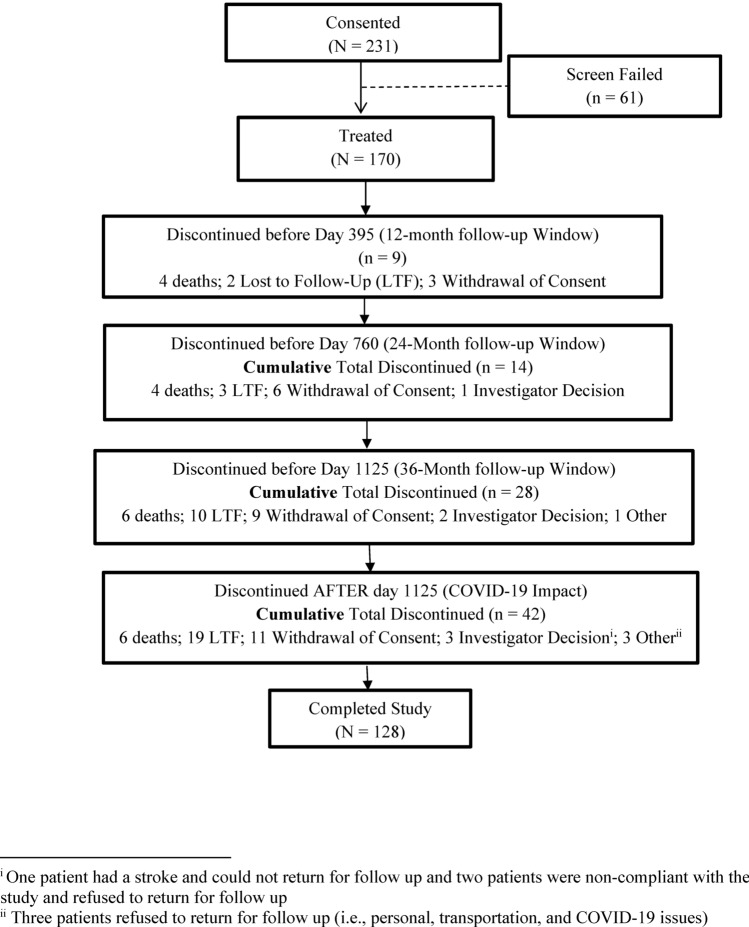
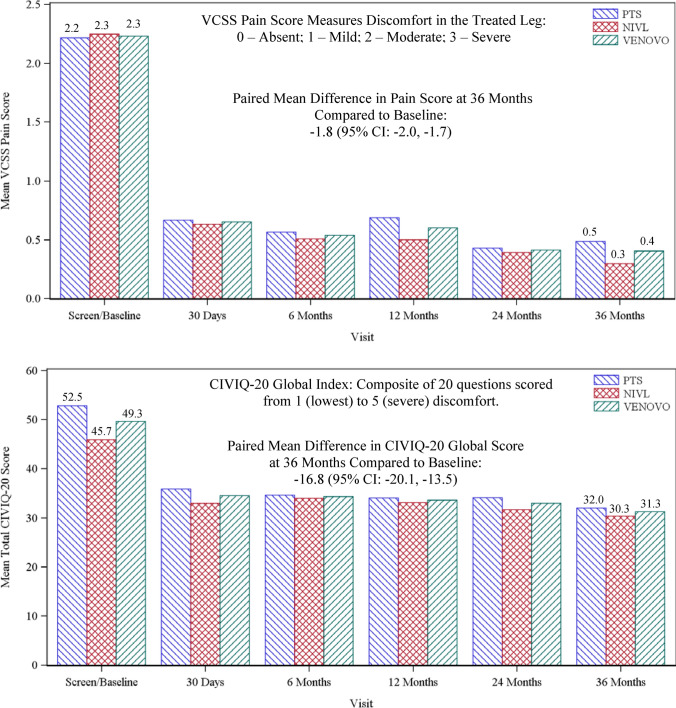
Twenty-two international centers enrolled 170 patients in the VERNACULAR study (93 post-thrombotic syndrome; 77 non-thrombotic iliac vein lesions). Primary outcome measures were major adverse events at 30 days and 12-month primary patency (freedom from target vessel revascularization, thrombotic occlusion, or stenosis > 50%). Secondary outcomes included the Venous Clinical Severity Score Pain Assessment and Chronic Venous Quality-of-Life Questionnaire assessments (hypothesis tested). Secondary observations included primary patency, target vessel and lesion revascularization (TVR/TLR), and assessment of stent integrity through 36 months.
Freedom from major adverse events through 30 days was 93.5%, statistically higher than a pre-specified performance goal of 89% (p = 0.032) while primary patency at 12 months was 88.6%, also statistically higher than a performance goal of 74% (p < 0.0001). Mean quality-of-life measures were statistically improved compared to baseline values at 12 months (p < 0.0001). Primary patency at 36 months was 84% (Kaplan-Meier analysis) while freedom from TVR/TLR was 88.1%. There was no stent embolization/migration, and no core laboratory assessed stent fractures reported through 36 months. Six deaths were reported; none adjudicated as device or procedure related.
The Venovo venous stent was successfully deployed in obstructive iliofemoral vein lesions and met the pre-specified primary outcome measures through 12 months. At 3 years, primary patency was 84%, reintervention rates were low, standardized quality-of-life and pain measures improved from baseline, and there was no stent migration or fractures.
Level 2-prospective, multicenter, controlled clinical study without a concurrent control or randomization. Pre-specified endpoints were hypothesis-tested to performance goals derived from peer-reviewed clinical literature. REGISTRATION CLINICALTRIALS.GOV: Unique Identifier NCT02655887.
评估 Venovo 静脉支架治疗髂股静脉阻塞的安全性和通畅性。
22 个国际中心在 VERNACULAR 研究中招募了 170 名患者(93 例血栓后综合征;77 例非血栓性髂静脉病变)。主要终点测量指标为 30 天和 12 个月时的主要不良事件和主要通畅率(免于靶血管血运重建、血栓闭塞或狭窄>50%)。次要终点包括静脉临床严重程度评分疼痛评估和慢性静脉生活质量问卷评估(假设检验)。次要观察包括主要通畅率、靶血管和病变血运重建(TVR/TLR)以及通过 36 个月评估支架完整性。
30 天无重大不良事件发生率为 93.5%,显著高于预先设定的 89%的性能目标(p=0.032),而 12 个月时的主要通畅率为 88.6%,也显著高于 74%的性能目标(p<0.0001)。与基线相比,12 个月时平均生活质量测量指标均有统计学改善(p<0.0001)。36 个月时的主要通畅率为 84%(Kaplan-Meier 分析),TVR/TLR 无事件发生率为 88.1%。36 个月内无支架栓塞/迁移,也无核心实验室报告支架断裂。报告了 6 例死亡,均未判定与器械或手术相关。
Venovo 静脉支架成功植入阻塞性髂股静脉病变,12 个月时达到预先设定的主要终点。3 年时,主要通畅率为 84%,再干预率低,标准化生活质量和疼痛测量指标较基线改善,无支架迁移或断裂。
2 级-前瞻性、多中心、对照临床试验,无同期对照或随机分组。预先设定的终点是根据同行评议的临床文献推导的性能目标进行假设检验。临床试验注册:ClinicalTrials.gov 唯一标识符 NCT02655887。