• 文献检索
  • 文档翻译
  • 深度研究
  • 学术资讯
  • Suppr Zotero 插件Zotero 插件
  • 邀请有礼
  • 套餐&价格
  • 历史记录
应用&插件
Suppr Zotero 插件Zotero 插件浏览器插件Mac 客户端Windows 客户端微信小程序
定价
高级版会员购买积分包购买API积分包
服务
文献检索文档翻译深度研究API 文档MCP 服务
关于我们
关于 Suppr公司介绍联系我们用户协议隐私条款
关注我们

Suppr 超能文献

核心技术专利:CN118964589B侵权必究
粤ICP备2023148730 号-1Suppr @ 2026

文献检索

告别复杂PubMed语法,用中文像聊天一样搜索,搜遍4000万医学文献。AI智能推荐,让科研检索更轻松。

立即免费搜索

文件翻译

保留排版,准确专业,支持PDF/Word/PPT等文件格式,支持 12+语言互译。

免费翻译文档

深度研究

AI帮你快速写综述,25分钟生成高质量综述,智能提取关键信息,辅助科研写作。

立即免费体验

[新型冠状病毒肺炎疫情:证据综合传播的偏好与障碍:德国重症监护人员调查]

[COVID-19 pandemic: preferences and barriers for dissemination of evidence syntheses : Survey of intensive care personnel in Germany].

作者信息

Seeber Christian, Popp Maria, Meerpohl Joerg J, Fichtner Falk, Werner Anne, Schmaderer Christoph, Holzmann-Littig Christopher, Dickel Steffen, Grimm Clemens, Moerer Onnen, Kranke Peter

机构信息

Klinik und Poliklinik für Anästhesiologie und Intensivtherapie, Universitätsklinikum Leipzig AöR, Liebigstraße 20, 04103, Leipzig, Deutschland.

Klinik und Poliklinik für Anästhesiologie, Intensivmedizin, Notfallmedizin und Schmerztherapie, Universitätsklinikum Würzburg, Würzburg, Deutschland.

出版信息

Anaesthesist. 2022 Apr;71(4):281-290. doi: 10.1007/s00101-021-01037-z. Epub 2021 Sep 21.

DOI:10.1007/s00101-021-01037-z
PMID:34546394
原文链接:https://pmc.ncbi.nlm.nih.gov/articles/PMC8454015/
Abstract

BACKGROUND

In the context of COVID-19, the German CEOsys project (COVID-19 Evidenz Ökosystem, www.covid-evidenz.de ) identifies, evaluates and summarizes the results of scientific studies to obtain evidence on this disease. The evidence syntheses are used to derive specific recommendations for clinical practice and to contribute to national guidelines. Besides the necessity of conducting good quality evidence syntheses during a pandemic, just as important is that the dissemination of evidence needs to be quick and efficient, especially in a health crisis. The CEOsys project has set itself this challenge.

OBJECTIVE

Preparing the most suitable distribution of evidence syntheses as part of the CEOsys project tasks.

METHODS

Intensive care unit (ICU) personnel in Germany were surveyed via categorical and free text questions. The survey focused on the following topics: evidence syntheses, channels and strategies of distribution, possibility of feedback, structure and barriers of dissemination and trustworthiness of various organizations. Profession, qualification, setting and size of the facility were recorded. Questionnaires were pretested throughout the queried professions (physician, nurse, others). The survey was anonymously carried out online through SosciSurvey® and an e‑mail was sent directly to 940 addresses. The survey was launched on 3 December, a reminder was sent after 14 days and it ended on 31 December. The survey was also announced via e‑mail through DIVI.

RESULTS

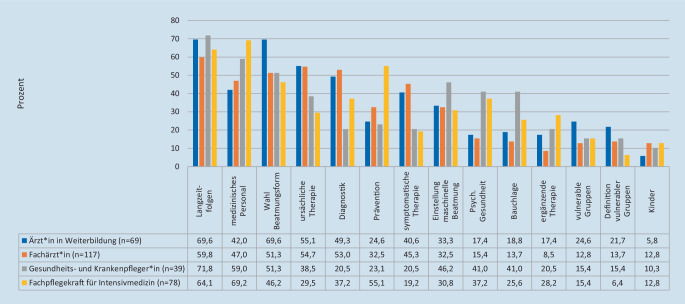
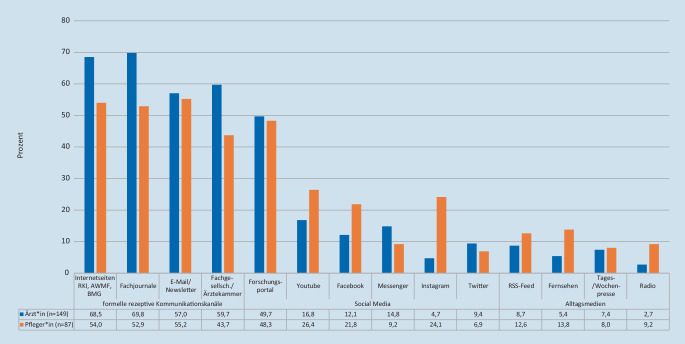
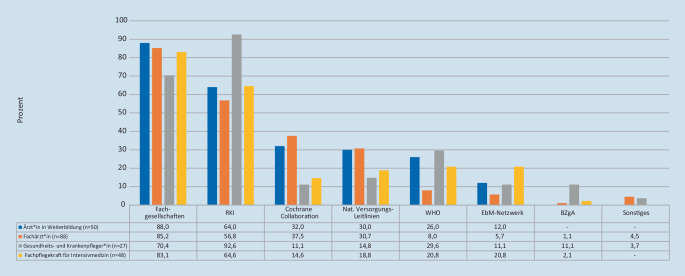
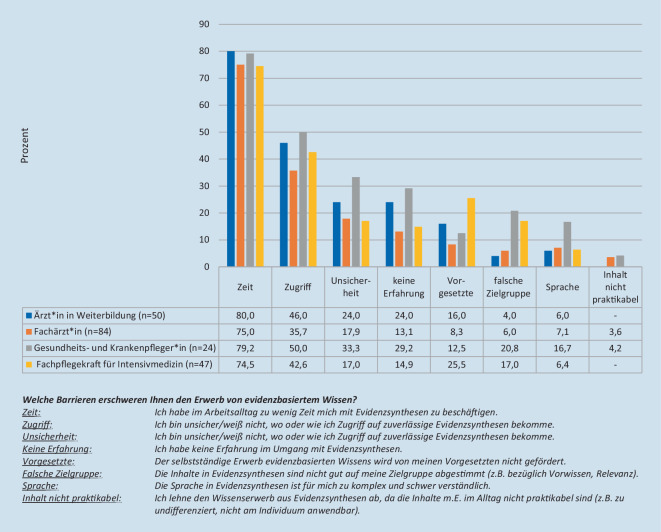
Of 317 respondents 200 completed the questionnaire. All information was analyzed including the responses from incomplete questionnaires. The most stated barriers were lack of time and access. Especially residents and nurses without specialization in intensive care mentioned uncertainty or insufficient experience in dealing with evidence syntheses as a barrier. Active distribution of evidence syntheses was clearly preferred. More than half of the participants chose websites of public institutions, medical journals, professional societies and e‑mail newsletters for drawing attention to new evidence syntheses. Short versions, algorithms and webinars were the most preferred strategies for dissemination. Trust in organizations supplying information on the COVID-19 pandemic was given to professional societies and the Robert Koch Institute (RKI) as the German governmental institute for infections and public health. The respondents' prioritized topics are long-term consequences of the disease, protection of medical personnel against infection and possibilities of ventilation treatment.

CONCLUSION

Even though universally valid, evidence syntheses should be actively brought to the target audience, especially during a health crisis such as the COVID-19 pandemic with its exceptional challenges including lack of time and uncertainties in patient care. The contents should be clear, short (short versions, algorithms) and with free access. E‑mail newsletters, websites or medical journals should continuously report on new evidence syntheses. Professional societies and the governmental institute for infections and public health should be involved in dissemination due to their obvious trustworthiness.

摘要

背景

在新冠疫情背景下,德国CEOsys项目(COVID-19证据生态系统,www.covid-evidenz.de )识别、评估并总结科学研究结果,以获取关于该疾病的证据。证据综合分析用于得出临床实践的具体建议,并为国家指南提供参考。除了在疫情期间进行高质量证据综合分析的必要性外,同样重要的是证据的传播需要快速且高效,尤其是在健康危机期间。CEOsys项目给自己设定了这一挑战。

目的

作为CEOsys项目任务的一部分,准备最合适的证据综合分析传播方式。

方法

通过分类和自由文本问题对德国重症监护病房(ICU)人员进行调查。调查聚焦于以下主题:证据综合分析、传播渠道和策略、反馈可能性、传播的结构和障碍以及各组织的可信度。记录了职业、资质、机构设置和规模。问卷在所有被调查职业(医生、护士、其他人员)中进行了预测试。调查通过SosciSurvey®在线匿名进行,并直接向940个地址发送了电子邮件。调查于12月3日启动,14天后发送了提醒,于12月31日结束。调查也通过DIVI以电子邮件形式进行了通知。

结果

317名受访者中有200人完成了问卷。所有信息都进行了分析,包括不完整问卷的回复。最常提到的障碍是时间不足和获取困难。特别是没有重症监护专业的住院医生和护士提到,在处理证据综合分析方面存在不确定性或经验不足是一个障碍。显然更倾向于积极传播证据综合分析。超过一半的参与者选择公共机构网站、医学期刊、专业协会和电子邮件时事通讯来关注新的证据综合分析。简短版本、算法和网络研讨会是最受欢迎的传播策略。在提供关于新冠疫情信息的组织中,专业协会和德国负责感染与公共卫生的政府机构罗伯特·科赫研究所(RKI)获得了受访者的信任。受访者优先关注的主题是该疾病的长期后果、医护人员的感染防护以及通气治疗的可能性。

结论

即使证据综合分析具有普遍有效性,但也应积极向目标受众传播,尤其是在像新冠疫情这样的健康危机期间,它带来了诸如时间不足和患者护理存在不确定性等特殊挑战。内容应清晰、简短(简短版本、算法)且可免费获取。电子邮件时事通讯、网站或医学期刊应持续报道新的证据综合分析。由于专业协会和负责感染与公共卫生的政府机构具有明显的可信度,应让它们参与传播。
https://cdn.ncbi.nlm.nih.gov/pmc/blobs/1d66/8986683/f3c432c0a7c2/101_2021_1037_Fig4_HTML.jpg
https://cdn.ncbi.nlm.nih.gov/pmc/blobs/1d66/8986683/e1ebd15ea505/101_2021_1037_Fig1_HTML.jpg
https://cdn.ncbi.nlm.nih.gov/pmc/blobs/1d66/8986683/60be9390e54b/101_2021_1037_Fig2_HTML.jpg
https://cdn.ncbi.nlm.nih.gov/pmc/blobs/1d66/8986683/c7e14c52af5a/101_2021_1037_Fig3_HTML.jpg
https://cdn.ncbi.nlm.nih.gov/pmc/blobs/1d66/8986683/f3c432c0a7c2/101_2021_1037_Fig4_HTML.jpg
https://cdn.ncbi.nlm.nih.gov/pmc/blobs/1d66/8986683/e1ebd15ea505/101_2021_1037_Fig1_HTML.jpg
https://cdn.ncbi.nlm.nih.gov/pmc/blobs/1d66/8986683/60be9390e54b/101_2021_1037_Fig2_HTML.jpg
https://cdn.ncbi.nlm.nih.gov/pmc/blobs/1d66/8986683/c7e14c52af5a/101_2021_1037_Fig3_HTML.jpg
https://cdn.ncbi.nlm.nih.gov/pmc/blobs/1d66/8986683/f3c432c0a7c2/101_2021_1037_Fig4_HTML.jpg

相似文献

1
[COVID-19 pandemic: preferences and barriers for dissemination of evidence syntheses : Survey of intensive care personnel in Germany].[新型冠状病毒肺炎疫情:证据综合传播的偏好与障碍:德国重症监护人员调查]
Anaesthesist. 2022 Apr;71(4):281-290. doi: 10.1007/s00101-021-01037-z. Epub 2021 Sep 21.
2
Public information needs and preferences on COVID-19: a cross-sectional study.公众对 COVID-19 的信息需求和偏好:一项横断面研究。
BMC Public Health. 2023 Feb 27;23(1):394. doi: 10.1186/s12889-023-15131-x.
3
Informing pandemic management in Germany with trustworthy living evidence syntheses and guideline development: lessons learned from the COVID-19 evidence ecosystem.利用可靠的实时证据综合分析和指南制定为德国的大流行管理提供信息:从 COVID-19 证据生态系统中吸取的经验教训。
J Clin Epidemiol. 2024 Sep;173:111456. doi: 10.1016/j.jclinepi.2024.111456. Epub 2024 Jul 14.
4
The future of Cochrane Neonatal.考克兰新生儿协作网的未来。
Early Hum Dev. 2020 Nov;150:105191. doi: 10.1016/j.earlhumdev.2020.105191. Epub 2020 Sep 12.
5
Improvements in Patient Monitoring in the Intensive Care Unit: Survey Study.重症监护病房患者监测的改进:调查研究
J Med Internet Res. 2020 Jun 19;22(6):e19091. doi: 10.2196/19091.
6
[Public trust in institutions in the first half of the Corona pandemic: findings from the COVID-19 Snapshot Monitoring (COSMO) project].[新冠疫情上半年公众对机构的信任:来自COVID-19快照监测(COSMO)项目的发现]
Bundesgesundheitsblatt Gesundheitsforschung Gesundheitsschutz. 2021 Mar;64(3):268-276. doi: 10.1007/s00103-021-03279-z. Epub 2021 Jan 29.
7
[Crisis management at the Robert Koch Institute during the COVID-19 pandemic and the exchange between federal and state governments].[新冠疫情期间罗伯特·科赫研究所的危机管理以及联邦政府与州政府之间的交流]
Bundesgesundheitsblatt Gesundheitsforschung Gesundheitsschutz. 2021 Apr;64(4):418-425. doi: 10.1007/s00103-021-03294-0. Epub 2021 Mar 5.
8
Locating Medical Information during an Infodemic: Information Seeking Behavior and Strategies of Health-Care Workers in Germany.信息疫情期间查找医学信息:德国医护人员的信息寻求行为与策略
Healthcare (Basel). 2023 May 30;11(11):1602. doi: 10.3390/healthcare11111602.
9
Provision of community pharmacy services during COVID-19 pandemic: a cross sectional study of community pharmacists' experiences with preventative measures and sources of information.2019冠状病毒病大流行期间社区药房服务的提供:一项关于社区药剂师预防措施经验和信息来源的横断面研究
Int J Clin Pharm. 2020 Aug;42(4):1197-1206. doi: 10.1007/s11096-020-01078-1. Epub 2020 Jun 11.
10
[Evaluation of the "TeleCOVID Hesse" project after 1 year in operation].[运营1年后对“黑森州远程新冠项目”的评估]
Anaesthesiologie. 2023 May;72(5):317-324. doi: 10.1007/s00101-023-01269-1. Epub 2023 Mar 17.

引用本文的文献

1
Locating Medical Information during an Infodemic: Information Seeking Behavior and Strategies of Health-Care Workers in Germany.信息疫情期间查找医学信息:德国医护人员的信息寻求行为与策略
Healthcare (Basel). 2023 May 30;11(11):1602. doi: 10.3390/healthcare11111602.
2
Public information needs and preferences on COVID-19: a cross-sectional study.公众对 COVID-19 的信息需求和偏好:一项横断面研究。
BMC Public Health. 2023 Feb 27;23(1):394. doi: 10.1186/s12889-023-15131-x.
3
COVID-19 Intensive Care-Evaluation of Public Information Sources and Current Standards of Care in German Intensive Care Units: A Cross Sectional Online Survey on Intensive Care Staff in Germany.

本文引用的文献

1
Invasive and Non-Invasive Ventilation in Patients With COVID-19.新型冠状病毒肺炎患者的有创和无创通气
Dtsch Arztebl Int. 2020 Aug 3;117(31-32):528-533. doi: 10.3238/arztebl.2020.0528.
2
Multidisciplinary Tracheostomy Quality Improvement in the COVID-19 Pandemic: Building a Global Learning Community.COVID-19 大流行期间的多学科气管切开术质量改进:建立全球学习社区。
Ann Otol Rhinol Laryngol. 2021 Mar;130(3):262-272. doi: 10.1177/0003489420941542. Epub 2020 Jul 17.
3
The Twitter pandemic: The critical role of Twitter in the dissemination of medical information and misinformation during the COVID-19 pandemic.
新型冠状病毒肺炎重症监护——德国重症监护病房公共信息来源及当前护理标准评估:一项针对德国重症监护医护人员的横断面在线调查
Healthcare (Basel). 2022 Jul 15;10(7):1315. doi: 10.3390/healthcare10071315.
推特疫情:推特在新冠疫情期间医学信息与错误信息传播中的关键作用
CJEM. 2020 Jul;22(4):418-421. doi: 10.1017/cem.2020.361.
4
Survey Research.调查研究。
Anesthesiology. 2019 Feb;130(2):192-202. doi: 10.1097/ALN.0000000000002436.
5
Getting the Word Out: New Approaches for Disseminating Public Health Science.传播知识:公共卫生科学传播的新途径。
J Public Health Manag Pract. 2018 Mar/Apr;24(2):102-111. doi: 10.1097/PHH.0000000000000673.
6
Implementation strategies for guidelines at ICUs: a systematic review.重症监护病房指南的实施策略:一项系统综述
Int J Health Care Qual Assur. 2017 May 8;30(4):358-372. doi: 10.1108/IJHCQA-08-2016-0119.
7
Barriers and Strategies in Guideline Implementation-A Scoping Review.指南实施中的障碍与策略——一项范围综述
Healthcare (Basel). 2016 Jun 29;4(3):36. doi: 10.3390/healthcare4030036.
8
The Impact of Social Media on Dissemination and Implementation of Clinical Practice Guidelines: A Longitudinal Observational Study.社交媒体对临床实践指南传播与实施的影响:一项纵向观察研究。
J Med Internet Res. 2015 Aug 13;17(8):e193. doi: 10.2196/jmir.4414.
9
Changing physician behavior: what works?改变医生的行为:哪些方法有效?
Am J Manag Care. 2015 Jan;21(1):75-84.
10
Knowledge translation of research findings.研究成果的知识转化。
Implement Sci. 2012 May 31;7:50. doi: 10.1186/1748-5908-7-50.