Department of Biomolecular Sciences, The Weizmann Institute of Science, Rehovot 76100, Israel.
Pharmaceutical Microbiology Section, Institute for Medical Microbiology, Immunology and Parasitology, University of Bonn, Sigmund-Freud-Strasse 25, D-53127 Bonn, Germany.
Biochemistry. 2021 Oct 5;60(39):2943-2955. doi: 10.1021/acs.biochem.1c00287. Epub 2021 Sep 22.
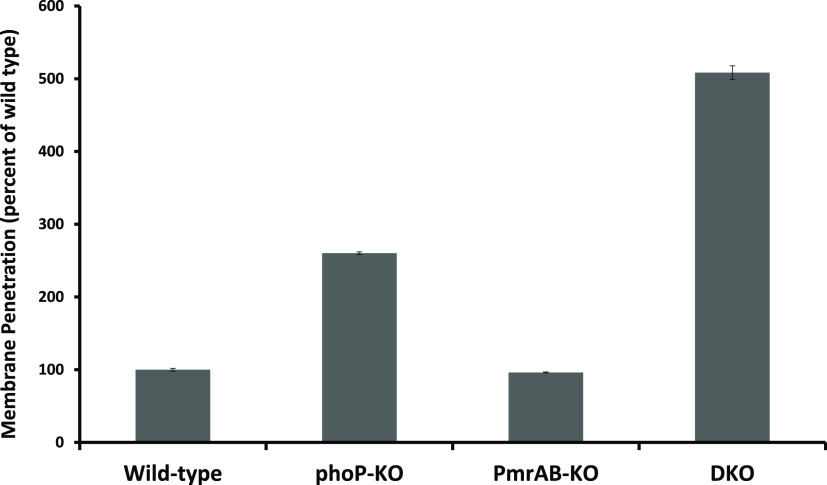
The increasing number of resistant bacteria is a major threat worldwide, leading to the search for new antibiotic agents. One of the leading strategies is the use of antimicrobial peptides (AMPs), cationic and hydrophobic innate immune defense peptides. A major target of AMPs is the bacterial membrane. Notably, accumulating data suggest that AMPs can activate the two-component systems (TCSs) of Gram-negative bacteria. These include PhoP-PhoQ (PhoPQ) and PmrA-PmrB (PmrAB), responsible for remodeling of the bacterial cell surface. To better understand this mechanism, we utilized bacteria deficient either in one system alone or in both and biophysical tools including fluorescence spectroscopy, single-cell atomic force microscopy, electron microscopy, and mass spectrometry (Moskowitz, S. M.; 2012, 56, 1019-1030; Cheng, H. Y.; 2010, 17, 60). Our data suggested that the two systems have opposing effects on the properties of . The knockout of PhoPQ made the bacteria more susceptible to AMPs by making the surface less rigid, more polarized, and permeable with a slightly more negatively charged cell wall. In addition, the periplasmic space is thinner. In contrast, the knockout of PmrAB did not affect its susceptibility, while it made the bacterial outer layer very rigid, less polarized, and less permeable than the other two mutants, with a negatively charged cell wall similar to the WT. Overall, the data suggest that the coexistence of systems with opposing effects on the biophysical properties of the bacteria contribute to their membrane flexibility, which, on the one hand, is important to accommodate changing environments and, on the other hand, may inhibit the development of meaningful resistance to AMPs.
越来越多的耐药菌是全球的主要威胁,这导致人们寻找新的抗生素。其中一种主要策略是使用抗菌肽(AMPs),即阳离子和疏水性先天免疫防御肽。AMPs 的主要靶标是细菌膜。值得注意的是,越来越多的数据表明,AMPs 可以激活革兰氏阴性菌的双组分系统(TCSs)。其中包括 PhoP-PhoQ(PhoPQ)和 PmrA-PmrB(PmrAB),它们负责重塑细菌表面。为了更好地理解这一机制,我们利用单个系统缺失或两个系统都缺失的细菌以及包括荧光光谱、单细胞原子力显微镜、电子显微镜和质谱(Moskowitz,S. M.;2012,56,1019-1030;Cheng,H. Y.;2010,17,60)在内的生物物理工具。我们的数据表明,这两个系统对的性质具有相反的影响。PhoPQ 的敲除使细菌表面更具柔韧性、极性和渗透性,细胞壁带轻微负电荷,因此更容易受到 AMP 的影响。此外,周质空间更薄。相比之下,PmrAB 的敲除并不影响其敏感性,而使细菌外层比其他两个突变体更具刚性、极性和渗透性降低,细胞壁带负电荷,与 WT 相似。总体而言,数据表明,对细菌的生物物理性质具有相反影响的系统共存有助于其膜的灵活性,一方面,这对于适应不断变化的环境很重要;另一方面,可能会抑制 AMP 产生有意义的耐药性。