Centre for Genomics Research, Discovery Science, BioPharmaceuticals R&D, AstraZeneca, Cambridge, United Kingdom.
Division of Population Health and Genomics, School of Medicine, University of Dundee, Dundee, United Kingdom.
PLoS One. 2021 Sep 22;16(9):e0257396. doi: 10.1371/journal.pone.0257396. eCollection 2021.
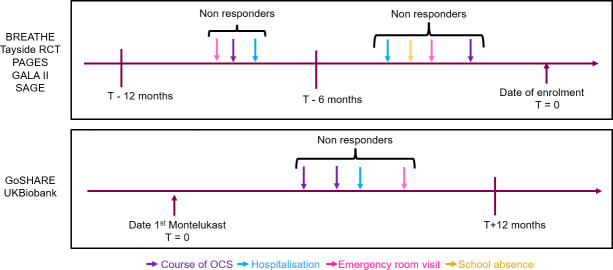
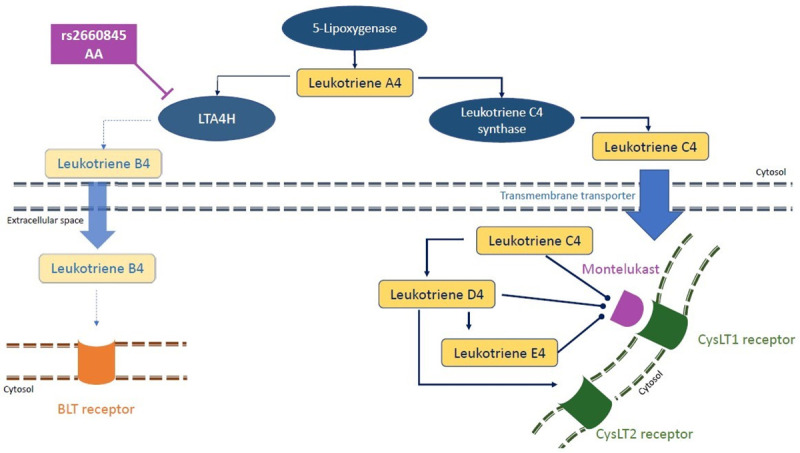
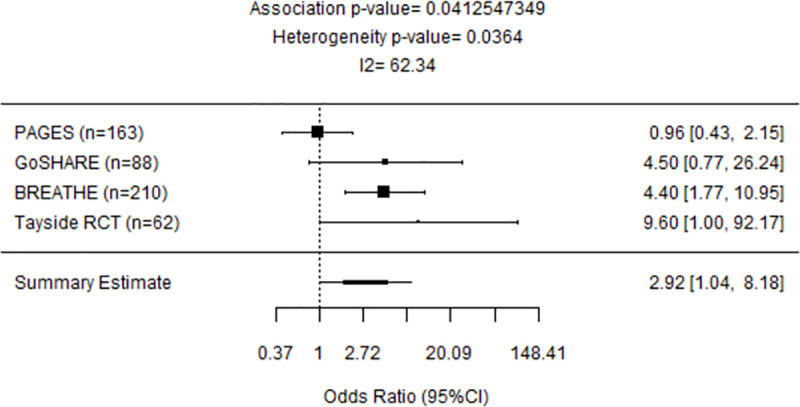
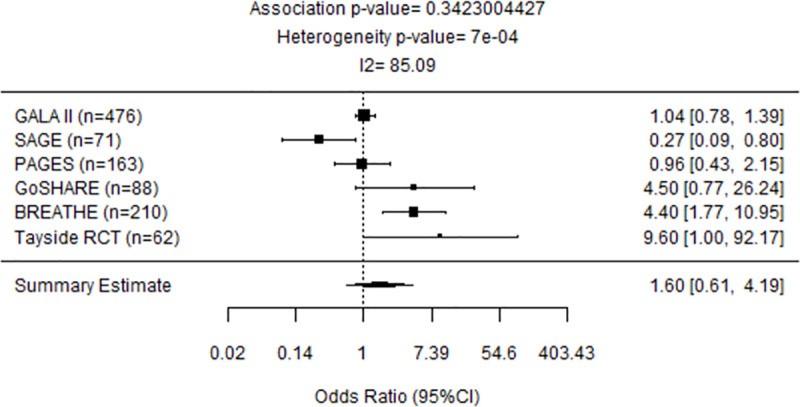
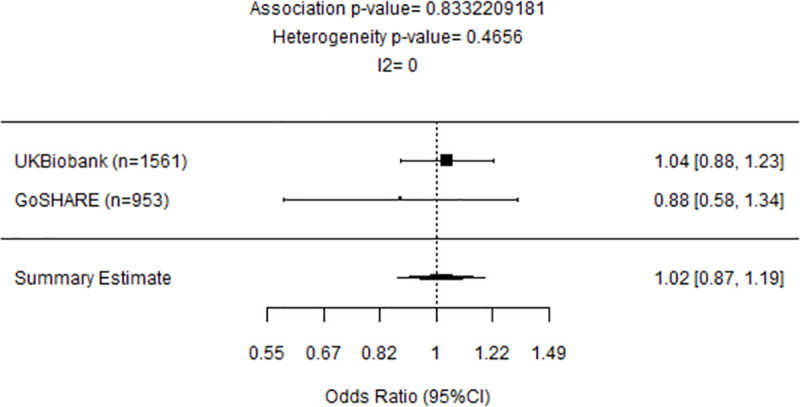
Leukotrienes play a central pathophysiological role in both paediatric and adult asthma. However, 35% to 78% of asthmatics do not respond to leukotriene inhibitors. In this study we tested the role of the LTA4H regulatory variant rs2660845 and age of asthma onset in response to montelukast in ethnically diverse populations. We identified and genotyped 3,594 asthma patients treated with montelukast (2,514 late-onset and 1,080 early-onset) from seven cohorts (UKBiobank, GoSHARE, BREATHE, Tayside RCT, PAGES, GALA II and SAGE). Individuals under montelukast treatment experiencing at least one exacerbation in a 12-month period were compared against individuals with no exacerbation, using logistic regression for each cohort and meta-analysis. While no significant association was found with European late-onset subjects, a meta-analysis of 523 early-onset individuals from European ancestry demonstrated the odds of experiencing asthma exacerbations by carriers of at least one G allele, despite montelukast treatment, were increased (odds-ratio = 2.92, 95%confidence interval (CI): 1.04-8.18, I2 = 62%, p = 0.0412) compared to those in the AA group. When meta-analysing with other ethnic groups, no significant increased risk of asthma exacerbations was found (OR = 1.60, 95% CI: 0.61-4.19, I2 = 85%, p = 0.342). Our study demonstrates that genetic variation in LTA4H, together with timing of asthma onset, may contribute to variability in montelukast response. European individuals with early-onset (≤18y) carrying at least one copy of rs2660845 have increased odd of exacerbation under montelukast treatment, presumably due to the up-regulation of LTA4H activity. These findings support a precision medicine approach for the treatment of asthma with montelukast.
白三烯在儿童和成人哮喘中都起着核心的病理生理作用。然而,35%至 78%的哮喘患者对白三烯抑制剂没有反应。在这项研究中,我们测试了 LTA4H 调节变体 rs2660845 和哮喘发病年龄在不同种族人群对白三烯受体拮抗剂孟鲁司特反应中的作用。我们从七个队列(英国生物库、GoSHARE、BREATHE、泰赛德 RCT、PAGES、GALA II 和 SAGE)中鉴定并对 3594 名接受孟鲁司特治疗的哮喘患者(2514 名晚发性和 1080 名早发性)进行了基因分型。在 12 个月内至少经历过一次加重的孟鲁司特治疗个体与无加重的个体进行比较,每个队列均采用逻辑回归,然后进行荟萃分析。虽然在欧洲晚发性患者中未发现显著相关性,但对来自欧洲血统的 523 名早发性患者的荟萃分析表明,尽管接受了孟鲁司特治疗,但至少携带一个 G 等位基因的患者发生哮喘加重的几率增加(优势比=2.92,95%置信区间(CI):1.04-8.18,I2=62%,p=0.0412),与 AA 组相比。当与其他种族群体进行荟萃分析时,未发现哮喘加重的风险显著增加(OR=1.60,95%CI:0.61-4.19,I2=85%,p=0.342)。我们的研究表明,LTA4H 中的遗传变异与哮喘发病时间一起,可能导致孟鲁司特反应的可变性。携带至少一个 rs2660845 拷贝的欧洲早发性(≤18 岁)患者在孟鲁司特治疗下发生加重的几率增加,这可能是由于 LTA4H 活性的上调。这些发现支持使用孟鲁司特治疗哮喘的精准医学方法。