Kimura Shigeo S, Murase Kohta, Mészáros Péter
Frontier Research Institute for Interdisciplinary Sciences, Tohoku University, Sendai, Japan.
Astronomical Institute, Tohoku University, Sendai, Japan.
Nat Commun. 2021 Sep 23;12(1):5615. doi: 10.1038/s41467-021-25111-7.
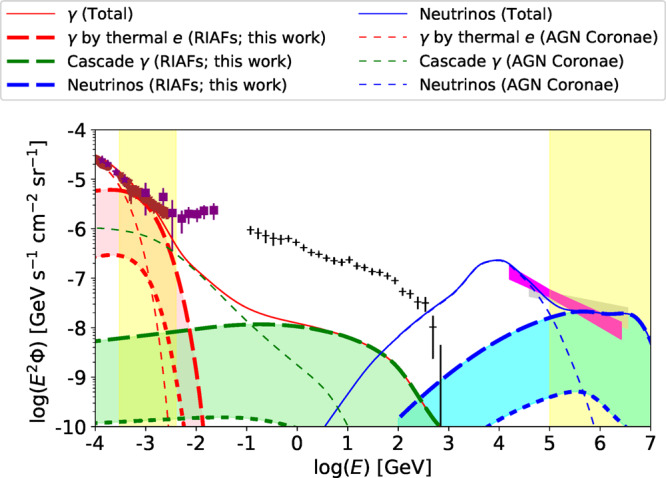
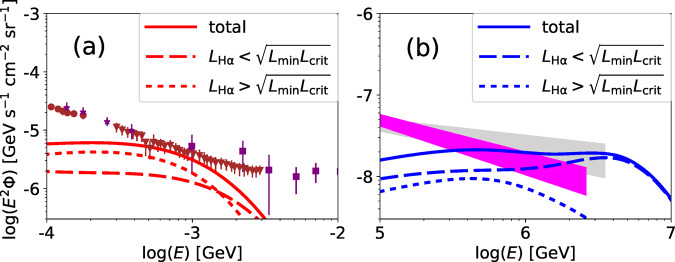
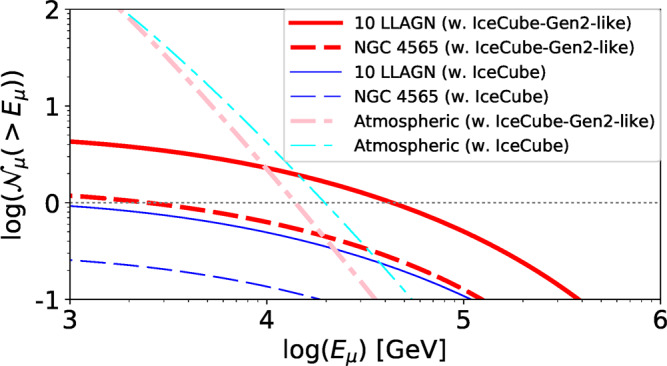
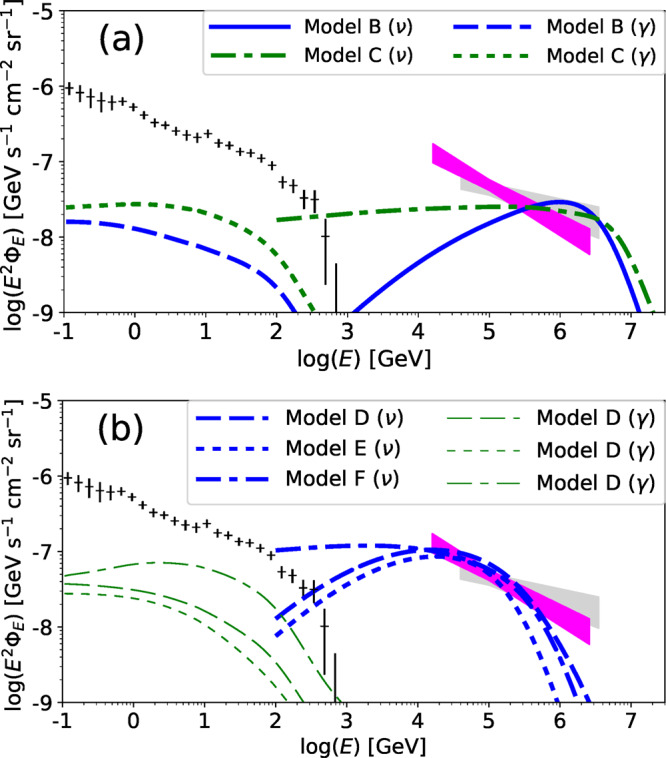
The Universe is filled with a diffuse background of MeV gamma-rays and PeV neutrinos, whose origins are unknown. Here, we propose a scenario that can account for both backgrounds simultaneously. Low-luminosity active galactic nuclei have hot accretion flows where thermal electrons naturally emit soft gamma rays via Comptonization of their synchrotron photons. Protons there can be accelerated via turbulence or reconnection, producing high-energy neutrinos via hadronic interactions. We demonstrate that our model can reproduce the gamma-ray and neutrino data. Combined with a contribution by hot coronae in luminous active galactic nuclei, these accretion flows can explain the keV - MeV photon and TeV - PeV neutrino backgrounds. This scenario can account for the MeV background without non-thermal electrons, suggesting a higher transition energy from the thermal to nonthermal Universe than expected. Our model is consistent with X-ray data of nearby objects, and testable by future MeV gamma-ray and high-energy neutrino detectors.
宇宙中弥漫着能量为兆电子伏特的伽马射线和拍电子伏特的中微子背景,其起源不明。在此,我们提出一种能同时解释这两种背景的设想。低光度活动星系核存在热吸积流,其中热电子通过对其同步辐射光子的逆康普顿散射自然发射软伽马射线。那里的质子可通过湍流或重联加速,通过强子相互作用产生高能中微子。我们证明我们的模型能够重现伽马射线和中微子数据。结合亮活动星系核中热冕的贡献,这些吸积流能够解释千电子伏特至兆电子伏特的光子背景以及太电子伏特至拍电子伏特的中微子背景。这种设想能够在没有非热电子的情况下解释兆电子伏特背景,这表明从热宇宙到非热宇宙的转变能量比预期更高。我们的模型与附近天体的X射线数据相符,并且可由未来的兆电子伏特伽马射线和高能中微子探测器进行检验。