Chen Qingxing, Xu Lili, Zou Tian, Cheng Kuang, Ling Yunlong, Xu Ye, Pang Yang, Liu Guijian, Zhu Wenqing, Ge Junbo
Department of Cardiology, Zhongshan Hospital, Fudan University, Shanghai Institute of Cardiovascular Diseases, Shanghai, China.
Front Cardiovasc Med. 2021 Sep 7;8:692945. doi: 10.3389/fcvm.2021.692945. eCollection 2021.
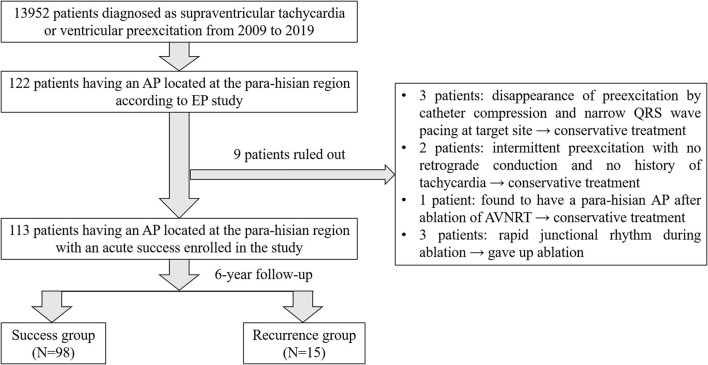
Ablation of para-hisian accessory pathways (APs) remains challenging due to anatomic characteristics, and a few studies have focused on the causes for recurrence of radiofrequency ablation of para-hisian APs. This retrospective single center study aimed to explore the risk factors for recurrence of para-hisian APs. One hundred thirteen patients who had para-hisian AP with an acute success were enrolled in the study. In the 6-year follow-up, 15 cases had a recurrent para-hisian AP. Therefore, 98 patients were classified into the success group, while 15 patients were classified into the recurrence group. Demographic and ablation characteristics were analyzed. Gender difference was similar in two groups. The median age was 36.2 years old and was younger in the recurrence group. Maximum ablation power was significantly higher in the success group (29 ± 7.5 vs. 22.9 ± 7.8, < 0.01). Ablation time of final target sites was found to be markedly higher in the success group (123.4 ± 53.1 vs. 86.7 ± 58.3, < 0.05). Ablation time <60 s was detected in 12 (12.2%) cases in the success group and 7 (46.7%) cases in the recurrence group ( < 0.01). Occurrence of junctional rhythm was significantly higher in the recurrence group (25.5% vs. 53.3%, < 0.05). No severe conduction block, no pacemaker implantation, and no stroke were reported. Junctional rhythm during ablation (OR = 3.833, 95% CI 1.083-13.572, = 0.037) and ablation time <60 s (OR = 5.487, 95% CI 1.411-21.340, = 0.014) were independent risk factors for the recurrence of para-hisian AP. With careful and accurate mapping, it is relatively safe to ablate para-hisian AP. If possible, proper extension of ablation time could reduce the recurrence rate of para-hisian APs.
由于解剖学特征,希氏束旁旁路(APs)的消融仍然具有挑战性,并且一些研究关注希氏束旁APs射频消融复发的原因。这项回顾性单中心研究旨在探讨希氏束旁APs复发的危险因素。113例希氏束旁APs消融即刻成功的患者纳入本研究。在6年的随访中,15例出现希氏束旁APs复发。因此,98例患者被分类为成功组,15例患者被分类为复发组。分析了人口统计学和消融特征。两组性别差异相似。中位年龄为36.2岁,复发组年龄更小。成功组的最大消融功率显著更高(29±7.5 vs. 22.9±7.8,<0.01)。发现成功组最终靶点的消融时间明显更长(123.4±53.1 vs. 86.7±58.3,<0.05)。成功组12例(12.2%)病例和复发组7例(46.7%)病例检测到消融时间<60秒(<0.01)。复发组交界性心律的发生率显著更高(25.5% vs. 53.3%,<0.05)。未报告严重传导阻滞、未植入起搏器和未发生卒中。消融期间的交界性心律(OR = 3.833,95%CI 1.083 - 13.572,= 0.037)和消融时间<60秒(OR = 5.487,95%CI 1.411 - 21.340,= 0.014)是希氏束旁APs复发的独立危险因素。通过仔细准确的标测,希氏束旁APs消融相对安全。如果可能,适当延长消融时间可降低希氏束旁APs的复发率。