
2018年南非甲型流感病毒血凝素基因中K162和N163缺失的维多利亚谱系乙型流感病毒检测
Detection of Victoria lineage influenza B viruses with K162 and N163 deletions in the hemagglutinin gene, South Africa, 2018.
作者信息
Hellferscee Orienka, Treurnicht Florette, Gaelejwe Lucinda, Moerdyk Alexandra, Reubenson Gary, McMorrow Meredith, Tempia Stefano, McAnerney Johanna, Walaza Sibongile, Wolter Nicole, von Gottberg Anne, Cohen Cheryl
机构信息
Centre for Respiratory Diseases and Meningitis National Institute for Communicable Diseases of the National Health Laboratory Service Johannesburg South Africa.
Department of Medical Virology, School of Pathology, Faculty of Health Sciences University of the Witwatersrand Johannesburg South Africa.
出版信息
Health Sci Rep. 2021 Sep 17;4(3):e367. doi: 10.1002/hsr2.367. eCollection 2021 Sep.
BACKGROUND
A group of Victoria lineage influenza B viruses with a two amino acid deletion in the hemagglutinin (HA) at residues K162 and N163, was detected during the 2016 to 2017 Northern Hemisphere influenza season and continues to spread geographically. We describe the first identification of viruses with these deletions from South Africa in 2018.
METHODS
Nasopharyngeal samples were obtained from the syndromic surveillance programs. Real-time reverse transcription-polymerase chain reaction was used for virus detection and lineage determination. Influenza genetic characterization was done using next-generation sequencing on the MiSeq platform. The duration of virus circulation was determined using thresholds calculated using the Moving Epidemic Method; duration was used as an indicator of disease transmissibility and impact.
RESULTS
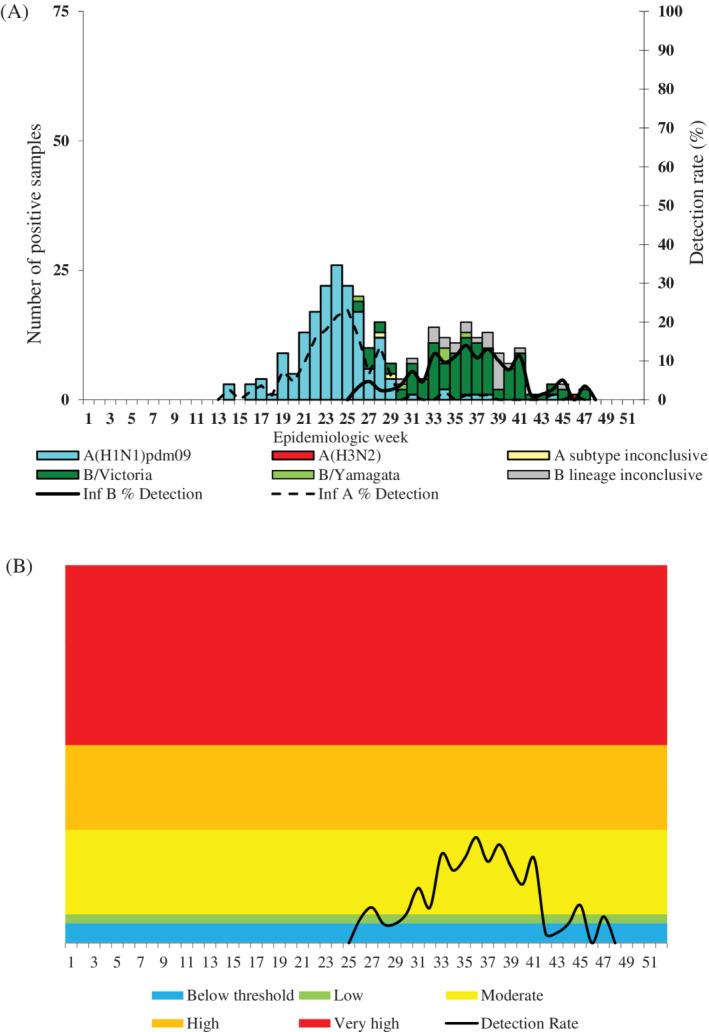
In 2018, 42% (426/1015) of influenza-positive specimens were influenza B viruses. Of 426 influenza B-positive samples, 376 (88%) had the lineage determined of which 75% (283/376) were Victoria lineage. The transmissibility of the 2018 South African influenza season was high for a few weeks, although the severity remained moderate through most of the season. The sequenced 2018 South African Victoria lineage influenza B viruses clustered in sub-clade V1A.1 with the 162-163 deletions.
CONCLUSIONS
We report the first detection of the 162-163 deletion variant of influenza B/Victoria viruses from South Africa in 2018, and suggest that this deletion variant replaced the previous circulating influenza B/Victoria viruses. These deletions putatively affect the antigenic properties of the viruses because they border an immune-dominant region at the tip of the HA. Therefore, close monitoring of these newly emerging viruses is essential.
背景
在2016至2017年北半球流感季节期间,检测到一组维多利亚系乙型流感病毒,其血凝素(HA)中第162位氨基酸残基K和第163位氨基酸残基N处有两个氨基酸缺失,并且该病毒仍在继续在地理上传播。我们描述了2018年首次在南非鉴定出具有这些缺失的病毒。
方法
从症状监测项目中获取鼻咽样本。使用实时逆转录-聚合酶链反应进行病毒检测和谱系确定。利用MiSeq平台上的下一代测序技术对流感病毒进行基因特征分析。使用移动流行法计算的阈值来确定病毒传播持续时间;传播持续时间用作疾病传播性和影响的指标。
结果
2018年,42%(426/1015)的流感阳性标本为乙型流感病毒。在426份乙型流感阳性样本中,376份(88%)确定了谱系,其中75%(283/376)为维多利亚系。2018年南非流感季节的传播性在几周内较高,尽管在该季节的大部分时间里严重程度仍为中等。测序的2018年南非维多利亚系乙型流感病毒聚集在带有162 - 163缺失的V1A.1亚分支中。
结论
我们报告了2018年首次在南非检测到乙型/维多利亚流感病毒的162 - 163缺失变异株,并表明该缺失变异株取代了先前流行的乙型/维多利亚流感病毒。这些缺失可能会影响病毒的抗原特性,因为它们位于HA顶端的一个免疫优势区域附近。因此,密切监测这些新出现的病毒至关重要。



 Zotero 插件