Department of MedicineUniversity of Illinois at ChicagoChicagoILUSA.
Department of Internal MedicineRush UniversityChicagoILUSA.
Hepatol Commun. 2021 Nov;5(11):1953-1963. doi: 10.1002/hep4.1792. Epub 2021 Jul 28.
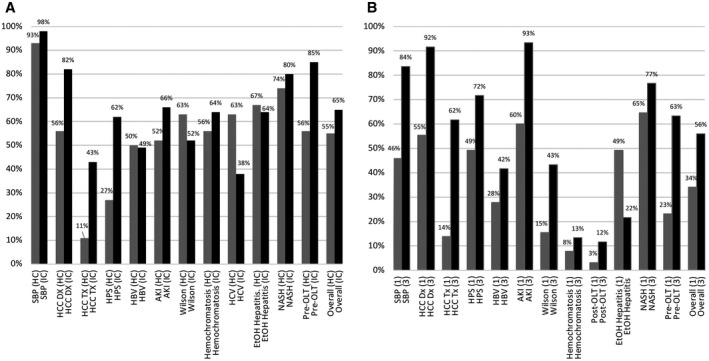
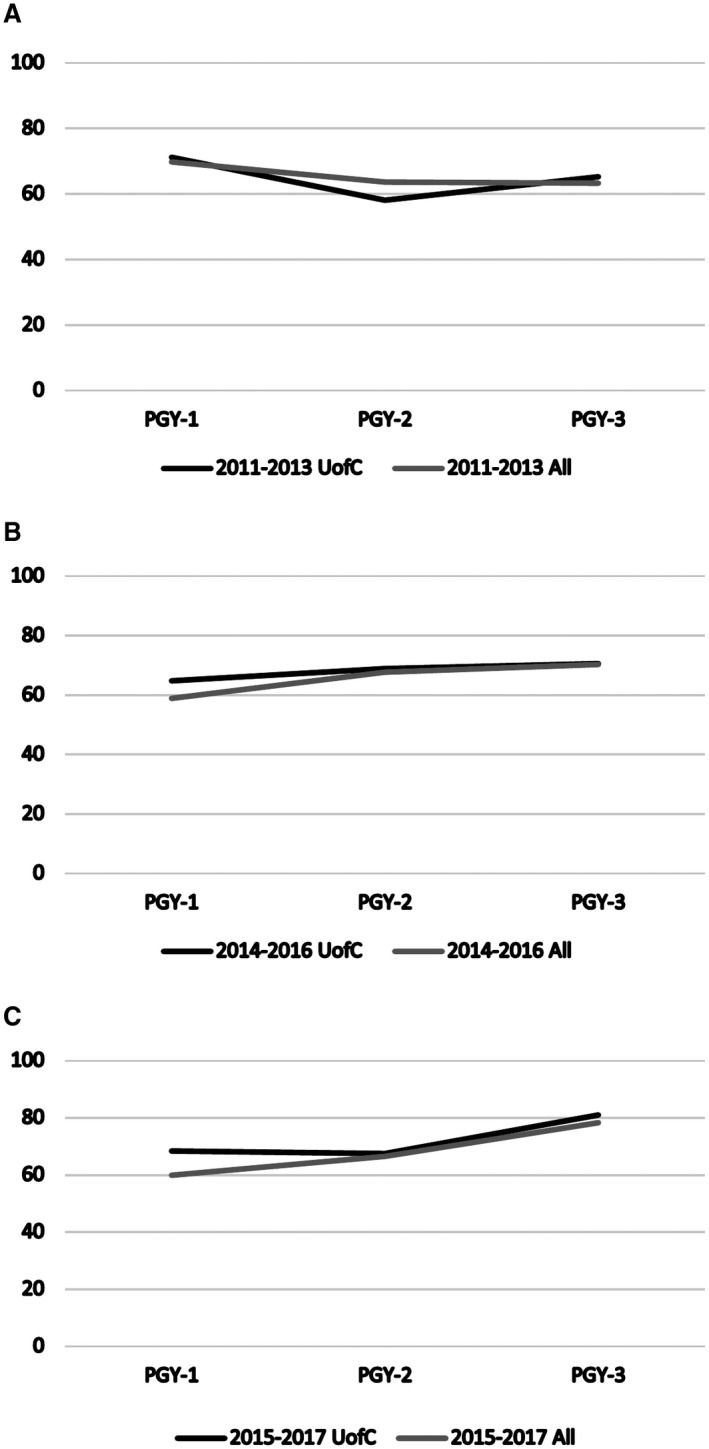
We previously created a mandatory, inpatient, hepatology resident curriculum that immediately improved comfort, knowledge, and career interest in chronic liver disease (CLD). The durability of these effects needs to be known to use this intervention to address the hepatologist shortage. Thus, we aimed to assess this curriculum's long-term outcomes on internal medicine (IM) residents' CLD comfort, knowledge, and career interest. From 2015 to 2019 at a single institution, one IM resident was always assigned to the rotation. Similar anonymous assessments were administered to incoming postgraduate year (PGY)-1 residents and graduating PGY-3 residents, including a historic control cohort that graduated in June 2015. At residency completion, the intervention cohort (n = 61) had significantly higher comfort (1, not at all comfortable/strongly disagree; 5, very comfortable/strongly agree) with both hepatology (e.g., hepatitis C, 2.5 vs. 3.3, P < 0.001) and common IM topics (e.g., heart failure, 3.6 vs. 4.8, P < 0.001) but not specialty topics lacking curricula (e.g., inflammatory bowel disease, 2.8 vs. 2.7, P = 0.54). Compared to the historic cohort (n = 27), the intervention cohort was more comfortable in several CLD topics (e.g., cirrhosis, 3.2 vs. 3.8; P = 0.005) and answered more questions correctly (65% vs. 55%; P = 0.04), but career interest was unchanged (1.9 vs. 1.8; P = 0.45). Many residents (33%) would consider a hepatology career if training were separated from gastroenterology. Conclusion: With the completion of a mandatory hepatology curriculum, residents' CLD comfort and knowledge durably improved and exceeded that of historic counterparts. Initial career interest was not sustained, perhaps due to prerequisite gastroenterology training. These findings suggest IM educational initiatives may better address hepatology workforce needs by generating comanagers than by recruiting trainees.
我们之前创建了一个强制性的住院内科医师住院医师课程,该课程立即提高了对慢性肝病(CLD)的舒适度,知识和职业兴趣。为了解决肝病学家短缺的问题,需要了解这种干预措施的持久性。因此,我们旨在评估该课程对内科住院医师(IM)慢性肝病舒适度,知识和职业兴趣的长期影响。在一个机构中,从 2015 年到 2019 年,始终为一名 IM 住院医师分配了轮班。对即将毕业的住院医师 1 年级(PGY)-1 居民和毕业的 PGY-3 居民进行了类似的匿名评估,包括 2015 年 6 月毕业的历史对照队列。在住院医师完成学业时,干预组(n=61)对肝病学(例如丙型肝炎)的舒适度明显更高(1,一点也不舒服/非常不同意;5,非常舒适/非常同意)和常见的 IM 主题(例如心力衰竭),3.6 与 4.8 相比,P <0.001),但对缺乏课程的专业主题(例如炎症性肠病)则不然,2.8 与 2.7 相比,P=0.54)。与历史队列(n=27)相比,干预组在几个 CLD 主题上(例如肝硬化)的舒适度更高,3.2 与 3.8 相比,P=0.005),并且答对的问题更多(65%对 55%; P=0.04),但职业兴趣保持不变(1.9 对 1.8; P=0.45)。许多居民(33%)会考虑从事肝病学职业,如果培训与胃肠病学分开进行。结论:完成强制性的肝病学课程后,住院医师的 CLD 舒适度和知识水平持久提高,并超过了历史对照。最初的职业兴趣没有持续下去,也许是由于先修的胃肠病学培训。这些发现表明,通过产生共同管理者,而不是通过招募受训人员,内科教育计划可能会更好地满足肝病学劳动力需求。