Department of Integrative Biology, The University of Texas at Austin, Austin, TX, USA.
Molecular Biosciences, The University of Texas at Austin, Austin, TX, USA.
Nat Commun. 2021 Sep 24;12(1):5632. doi: 10.1038/s41467-021-25732-y.
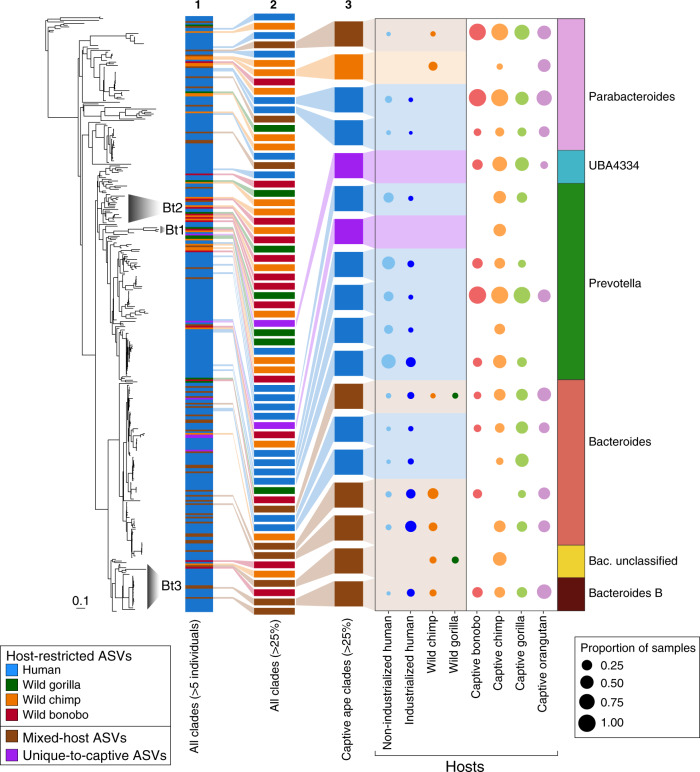
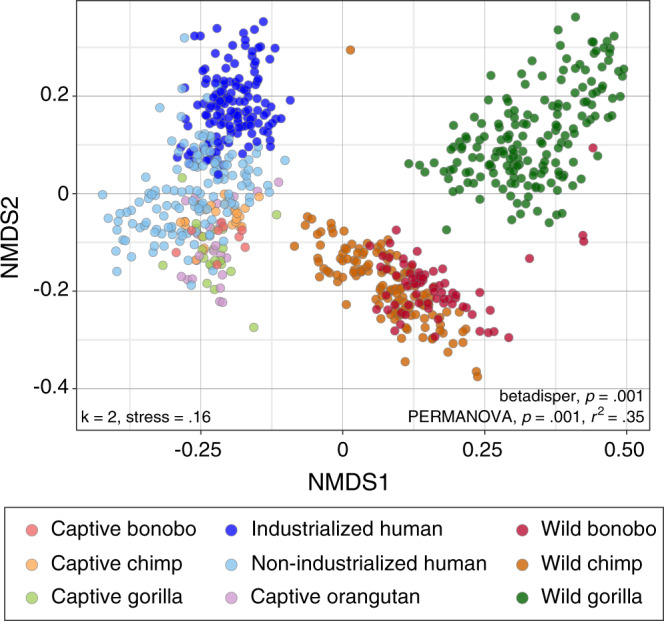
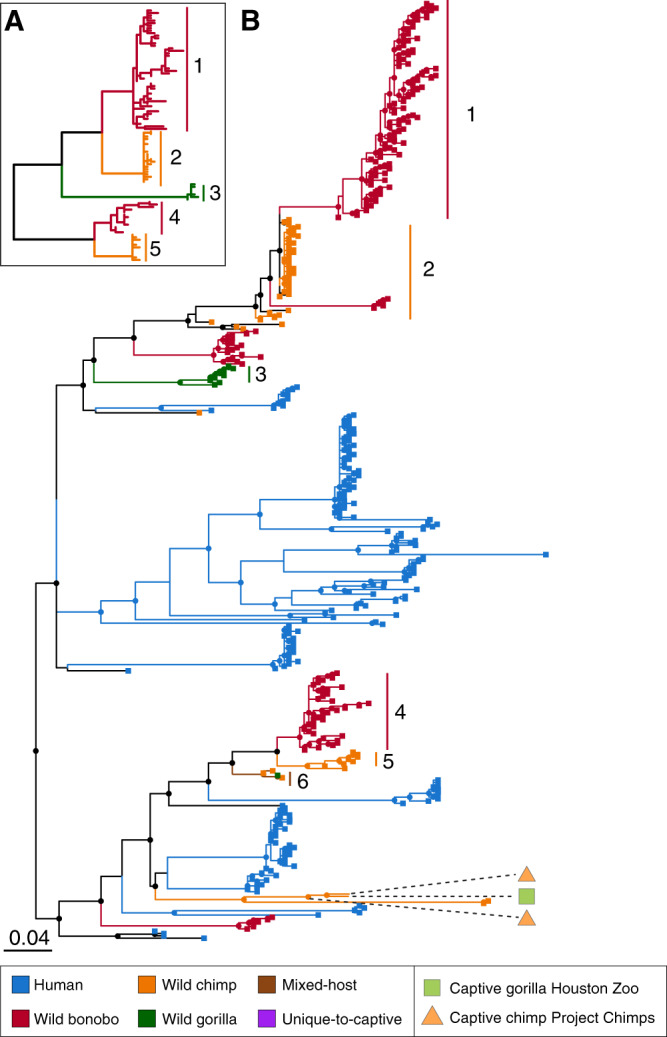
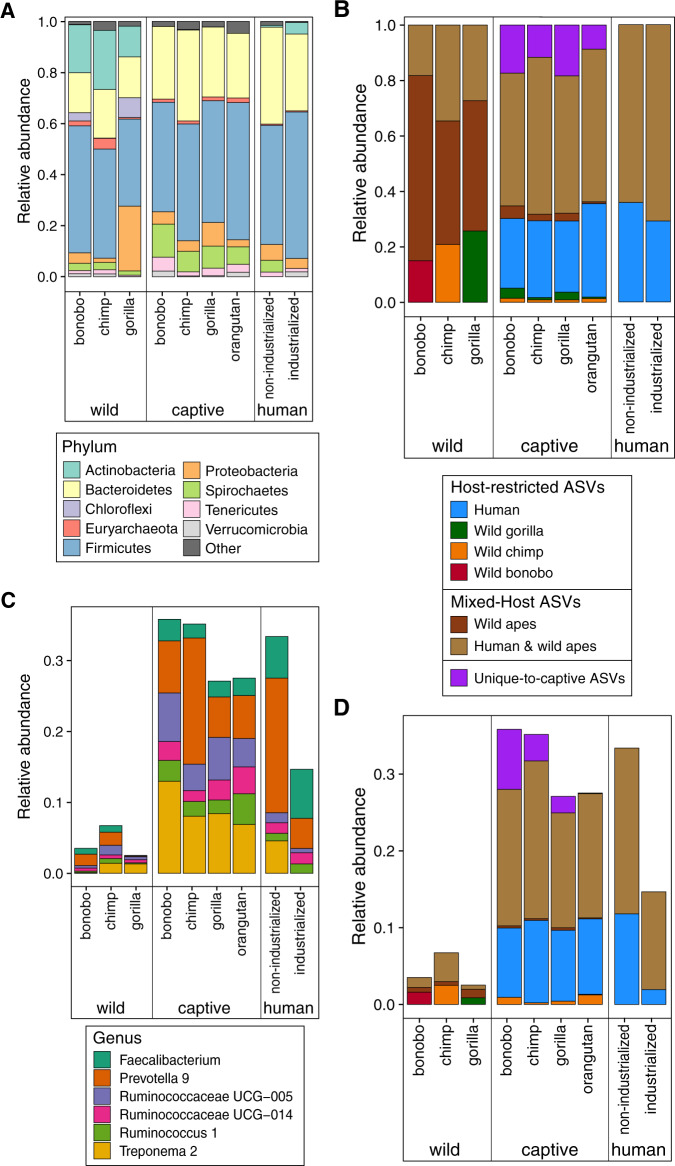
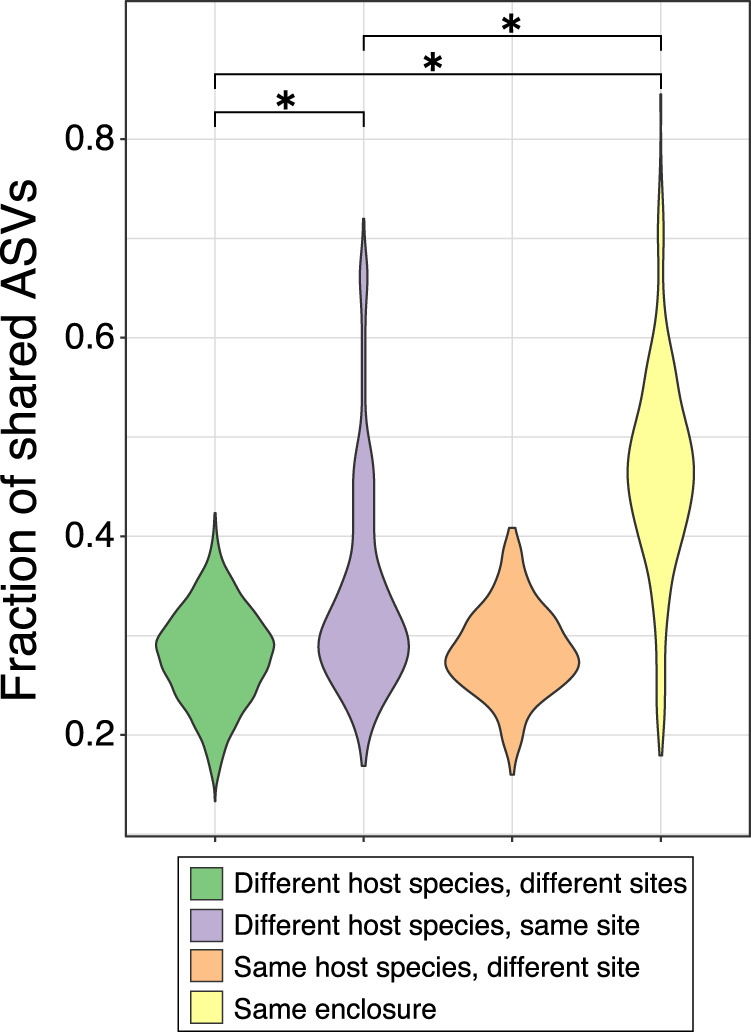
Wild great apes harbor clades of gut bacteria that are restricted to each host species. Previous research shows the evolutionary relationships among several host-restricted clades mirror those of great-ape species. However, processes such as geographic separation, host-shift speciation, and host-filtering based on diet or gut physiology can generate host-restricted bacterial clades and mimic patterns of co-diversification across host species. To gain insight into the distribution of host-restricted taxa, we examine captive great apes living under conditions where sharing of bacterial strains is readily possible. Here, we show that increased sampling of wild and captive apes identifies additional host-restricted lineages whose relationships are not concordant with the host phylogeny. Moreover, the gut microbiomes of captive apes converge through the displacement of strains that are restricted to their wild conspecifics by human-restricted strains. We demonstrate that host-restricted and co-diversifying bacterial strains in wild apes lack persistence and fidelity in captive environments.
野生大猿携带的肠道细菌菌群仅局限于各宿主物种。先前的研究表明,几种宿主限制性菌群的进化关系与大猿物种的进化关系相吻合。然而,地理隔离、宿主转移物种形成以及基于饮食或肠道生理学的宿主过滤等过程会产生宿主限制性细菌菌群,并模拟宿主物种之间的共同多样化模式。为了深入了解宿主限制性分类群的分布,我们检查了生活在易于共享细菌菌株条件下的圈养大猿。在这里,我们表明,增加对野生和圈养猿的采样可以识别出其他宿主限制性谱系,其关系与宿主系统发育不一致。此外,通过由人类限制性菌株取代仅局限于野生同种动物的菌株,圈养猿的肠道微生物组趋同。我们证明,野生大猿中的宿主限制性和共同多样化的细菌菌株在圈养环境中缺乏持久性和保真度。