University of Pennsylvania Perelman School of Medicine, Philadelphia, Pennsylvania, USA.
University of Florida College of Medicine, Gainesville, Florida, USA.
Clin Transl Sci. 2022 Feb;15(2):371-383. doi: 10.1111/cts.13154. Epub 2021 Sep 25.
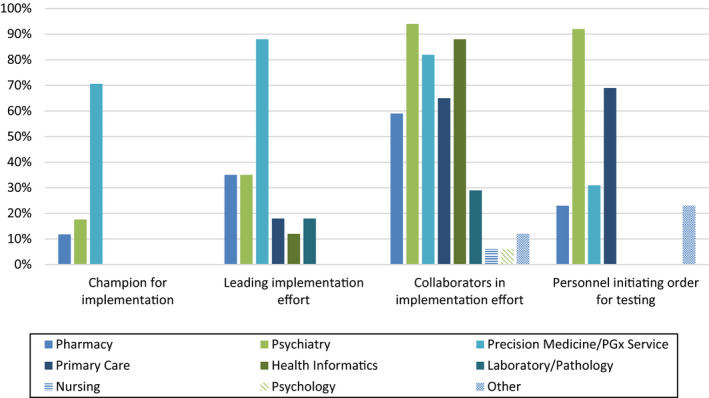
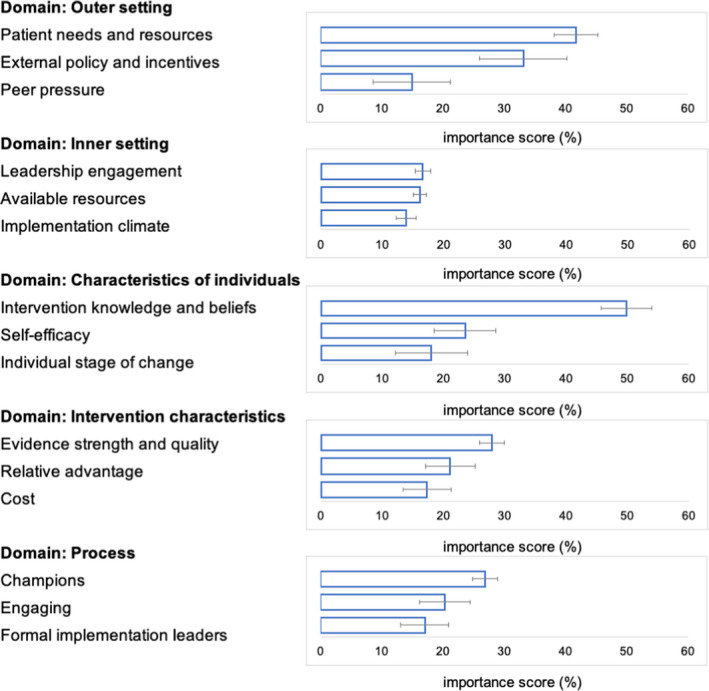
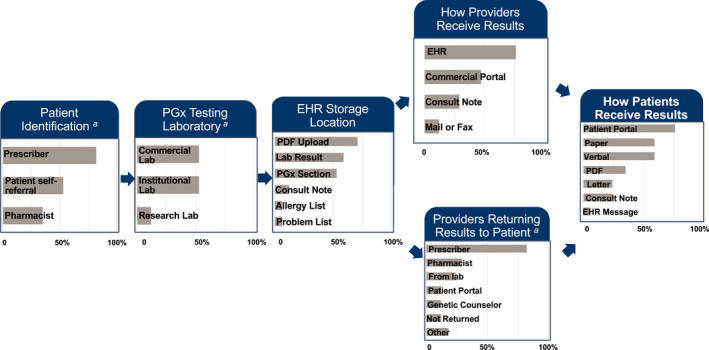
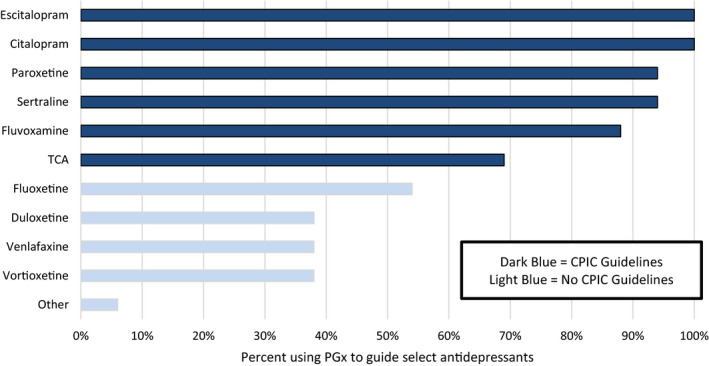
There is growing interest in utilizing pharmacogenetic (PGx) testing to guide antidepressant use, but there is lack of clarity on how to implement testing into clinical practice. We administered two surveys at 17 sites that had implemented or were in the process of implementing PGx testing for antidepressants. Survey 1 collected data on the process and logistics of testing. Survey 2 asked sites to rank the importance of Consolidated Framework for Implementation Research (CFIR) constructs using best-worst scaling choice experiments. Of the 17 sites, 13 had implemented testing and four were in the planning stage. Thirteen offered testing in the outpatient setting, and nine in both outpatient/inpatient settings. PGx tests were mainly ordered by psychiatry (92%) and primary care (69%) providers. CYP2C19 and CYP2D6 were the most commonly tested genes. The justification for antidepressants selected for PGx guidance was based on Clinical Pharmacogenetics Implementation Consortium guidelines (94%) and US Food and Drug Administration (FDA; 75.6%) guidance. Both institutional (53%) and commercial laboratories (53%) were used for testing. Sites varied on the methods for returning results to providers and patients. Sites were consistent in ranking CFIR constructs and identified patient needs/resources, leadership engagement, intervention knowledge/beliefs, evidence strength and quality, and the identification of champions as most important for implementation. Sites deployed similar implementation strategies and measured similar outcomes. The process of implementing PGx testing to guide antidepressant therapy varied across sites, but key drivers for successful implementation were similar and may help guide other institutions interested in providing PGx-guided pharmacotherapy for antidepressant management.
人们越来越关注利用药物遗传学(PGx)测试来指导抗抑郁药的使用,但对于如何将测试纳入临床实践,仍缺乏明确性。我们在已经实施或正在实施 PGx 测试来指导抗抑郁药使用的 17 个地点进行了两项调查。第一项调查收集了测试过程和后勤方面的数据。第二项调查要求各地点使用最佳最差分级选择实验,对实施研究综合框架(CFIR)结构的重要性进行排名。在这 17 个地点中,有 13 个已经实施了测试,还有 4 个处于规划阶段。13 个地点在门诊环境中提供测试,9 个在门诊/住院环境中提供测试。PGx 测试主要由精神病学(92%)和初级保健(69%)提供者开单。CYP2C19 和 CYP2D6 是最常测试的基因。选择进行 PGx 指导的抗抑郁药的理由主要基于临床药物遗传学实施联盟指南(94%)和美国食品和药物管理局(FDA;75.6%)的指南。机构实验室(53%)和商业实验室(53%)都用于测试。各地点在向提供者和患者反馈结果的方法上存在差异。各地点在 CFIR 结构的排名以及确定患者需求/资源、领导力参与、干预知识/信念、证据强度和质量以及确定拥护者的重要性方面保持一致,这些因素对于实施最为重要。各地点采用了类似的实施策略,并衡量了类似的结果。实施 PGx 测试来指导抗抑郁治疗的过程在各地点有所不同,但成功实施的关键驱动因素相似,这可能有助于指导其他有兴趣提供 PGx 指导的抗抑郁药治疗的机构。