• 文献检索
  • 文档翻译
  • 深度研究
  • 学术资讯
  • Suppr Zotero 插件Zotero 插件
  • 邀请有礼
  • 套餐&价格
  • 历史记录
应用&插件
Suppr Zotero 插件Zotero 插件浏览器插件Mac 客户端Windows 客户端微信小程序
定价
高级版会员购买积分包购买API积分包
服务
文献检索文档翻译深度研究API 文档MCP 服务
关于我们
关于 Suppr公司介绍联系我们用户协议隐私条款
关注我们

Suppr 超能文献

核心技术专利:CN118964589B侵权必究
粤ICP备2023148730 号-1Suppr @ 2026

文献检索

告别复杂PubMed语法,用中文像聊天一样搜索,搜遍4000万医学文献。AI智能推荐,让科研检索更轻松。

立即免费搜索

文件翻译

保留排版,准确专业,支持PDF/Word/PPT等文件格式,支持 12+语言互译。

免费翻译文档

深度研究

AI帮你快速写综述,25分钟生成高质量综述,智能提取关键信息,辅助科研写作。

立即免费体验

截短变异和基因组重排的复合杂合性导致一个意大利家族的常染色体隐性遗传性感音神经性听力损失。

Compound Heterozygosity for Truncating Variant and Genomic Rearrangement Cause Autosomal Recessive Sensorineural Hearing Loss in an Italian Family.

作者信息

Ortore Rocco Pio, Leone Maria Pia, Palumbo Orazio, Petracca Antonio, Trecca Eleonora M C, D'Ecclesia Aurelio, Vigliaroli Ciro Lucio, Micale Lucia, Longo Francesco, Melchionda Salvatore, Castori Marco

机构信息

Division of Maxillofacial Surgery and Otolaryngology, Fondazione IRCCS-Casa Sollievo della Sofferenza, San Giovanni Rotondo, 71013 Foggia, Italy.

Division of Medical Genetics, Fondazione IRCCS-Casa Sollievo della Sofferenza, San Giovanni Rotondo, 71013 Foggia, Italy.

出版信息

Audiol Res. 2021 Sep 9;11(3):443-451. doi: 10.3390/audiolres11030041.

DOI:10.3390/audiolres11030041
PMID:34562879
原文链接:https://pmc.ncbi.nlm.nih.gov/articles/PMC8482239/
Abstract

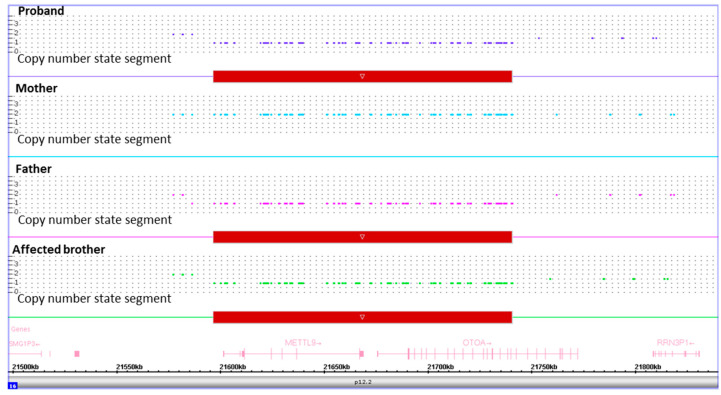
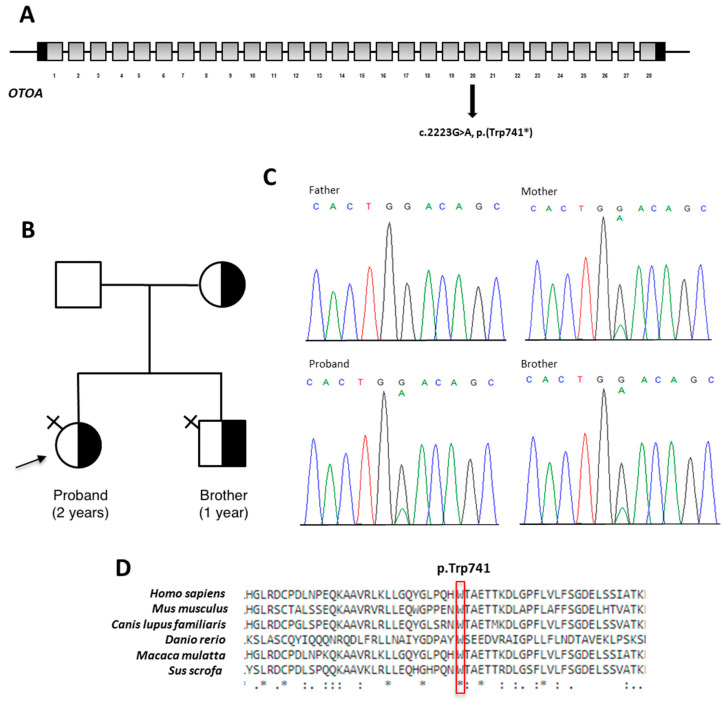
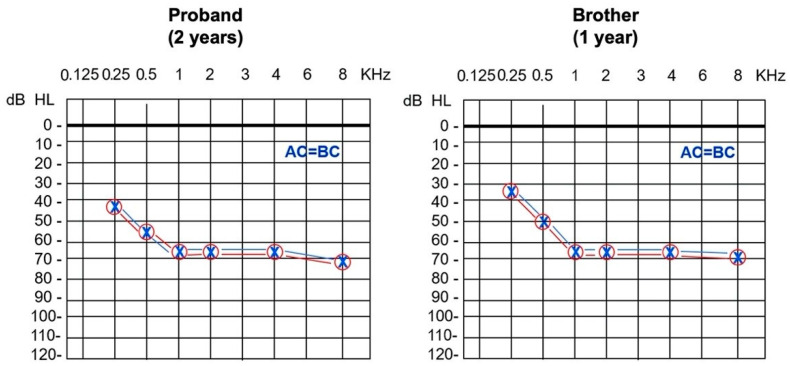
Hearing loss (HL) affects 1-3 newborns per 1000 and, in industrialized countries, recognizes a genetic etiology in more than 80% of the congenital cases. Excluding and , is one of the leading genes associated with autosomal recessive non-syndromic HL. Allelic heterogeneity linked to also includes genomic rearrangements facilitated by non-allelic homologous recombination with the neighboring pseudogene. We present a couple of Italian siblings affected by moderate to severe sensorineural hearing loss (SNHL) due to compound heterozygosity at the locus. Multigene panel next-generation sequencing identified the c.2223G>A, p.(Trp741*) variant transmitted from the unaffected mother. Assuming the existence of a second paternal deleterious variant which evaded detection at sequencing, genomic array analysis found a ~150 Kb microdeletion of paternal origin and spanning part of . Both deleterious alleles were identified for the first time. This study demonstrates the utility of an integrated approach to solve complex cases and allow appropriate management to affected individuals and at-risk relatives.

摘要

听力损失(HL)在每1000名新生儿中影响1至3名,在工业化国家,超过80%的先天性病例可归因于遗传病因。排除[具体基因1]和[具体基因2]后,[目标基因]是与常染色体隐性非综合征性HL相关的主要基因之一。与[目标基因]相关的等位基因异质性还包括由与相邻[假基因名称]的非等位基因同源重组促进的基因组重排。我们报告了一对意大利兄弟姐妹,他们因[目标基因]位点的复合杂合性而患有中度至重度感音神经性听力损失(SNHL)。多基因panel下一代测序确定了从未受影响的母亲遗传而来的c.2223G>A,p.(Trp741*)变异。假设存在第二个在测序时未被检测到的父系有害变异,基因组阵列分析发现了一个约150 Kb的父系来源微缺失,该微缺失跨越了[目标基因]的一部分。这两个有害等位基因均为首次鉴定。本研究证明了采用综合方法解决复杂病例并为受影响个体和高危亲属提供适当管理的实用性。
https://cdn.ncbi.nlm.nih.gov/pmc/blobs/89aa/8482239/9454ea0208fb/audiolres-11-00041-g003.jpg
https://cdn.ncbi.nlm.nih.gov/pmc/blobs/89aa/8482239/1fd161c20536/audiolres-11-00041-g001.jpg
https://cdn.ncbi.nlm.nih.gov/pmc/blobs/89aa/8482239/87d060b62ae8/audiolres-11-00041-g002.jpg
https://cdn.ncbi.nlm.nih.gov/pmc/blobs/89aa/8482239/9454ea0208fb/audiolres-11-00041-g003.jpg
https://cdn.ncbi.nlm.nih.gov/pmc/blobs/89aa/8482239/1fd161c20536/audiolres-11-00041-g001.jpg
https://cdn.ncbi.nlm.nih.gov/pmc/blobs/89aa/8482239/87d060b62ae8/audiolres-11-00041-g002.jpg
https://cdn.ncbi.nlm.nih.gov/pmc/blobs/89aa/8482239/9454ea0208fb/audiolres-11-00041-g003.jpg

相似文献

1
Compound Heterozygosity for Truncating Variant and Genomic Rearrangement Cause Autosomal Recessive Sensorineural Hearing Loss in an Italian Family.截短变异和基因组重排的复合杂合性导致一个意大利家族的常染色体隐性遗传性感音神经性听力损失。
Audiol Res. 2021 Sep 9;11(3):443-451. doi: 10.3390/audiolres11030041.
2
Molecular characterization of pathogenic OTOA gene conversions in hearing loss patients.听力损失患者中致病性 OTOA 基因转换的分子特征。
Hum Mutat. 2021 Apr;42(4):373-377. doi: 10.1002/humu.24167. Epub 2021 Mar 14.
3
The controversial p.Met34Thr variant in GJB2 gene: Two siblings, one genotype, two phenotypes.GJB2基因中存在争议的p.Met34Thr变异:两名同胞,一种基因型,两种表型。
Int J Pediatr Otorhinolaryngol. 2015 Aug;79(8):1316-9. doi: 10.1016/j.ijporl.2015.05.041. Epub 2015 Jun 9.
4
[Phenotype-genotype analysis of the autosomal recessive hereditary hearing loss caused by variations].[变异所致常染色体隐性遗传性听力损失的表型-基因型分析]
Zhonghua Er Bi Yan Hou Tou Jing Wai Ke Za Zhi. 2023 May 7;58(5):460-469. doi: 10.3760/cma.j.cn115330-20220620-00361.
5
'Distal 16p12.2 microdeletion' in a patient with autosomal recessive deafness-22.一名患有常染色体隐性遗传性耳聋22型患者的“16号染色体短臂12.2区远端微缺失”
J Genet. 2019 Jun;98(2).
6
Genomic study of nonsyndromic hearing loss in unaffected individuals: Frequency of pathogenic and likely pathogenic variants in a Brazilian cohort of 2,097 genomes.未受影响个体非综合征性听力损失的基因组研究:巴西2097个基因组队列中致病和可能致病变异的频率
Front Genet. 2022 Aug 30;13:921324. doi: 10.3389/fgene.2022.921324. eCollection 2022.
7
Mid-Frequency Hearing Loss Is Characteristic Clinical Feature of -Associated Hearing Loss.中频听力损失是 - 相关听力损失的特征性临床特征。
Genes (Basel). 2019 Sep 16;10(9):715. doi: 10.3390/genes10090715.
8
GJB3/GJB6 screening in GJB2 carriers with idiopathic hearing loss: Is it necessary?对伴有特发性听力损失的GJB2携带者进行GJB3/GJB6筛查:有必要吗?
J Clin Lab Anal. 2018 Nov;32(9):e22592. doi: 10.1002/jcla.22592. Epub 2018 Jun 21.
9
Alport syndrome. Molecular genetic aspects.奥尔波特综合征。分子遗传学方面。
Dan Med Bull. 2009 Aug;56(3):105-52.
10
A novel pathogenic variant in the MARVELD2 gene causes autosomal recessive non-syndromic hearing loss in an Iranian family.一个新的 MARVELD2 基因突变导致一个伊朗家系的常染色体隐性非综合征型耳聋。
Genomics. 2019 Jul;111(4):840-848. doi: 10.1016/j.ygeno.2018.05.008. Epub 2018 May 9.

引用本文的文献

1
A 250-kb Microdeletion Identified in Chromosome 16 Is Associated With Non-Syndromic Sensorineural Hearing Loss in a South Indian Consanguineous Family.在一个南印度近亲家庭中,16号染色体上发现的一个250 kb微缺失与非综合征性感音神经性听力损失相关。
J Audiol Otol. 2025 Jan;29(1):31-37. doi: 10.7874/jao.2024.00038. Epub 2025 Jan 20.

本文引用的文献

1
Molecular characterization of pathogenic OTOA gene conversions in hearing loss patients.听力损失患者中致病性 OTOA 基因转换的分子特征。
Hum Mutat. 2021 Apr;42(4):373-377. doi: 10.1002/humu.24167. Epub 2021 Mar 14.
2
A Private 16q24.2q24.3 Microduplication in a Boy with Intellectual Disability, Speech Delay and Mild Dysmorphic Features.一个患有智力障碍、言语延迟和轻度发育异常特征的男孩存在 16q24.2q24.3 微重复
Genes (Basel). 2020 Jun 26;11(6):707. doi: 10.3390/genes11060707.
3
Technical standards for the interpretation and reporting of constitutional copy-number variants: a joint consensus recommendation of the American College of Medical Genetics and Genomics (ACMG) and the Clinical Genome Resource (ClinGen).
《常染色体拷贝数变异解释和报告的技术标准:美国医学遗传学与基因组学学会(ACMG)与临床基因组资源(ClinGen)的联合共识推荐》
Genet Med. 2020 Feb;22(2):245-257. doi: 10.1038/s41436-019-0686-8. Epub 2019 Nov 6.
4
Expert specification of the ACMG/AMP variant interpretation guidelines for genetic hearing loss.遗传听力损失 ACMG/AMP 变异解读指南的专家规范
Hum Mutat. 2018 Nov;39(11):1593-1613. doi: 10.1002/humu.23630.
5
Standards and guidelines for the interpretation of sequence variants: a joint consensus recommendation of the American College of Medical Genetics and Genomics and the Association for Molecular Pathology.序列变异解读的标准与指南:美国医学遗传学与基因组学学会和分子病理学协会的联合共识推荐
Genet Med. 2015 May;17(5):405-24. doi: 10.1038/gim.2015.30. Epub 2015 Mar 5.
6
Genetic investigations in childhood deafness.儿童期耳聋的遗传学研究。
Arch Dis Child. 2015 Mar;100(3):271-8. doi: 10.1136/archdischild-2014-306099. Epub 2014 Oct 16.
7
The Database of Genomic Variants: a curated collection of structural variation in the human genome.基因组变异数据库:人类基因组中结构变异的精心整理集合。
Nucleic Acids Res. 2014 Jan;42(Database issue):D986-92. doi: 10.1093/nar/gkt958. Epub 2013 Oct 29.
8
Genetics: advances in genetic testing for deafness.遗传学:耳聋基因检测的进展。
Curr Opin Pediatr. 2012 Dec;24(6):679-86. doi: 10.1097/MOP.0b013e3283588f5e.
9
American College of Medical Genetics standards and guidelines for interpretation and reporting of postnatal constitutional copy number variants.美国医学遗传学学会关于产后先天性拷贝数变异的解读和报告的标准和指南。
Genet Med. 2011 Jul;13(7):680-5. doi: 10.1097/GIM.0b013e3182217a3a.
10
Copy number variation in human health, disease, and evolution.人类健康、疾病与进化中的拷贝数变异
Annu Rev Genomics Hum Genet. 2009;10:451-81. doi: 10.1146/annurev.genom.9.081307.164217.