Eli Lilly and Company, Lilly Corporate Center, Indianapolis, IN, 46285, USA.
Oregon Health & Science University, Portland, USA.
Cardiovasc Diabetol. 2021 Sep 25;20(1):194. doi: 10.1186/s12933-021-01386-4.
The REWIND trial demonstrated cardiovascular (CV) benefits to patients with type 2 diabetes and multiple CV risk factors or established CV disease. This exploratory analysis evaluated the degree to which the effect of dulaglutide on CV risk factors could statistically account for its effects on major adverse cardiovascular events (MACE) in the REWIND trial.
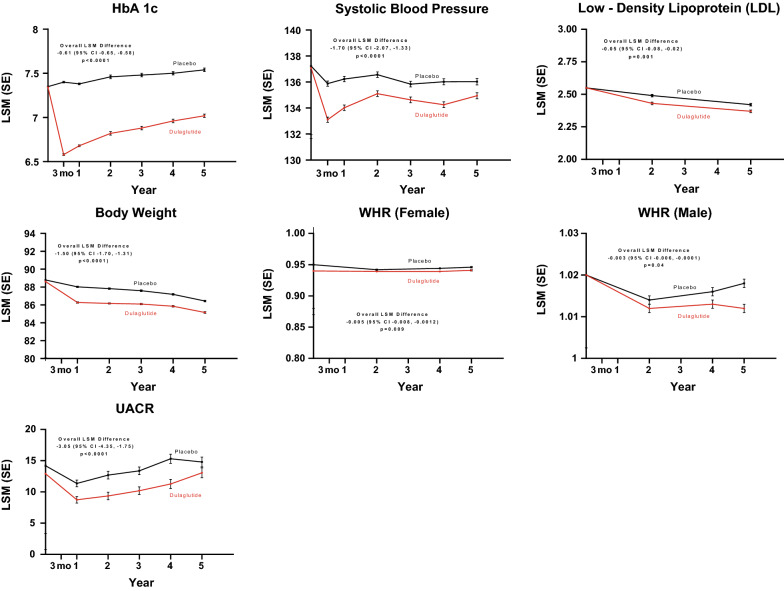
Potential mediators of established CV risk factors that were significantly reduced by dulaglutide were assessed in a post hoc analysis using repeated measures mixed models and included glycated hemoglobin (HbA1c), body weight, waist-to-hip ratio, systolic blood pressure, low-density lipoprotein (LDL), and urine albumin/creatinine ratio (UACR). These factors, for which the change in level during follow-up was significantly associated with incident MACE, were identified using Cox regression modeling. Each identified variable was then included as a covariate in the Cox model assessing the effect of dulaglutide on MACE to estimate the degree to which the hazard ratio of dulaglutide vs placebo was attenuated. The combined effect of the variables associated with attenuation was assessed by including all variables in an additional Cox model.
Although all evaluated variables were significantly improved by treatment, only changes in HbA1c and UACR were associated with MACE and a reduction in the effect of dulaglutide on this outcome was observed. The observed hazard ratio for MACE for dulaglutide vs placebo reduced by 36.1% by the updated mean HbA1c, and by 28.5% by the updated mean UACR. A similar pattern was observed for change from baseline in HbA1c and UACR and a reduction of 16.7% and 25.4%, respectively in the hazard ratio for MACE with dulaglutide vs placebo was observed. When HbA1c and UACR were both included, the observed hazard ratio reduced by 65.4% for the updated mean and 41.7% for the change from baseline with no HbA1c-UACR interaction (P interaction = 0.75 and 0.15, respectively).
Treatment-induced improvement in HbA1c and UACR, but not changes in weight, systolic blood pressure, or LDL cholesterol, appear to partly mediate the beneficial effects of dulaglutide on MACE outcomes. These observations suggest that the proven effects of dulaglutide on cardiovascular disease benefit are partially related to changes in glycemic control and albuminuria, with residual unexplained benefit. Clinicaltrials.gov; Trial registration number: NCT01394952. URL: https://clinicaltrials.gov/ct2/show/NCT01394952.
REWIND 试验表明,对于患有 2 型糖尿病和多种心血管危险因素或已患有心血管疾病的患者,心血管(CV)获益。本探索性分析评估了利拉鲁肽对 CV 危险因素的影响在多大程度上可以从统计学上解释其在 REWIND 试验中对主要不良心血管事件(MACE)的影响。
使用重复测量混合模型对利拉鲁肽显著降低的已建立的 CV 危险因素的潜在中介因子进行了事后分析,包括糖化血红蛋白(HbA1c)、体重、腰臀比、收缩压、低密度脂蛋白(LDL)和尿白蛋白/肌酐比值(UACR)。使用 Cox 回归模型确定了在随访期间水平变化与 MACE 事件显著相关的这些因素。然后,将每个确定的变量作为 Cox 模型中评估利拉鲁肽对 MACE 影响的协变量,以估计利拉鲁肽与安慰剂的风险比减弱的程度。通过在额外的 Cox 模型中包含所有变量来评估与衰减相关的变量的综合影响。
尽管所有评估的变量均经治疗显著改善,但仅 HbA1c 和 UACR 的变化与 MACE 相关,并且观察到利拉鲁肽对该结局的影响降低。与安慰剂相比,利拉鲁肽的 MACE 观察到的风险比降低了 36.1%,通过更新的平均 HbA1c,降低了 28.5%。对于基线时的 HbA1c 和 UACR 的变化以及利拉鲁肽与安慰剂相比 MACE 的风险比降低了 16.7%和 25.4%,观察到类似的模式。当同时包括 HbA1c 和 UACR 时,观察到更新的平均风险比降低了 65.4%,从基线开始降低了 41.7%,HbA1c-UACR 相互作用为 0.75 和 0.15(P 交互值分别为=0.75 和 0.15)。
治疗诱导的 HbA1c 和 UACR 改善,但体重、收缩压或 LDL 胆固醇的变化没有,似乎部分介导了利拉鲁肽对 MACE 结局的有益影响。这些观察结果表明,利拉鲁肽对心血管疾病的已证实的益处部分与血糖控制和白蛋白尿的变化有关,而未解释的益处仍存在。Clinicaltrials.gov;试验注册编号:NCT01394952。网址:https://clinicaltrials.gov/ct2/show/NCT01394952。