Cruz Nathan, Buscaglia Robert, Salanga Matthew, Kellar Robert
Department of Biological Sciences, Northern Arizona University, Flagstaff, AZ 86011, USA.
Department of Mathematics and Statistics, Northern Arizona University, Flagstaff, AZ 86011, USA.
Toxics. 2021 Sep 3;9(9):211. doi: 10.3390/toxics9090211.
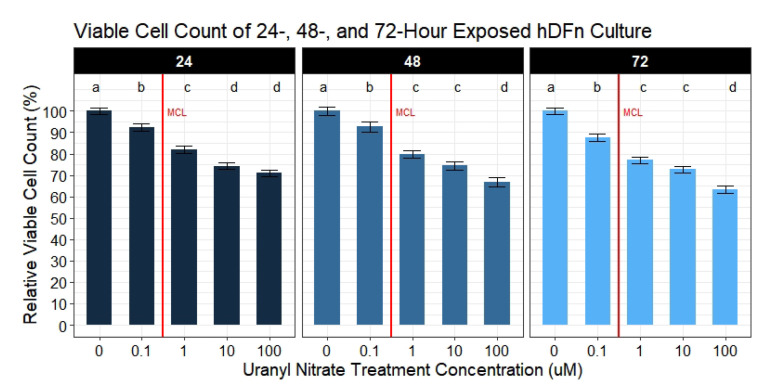
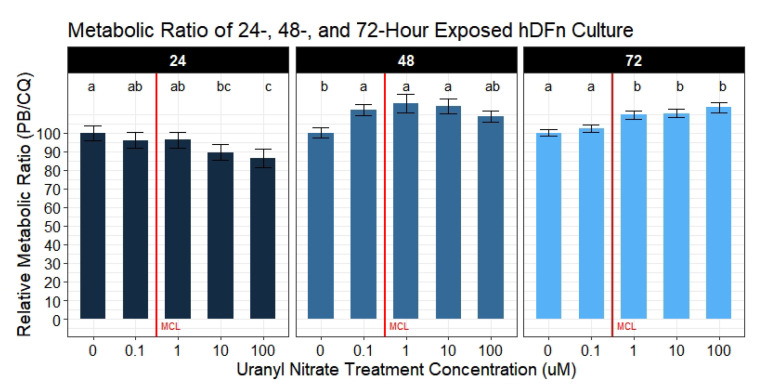
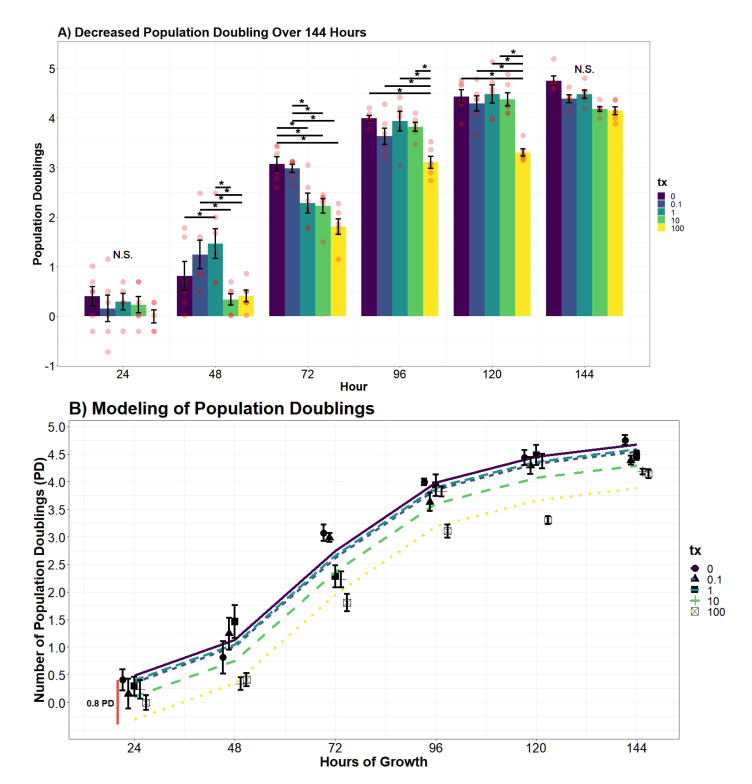
Uranium (U) is a heavy metal used in military and industrial settings, with a large portion being mined from the Southwest region of the United States. Uranium has uses in energy and military weaponry, but the mining process has released U into soil and surface waters that may pose threats to human and environmental health. The majority of literature regarding U's human health concern focuses on outcomes based on unintentional ingestion or inhalation, and limited data are available about its influence via cutaneous contact. Utilizing skin dermis cells, we evaluated U's topical chemotoxicity. Employing soluble depleted uranium (DU) in the form of uranyl nitrate (UN), we hypothesized that in vitro exposure of UN will have cytotoxic effects on primary dermal fibroblasts by affecting cell viability and metabolic activity and, further, may delay wound healing aspects via altering cell proliferation and migration. Using environmentally relevant levels of U found in water (0.1 μM to 100 μM [UN]; 23.8-23,800 ppb [U]), we quantified cellular mitosis and migration through growth curves and in vitro scratch assays. Cells were exposed from 24 h to 144 h for a time-course evaluation of UN chemical toxicity. The effects of UN were observed at concentrations above and below the Environmental Protection Agency threshold for safe exposure limits. UN exposure resulted in a dose-dependent decrease in the viable cell count; however, it produced an increase in metabolism when corrected for the viable cells present. Furthermore, cellular proliferation, population doubling, and percent closure was hindered at levels ≥10 μM UN. Therefore, inadvertent exposure may exacerbate pre-existing skin diseases in at-risk demographics, and additionally, it may substantially interfere in cutaneous tissue repair processes.
铀(U)是一种用于军事和工业领域的重金属,其中很大一部分是从美国西南部地区开采的。铀在能源和军事武器方面有应用,但采矿过程已将铀释放到土壤和地表水中,这可能对人类和环境健康构成威胁。大多数关于铀对人类健康影响的文献都集中在基于无意摄入或吸入的结果上,而关于其通过皮肤接触产生的影响的数据有限。我们利用皮肤真皮细胞评估了铀的局部化学毒性。使用硝酸铀酰(UN)形式的可溶性贫铀(DU),我们假设体外暴露于UN会通过影响细胞活力和代谢活性对原代表皮成纤维细胞产生细胞毒性作用,并且进一步可能通过改变细胞增殖和迁移来延迟伤口愈合。使用在水中发现的与环境相关水平的铀(0.1 μM至100 μM [UN];23.8 - 23,800 ppb [U]),我们通过生长曲线和体外划痕试验对细胞有丝分裂和迁移进行了定量。将细胞暴露24小时至144小时以对UN化学毒性进行时间进程评估。在高于和低于美国环境保护局安全暴露限值阈值的浓度下都观察到了UN的影响。UN暴露导致活细胞数量呈剂量依赖性减少;然而,在校正存在的活细胞后,它会使代谢增加。此外,在UN浓度≥10 μM时,细胞增殖、群体倍增和闭合百分比受到阻碍。因此,意外暴露可能会使高危人群中已有的皮肤疾病恶化,此外,它可能会严重干扰皮肤组织修复过程。