Department of Biology, Agricultural and Food Sciences, Institute for Sustainable Plant Protection, Research Unit of Bari, CNR, 70126, Bari, Italy.
Institute of Biology, Department of Plant Genetics, Martin Luther University, Halle-Wittenberg, 06120, Halle (Saale), Germany.
Virol J. 2021 Sep 26;18(1):194. doi: 10.1186/s12985-021-01664-3.
Plants in nature or crops in the field interact with a multitude of beneficial or parasitic organisms, including bacteria, fungi and viruses. Viruses are highly specialized to infect a limited range of host plants, leading in extreme cases to the full invasion of the host and a diseased phenotype. Resistance to viruses can be mediated by various passive or active mechanisms, including the RNA-silencing machinery and the innate immune system.
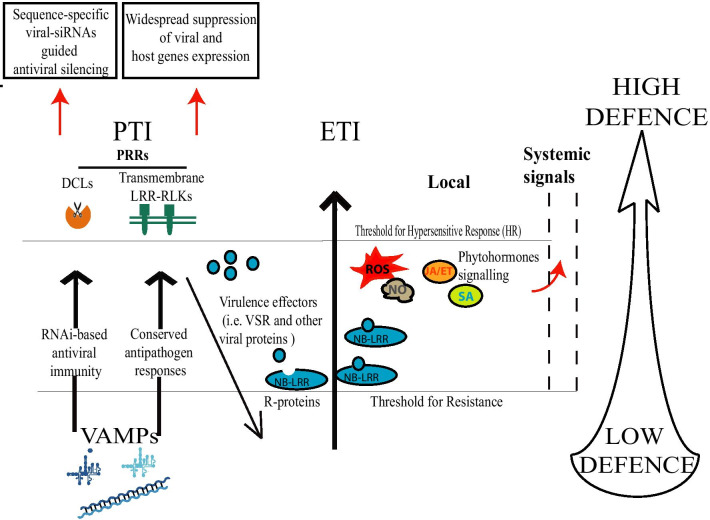
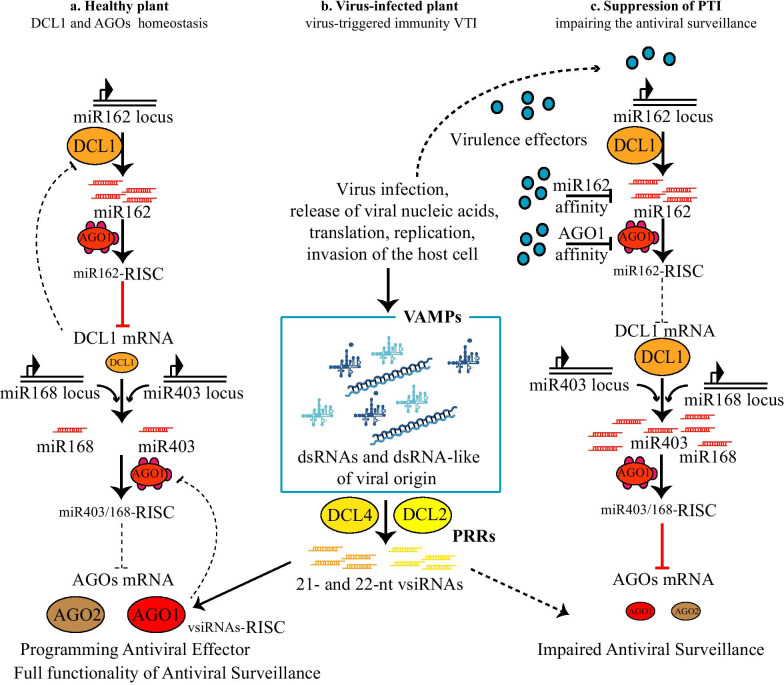
RNA-silencing mechanisms may inhibit viral replication, while viral components can elicit the innate immune system. Viruses that successfully enter the plant cell can elicit pattern-triggered immunity (PTI), albeit by yet unknown mechanisms. As a counter defense, viruses suppress PTI. Furthermore, viral Avirulence proteins (Avr) may be detected by intracellular immune receptors (Resistance proteins) to elicit effector-triggered immunity (ETI). ETI often culminates in a localized programmed cell death reaction, the hypersensitive response (HR), and is accompanied by a potent systemic defense response. In a dichotomous view, RNA silencing and innate immunity are seen as two separate mechanisms of resistance. Here, we review the intricate connections and similarities between these two regulatory systems, which are collectively required to ensure plant fitness and resilience.
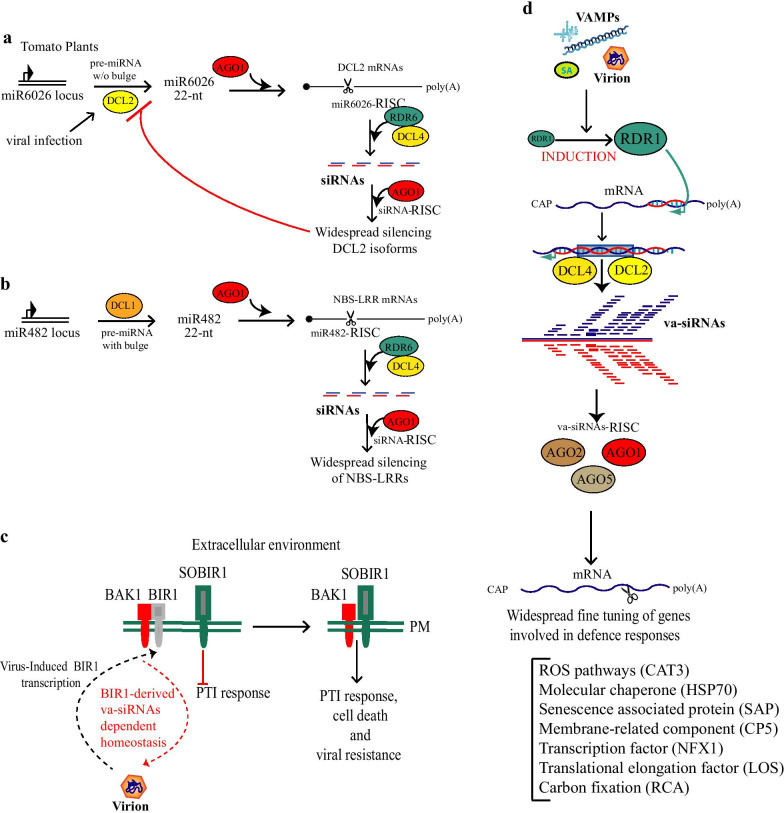
The detailed understanding of immune regulation at the transcriptional level provides novel opportunities for enhancing plant resistance to viruses by RNA-based technologies. However, extensive use of RNA technologies requires a thorough understanding of the molecular mechanisms of RNA gene regulation. We describe the main examples of host RNA-mediated regulation of virus resistance.
自然界中的植物或田间的作物与大量有益或寄生生物相互作用,包括细菌、真菌和病毒。病毒高度特化以感染有限范围的宿主植物,在极端情况下导致宿主完全入侵和患病表型。病毒的抗性可以通过各种被动或主动机制介导,包括 RNA 沉默机制和先天免疫系统。
RNA 沉默机制可能抑制病毒复制,而病毒成分可以引发先天免疫系统。成功进入植物细胞的病毒可以引发模式触发免疫(PTI),尽管其机制尚不清楚。作为一种反击,病毒会抑制 PTI。此外,病毒的非致病蛋白(Avr)可能被细胞内免疫受体(抗性蛋白)检测到,从而引发效应物触发的免疫(ETI)。ETI 通常导致局部程序性细胞死亡反应,即过敏反应(HR),并伴随着强烈的全身防御反应。从二分法的角度来看,RNA 沉默和先天免疫被视为两种独立的抗性机制。在这里,我们回顾了这两个调节系统之间复杂的联系和相似性,它们共同需要确保植物的适应性和弹性。
在转录水平上对免疫调节的详细了解为通过基于 RNA 的技术增强植物对病毒的抗性提供了新的机会。然而,广泛使用 RNA 技术需要对 RNA 基因调节的分子机制有透彻的了解。我们描述了宿主 RNA 介导的抗病毒抗性调节的主要例子。