Institute of Genome Research, Vietnam Academy of Science and Technology, Hanoi, Vietnam.
Graduate University of Science and Technology, Vietnam Academy of Science and Technology, Hanoi, Vietnam.
Mol Vis. 2021 Sep 2;27:555-563. eCollection 2021.
Congenital iris abnormality is a feature of several genetic conditions, such as aniridia syndrome and anterior segment degeneration (ASD) disorders. Aniridia syndrome is caused by mutations in the gene or its regulatory elements in the locus 11p13 or deletions of contiguous genes, while ASDs are the result of mutations in various genes, such as , , , and . This study aims to identify pathogenic mutations in Vietnamese individuals with congenital anomalies of the iris.
Genomic DNA was extracted from peripheral blood of 24 patients belonging to 15 unrelated families and their available family members. Multiplex ligation-dependent probe amplification (MLPA) was used to detect the deletions or duplications in the 11p13-14 region, including the gene and its neighboring genes. Direct PCR sequencing was used to screen mutations in 13 exons and flanking sequences of the gene. The patients without mutation in the locus were further analyzed with whole exome sequencing (WES). Identified mutations were tested with segregation analysis in proband family members.
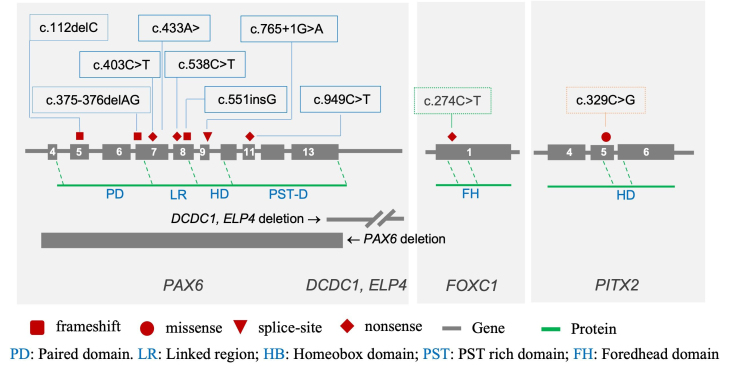
We identified a total of 8 novel and 4 recurrent mutations in 20 of 24 affected individuals from 12 families. Among these mutations, one large deletion of the whole gene and another deletion of the downstream region containing the and genes were identified. Eight mutations were detected in , including four nonsense, three frameshift, and one splice site. In addition, two point mutations were identified in the and genes in patients without mutation in . Some of the mutations segregated in an autosomal dominant pattern where family members were available.
This study provides new data on causative mutations in individuals with abnormal development of iris tissue in Vietnam. These results contribute to clinical management and genetic counseling for affected people and their families.
先天性虹膜异常是几种遗传疾病的特征,如无虹膜综合征和前段退行性变(ASD)疾病。无虹膜综合征是由 11p13 基因或其调控元件中的基因突变或相邻基因的连续缺失引起的,而 ASD 是各种基因突变的结果,如 、 、 、 等。本研究旨在鉴定越南先天性虹膜异常患者的致病突变。
从 15 个无关家庭的 24 名患者及其可利用的家族成员中提取外周血基因组 DNA。采用多重连接依赖性探针扩增(MLPA)检测 11p13-14 区域的缺失或重复,包括 基因及其相邻基因。直接 PCR 测序用于筛选 13 个外显子和 基因侧翼序列的突变。在 基因没有突变的患者中进一步进行全外显子组测序(WES)分析。在先证者的家族成员中,通过分离分析对鉴定出的突变进行了测试。
我们在 12 个家庭的 24 名受影响个体中的 20 名中总共发现了 8 个新突变和 4 个重复突变。在这些突变中,鉴定到一个 基因的全缺失和另一个包含 和 基因的下游缺失。在 基因中检测到 8 个突变,包括 4 个无义突变、3 个移码突变和 1 个剪接位点突变。此外,在 基因中还鉴定到 2 个点突变,而在 基因没有突变的患者中。一些突变呈常染色体显性遗传模式,有家族成员可供分析。
本研究为越南患有虹膜组织发育异常的个体提供了新的致病突变数据。这些结果有助于对受影响个体及其家属进行临床管理和遗传咨询。