Galbiati Andrea, Sforza Marco, Scarpellino Alessandro, Salibba Andrea, Leitner Caterina, D'Este Giada, Mombelli Samantha, Ferini-Strambi Luigi, Castronovo Vincenza
Vita-Salute San Raffaele University, Milan, Italy.
Department of Clinical Neurosciences, Neurology - Sleep Disorders Center, IRCCS San Raffaele Scientific Institute, Milan, Italy.
Front Psychol. 2021 Sep 9;12:705112. doi: 10.3389/fpsyg.2021.705112. eCollection 2021.
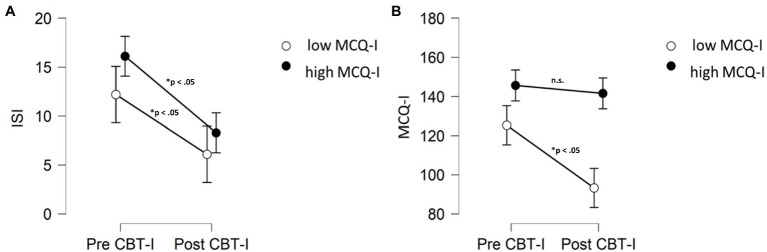
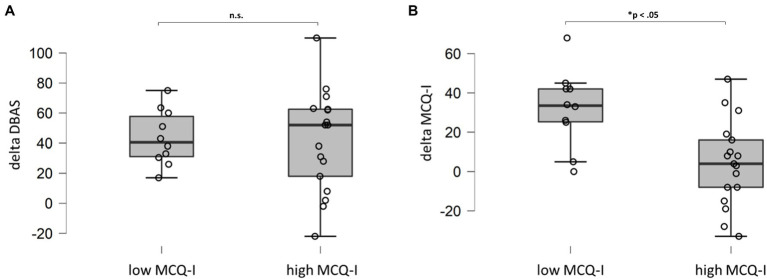
Metacognition is defined as the ability to reflect on one's mental state and to govern thoughts and beliefs. Metacognitive dysfunctions are typical of several psychopathologic conditions, and also a feature of insomnia disorder, possibly playing a crucial role in its genesis and maintenance. In the context of insomnia, metacognition describes how individuals react to their own sleep-related thoughts and beliefs, boosting the hyperarousal state experienced by these patients. Up to now, no studies evaluated the effect of cognitive behavioral therapy for insomnia (CBT-I) on metacognitive functioning. Therefore, the aim of our study was to evaluate the effect of CBT-I administered in group format in patients with insomnia disorder. As expected, all patients showed significant improvements in both insomnia and sleep diary parameters after treatment. Furthermore, an improvement was observed also in dysfunctional metacognitive levels, assessed by means of the Metacognitions Questionnaire-Insomnia (MCQ-I). However, 63% of patients still showed a MCQ-I score above the clinical cutoff after treatment. Dividing the sample on the basis of MCQ-I questionnaire scores after CBT-I, we found that patients, who still presented metacognitive impairment, received significant beneficial effects from CBT-I both on insomnia symptoms and on dysfunctional beliefs, but not on dysfunctional metacognitive functioning. These findings suggest that metacognition should be carefully evaluated in insomnia patients and further studies are needed to evaluate long-term implications of this remaining dysfunction.
元认知被定义为反思自己心理状态以及管理思想和信念的能力。元认知功能障碍是几种精神病理状况的典型特征,也是失眠症的一个特点,可能在其发生和维持过程中起关键作用。在失眠的背景下,元认知描述了个体如何对自己与睡眠相关的思想和信念做出反应,加剧了这些患者所经历的过度觉醒状态。到目前为止,尚无研究评估失眠认知行为疗法(CBT-I)对元认知功能的影响。因此,我们研究的目的是评估以团体形式实施的CBT-I对失眠症患者的影响。正如预期的那样,所有患者在治疗后失眠和睡眠日记参数方面均有显著改善。此外,通过失眠元认知问卷(MCQ-I)评估发现,功能失调的元认知水平也有所改善。然而,63%的患者在治疗后MCQ-I评分仍高于临床临界值。根据CBT-I后MCQ-I问卷评分对样本进行划分,我们发现仍存在元认知损害的患者从CBT-I中在失眠症状和功能失调信念方面均获得了显著益处,但在功能失调的元认知功能方面未获益处。这些发现表明,应对失眠患者的元认知进行仔细评估,并且需要进一步研究来评估这种残留功能障碍的长期影响。