Aranda-Rickert Adriana, Torréns Javier, Yela Natalia I, Brizuela María Magdalena, Di Stilio Verónica S
Centro Regional de Investigaciones Científicas y Transferencia Tecnológica de La Rioja (CRILAR-CONICET), Anillaco, Argentina.
Universidad Nacional de La Rioja, La Rioja, Argentina.
Front Plant Sci. 2021 Sep 8;12:722405. doi: 10.3389/fpls.2021.722405. eCollection 2021.
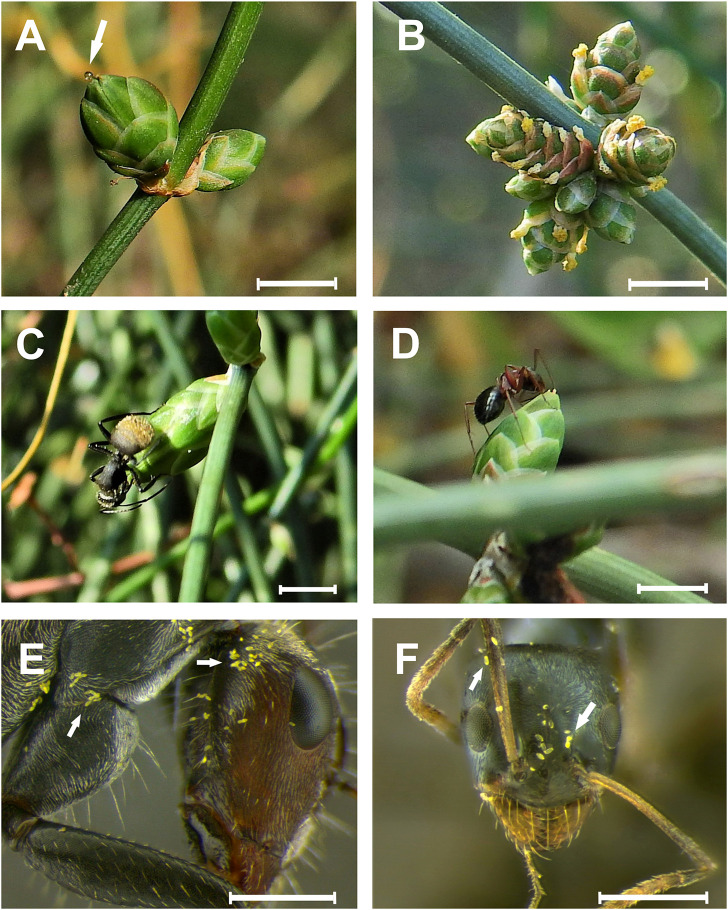
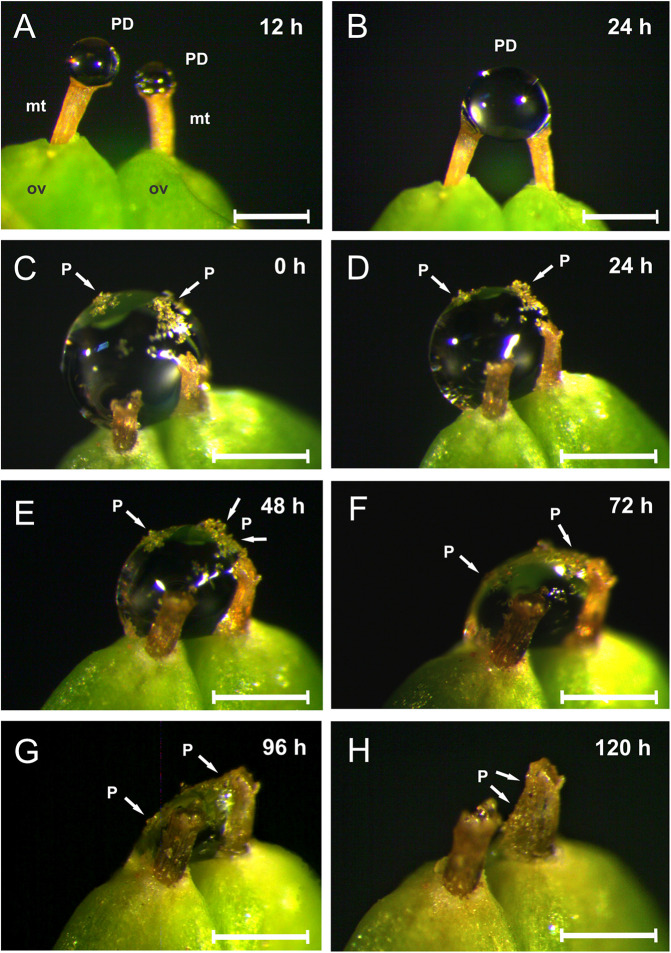
Dioecious plants are obligate outcrossers with separate male and female individuals, which can result in decreased seed set with increasing distance between the sexes. Wind pollination is a common correlate of dioecy, yet combined wind and insect pollination (ambophily) could be advantageous in compensating for decreased pollen flow to isolated females. Dioecious, ambophilous gymnosperms (Gnetales) secrete pollination drops (PDs) in female cones that capture airborne pollen and attract ants that feed on them. Plant sugary secretions commonly reward ants in exchange for indirect plant defense against herbivores, and more rarely for pollination. We conducted field experiments to investigate whether ants are pollinators and/or plant defenders of South American , and whether their contribution to seed set and seed cone protection varies with distance between female and male plants. We quantified pollen flow in the wind and assessed the effectiveness of ants as pollinators by investigating their relative contribution to seed set, and their visitation rate in female plants at increasing distance from the nearest male. Ants accounted for most insect visits to female cones of , where they consumed PDs, and pollen load was larger on bigger ants without reduction in pollen viability. While wind pollination was the main contributor to seed set overall, the relative contribution of ants was distance dependent. Ant contribution to seed set was not significant at shorter distances, yet at the farthest distance from the nearest male (23 m), where 20 times less pollen reached females, ants enhanced seed set by 30% compared to plants depending solely on wind pollination. We found no evidence that ants contribute to plant defense by preventing seed cone damage. Our results suggest that, despite their short-range movements, ants can offset pollen limitation in isolated females of wind-pollinated plants with separate sexes. We propose that ants enhance plant reproductive success via targeted delivery of airborne pollen, through frequent contact with ovule tips while consuming PDs. Our study constitutes the first experimental quantification of distance-dependent contribution of ants to pollination and provides a working hypothesis for ambophily in other dioecious plants lacking pollinator reward in male plants.
雌雄异株植物是专性异交植物,具有单独的雄性和雌性个体,这可能导致随着性别间距离的增加种子结实率降低。风媒传粉是雌雄异株的常见关联特征,然而风媒和虫媒结合传粉(兼性传粉)在补偿向孤立雌株的花粉传播减少方面可能具有优势。雌雄异株、兼性传粉的裸子植物(买麻藤目)在雌球果中分泌传粉滴,传粉滴能捕获空气中的花粉并吸引以花粉为食的蚂蚁。植物的含糖分泌物通常作为对蚂蚁的回报,以换取蚂蚁对植物的间接防御,抵御食草动物,而作为传粉回报则较为少见。我们进行了田间实验,以研究蚂蚁是否是南美[植物名称未给出]的传粉者和/或植物防御者,以及它们对种子结实和球果保护的贡献是否随雌雄植株间距离的变化而变化。我们量化了风中的花粉传播,并通过研究蚂蚁对种子结实的相对贡献以及它们在离最近雄株距离增加时对雌株的访花率,来评估蚂蚁作为传粉者的有效性。蚂蚁占了对[植物名称未给出]雌球果昆虫访花的大部分,它们在那里取食传粉滴,较大蚂蚁携带的花粉量更大,且花粉活力没有降低。虽然总体上风媒传粉是种子结实的主要贡献者,但蚂蚁的相对贡献取决于距离。在较短距离时,蚂蚁对种子结实的贡献不显著,但在离最近雄株最远的距离(23米)处,到达雌株的花粉量减少了20倍,与仅依靠风媒传粉的植株相比,蚂蚁使种子结实率提高了30%。我们没有发现证据表明蚂蚁通过防止球果受损来对植物防御做出贡献。我们的结果表明,尽管蚂蚁活动范围短,但它们可以抵消风媒传粉、雌雄异株植物中孤立雌株的花粉限制。我们提出,蚂蚁通过在取食传粉滴时频繁接触胚珠顶端,将空气中的花粉有针对性地传递,从而提高植物的繁殖成功率。我们的研究首次对蚂蚁传粉的距离依赖性贡献进行了实验量化,并为其他雄株缺乏传粉者回报的雌雄异株植物的兼性传粉提供了一个可行的假设。