IEEE Trans Biomed Eng. 2022 Apr;69(4):1359-1368. doi: 10.1109/TBME.2021.3115553. Epub 2022 Mar 18.
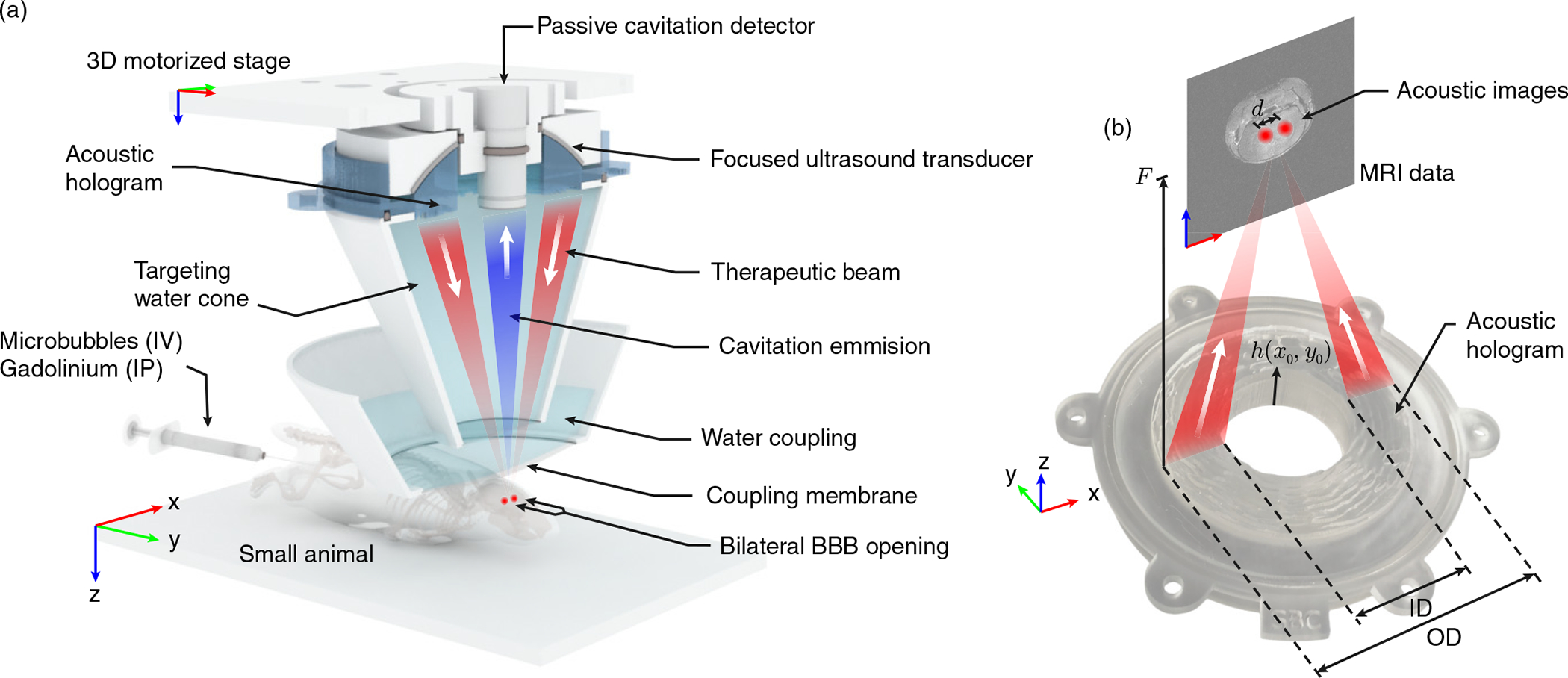
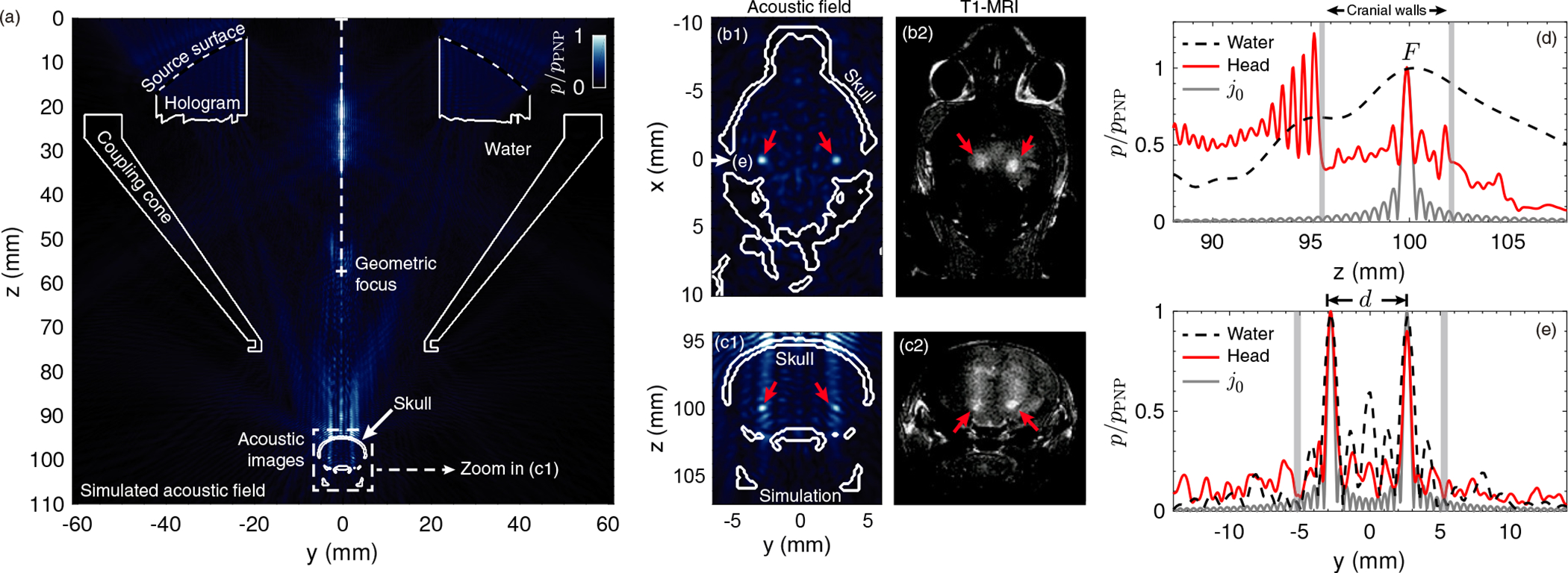
Transcranial focused ultrasound (FUS) in conjunction with circulating microbubbles injection is the sole non-invasive technique that temporally and locally opens the blood-brain barrier (BBB), allowing targeted drug delivery into the central nervous system (CNS). However, single-element FUS technologies do not allow the simultaneous targeting of several brain structures with high-resolution, and multi-element devices are required to compensate the aberrations introduced by the skull. In this work, we present the first preclinical application of acoustic holograms to perform a bilateral BBB opening in two mirrored regions in mice. The system consisted of a single-element focused transducer working at 1.68 MHz, coupled to a 3D-printed acoustic hologram designed to produce two symmetric foci in anesthetized mice in vivo and, simultaneously, compensate the aberrations of the wavefront caused by the skull bones. T1-weighed MR images showed gadolinium extravasation at two symmetric quasi-spherical focal spots. By encoding time-reversed fields, holograms are capable of focusing acoustic energy with a resolution near the diffraction limit at multiple spots inside the skull of small preclinical animals. This work demonstrates the feasibility of hologram-assisted BBB opening for low-cost and highly-localized targeted drug delivery in the CNS in symmetric regions of separate hemispheres.
经颅聚焦超声(FUS)联合循环微泡注射是唯一一种非侵入性技术,可以暂时和局部打开血脑屏障(BBB),允许靶向药物递送到中枢神经系统(CNS)。然而,单元素 FUS 技术无法实现对几个大脑结构的高分辨率同时靶向,需要多元素设备来补偿颅骨引入的像差。在这项工作中,我们首次将声全息术应用于在小鼠的两个镜像区域进行双侧 BBB 开放。该系统由一个工作在 1.68MHz 的单元素聚焦换能器组成,与 3D 打印的声全息图耦合,旨在在体内麻醉小鼠中产生两个对称焦点,并同时补偿颅骨波前引起的像差。T1 加权磁共振图像显示在两个对称的拟球焦点处钆外渗。通过编码时间反转场,全息图能够在小临床前动物颅骨内的多个点上以接近衍射极限的分辨率聚焦声能。这项工作证明了声全息辅助 BBB 开放在低成本和高度本地化靶向 CNS 药物输送中的可行性,适用于分开的半球的对称区域。