Faculty of Science, Department of Biology, Golestan University, Gorgan, Iran.
PLoS One. 2021 Sep 27;16(9):e0257916. doi: 10.1371/journal.pone.0257916. eCollection 2021.
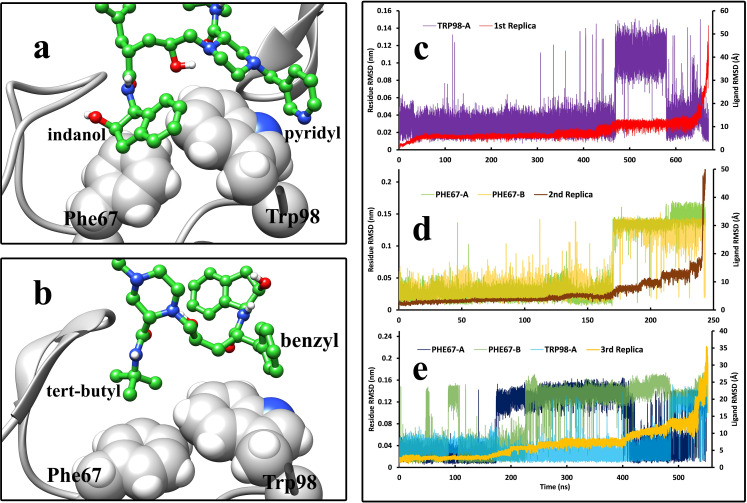
Determining the unbinding pathways of potential small molecule compounds from their target proteins is of great significance for designing efficacious treatment solutions. One of these potential compounds is the approved HIV-1 protease inhibitor, Indinavir, which has a weak effect on the HTLV-1 protease. In this work, by employing the SuMD method, we reconstructed the unbinding pathways of Indinavir from HIV and HTLV-1 proteases to compare and understand the mechanism of the unbinding and to discover the reasons for the lack of inhibitory activity of Indinavir against the HTLV-1 protease. We achieved multiple unbinding events from both HIV and HTLV-1 proteases in which the RMSD values of Indinavir reached over 40 Å. Also, we found that the mobility and fluctuations of the flap region are higher in the HTLV-1 protease, making the drug less stable. We realized that critically positioned aromatic residues such as Trp98/Trp98' and Phe67/Phe67' in the HTLV-1 protease could make strong π-Stacking interactions with Indinavir in the unbinding pathway, which are unfavorable for the stability of Indinavir in the active site. The details found in this study can make a reasonable explanation for the lack of inhibitory activity of this drug against HTLV-1 protease. We believe the details discovered in this work can help design more effective and selective inhibitors for the HTLV-1 protease.
确定潜在小分子化合物与其靶蛋白的解结合途径对于设计有效的治疗方案具有重要意义。其中一种潜在的化合物是已批准的 HIV-1 蛋白酶抑制剂,茚地那韦,它对 HTLV-1 蛋白酶的作用较弱。在这项工作中,我们通过 SuMD 方法,重建了 Indinavir 从 HIV 和 HTLV-1 蛋白酶中的解结合途径,以比较和理解解结合的机制,并发现 Indinavir 缺乏对 HTLV-1 蛋白酶抑制活性的原因。我们从 HIV 和 HTLV-1 蛋白酶中实现了多次解结合事件,其中 Indinavir 的 RMSD 值超过 40 Å。此外,我们发现 flap 区域的流动性和波动在 HTLV-1 蛋白酶中更高,使药物不太稳定。我们意识到,在 HTLV-1 蛋白酶中,关键性定位的芳香族残基(如 Trp98/Trp98' 和 Phe67/Phe67')可以在解结合途径中与 Indinavir 形成强 π-堆积相互作用,这不利于 Indinavir 在活性位点中的稳定性。本研究中发现的细节可以对该药物缺乏对 HTLV-1 蛋白酶的抑制活性做出合理的解释。我们相信,这项工作中发现的细节可以帮助设计更有效和选择性的 HTLV-1 蛋白酶抑制剂。