University of Colorado Anschutz Medical Campus, Aurora, CO.
Washington University School of Medicine, St. Louis, MO.
J Pediatr. 2022 Feb;241:147-153.e1. doi: 10.1016/j.jpeds.2021.09.032. Epub 2021 Sep 24.
To assess the odds of a psychiatric or neurodevelopmental diagnosis among youth with a diagnosis of gender dysphoria compared with matched controls in a large electronic health record dataset from 6 pediatric health systems, PEDSnet. We hypothesized that youth with gender dysphoria would have higher odds of having psychiatric and neurodevelopmental diagnoses than controls.
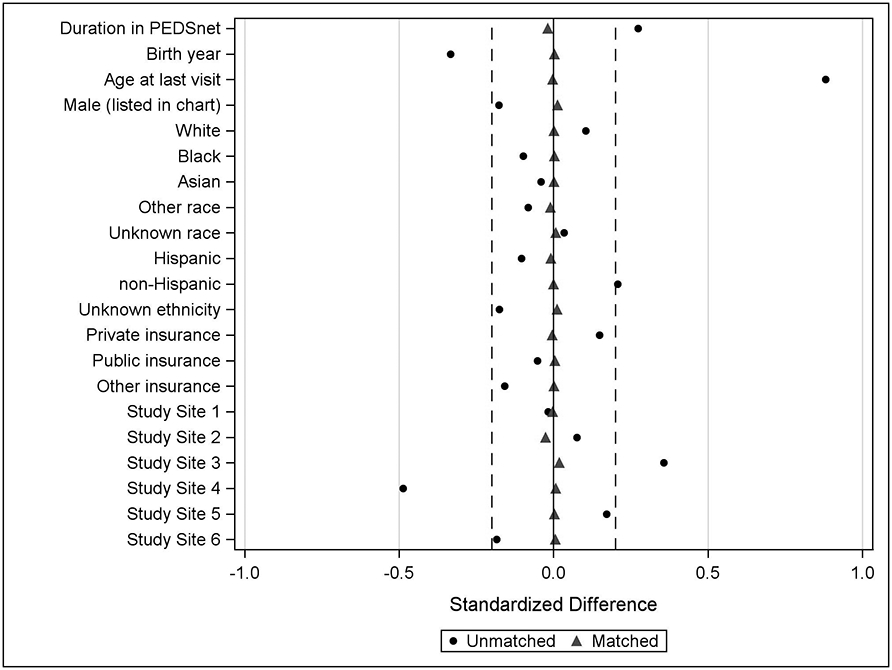
All youth with a diagnosis of gender dysphoria (n = 4173 age at last visit 16.2 ± 3.4) and at least 1 outpatient encounter were extracted from the PEDSnet database and propensity-score matched on 8 variables to controls without gender dysphoria (n = 16 648, age at last visit 16.2 ± 4.8) using multivariable logistic regression. The odds of having psychiatric and neurodevelopmental diagnoses were examined using generalized estimating equations.
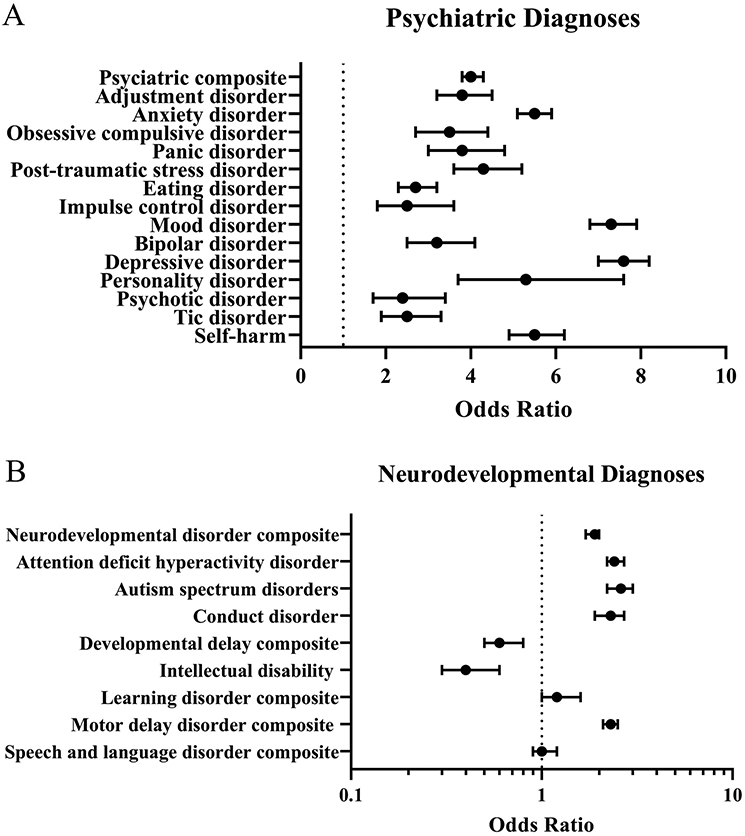
Youth with gender dysphoria had higher odds of psychiatric (OR 4.0 [95% CI 3.8, 4.3] P < .0001) and neurodevelopmental diagnoses (1.9 [1.7, 2.0], P < .0001). Youth with gender dysphoria were more likely to have a diagnosis across all psychiatric disorder subcategories, with particularly high odds of mood disorder (7.3 [6.8, 7.9], P < .0001) and anxiety (5.5 [5.1, 5.9], P < .0001). Youth with gender dysphoria had a greater odds of autism spectrum disorder (2.6, [2.2, 3.0], P < .0001).
Youth with gender dysphoria at large pediatric health systems have greater odds of psychiatric and several neurodevelopmental diagnoses compared with youth without gender dysphoria. Further studies are needed to evaluate changes in mental health over time with access to gender affirming care.
在来自 6 个儿科保健系统的大型电子健康记录数据库 PEDSnet 中,评估性别焦虑症青年与匹配对照者相比,出现精神或神经发育诊断的几率。我们假设,性别焦虑症青年比对照者更有可能出现精神和神经发育诊断。
从 PEDSnet 数据库中提取所有诊断为性别焦虑症的青年(n=4173,最后一次就诊年龄 16.2±3.4)和至少有 1 次门诊就诊记录,并使用多变量逻辑回归,根据 8 个变量,与无性别焦虑症的对照组(n=16648,最后一次就诊年龄 16.2±4.8)进行倾向评分匹配。使用广义估计方程检查出现精神和神经发育诊断的几率。
性别焦虑症青年出现精神疾病(比值比 4.0 [95%置信区间 3.8, 4.3] P<0.0001)和神经发育疾病(1.9 [1.7, 2.0] P<0.0001)的几率更高。性别焦虑症青年更有可能被诊断为所有精神障碍亚类疾病,尤其是情绪障碍(7.3 [6.8, 7.9] P<0.0001)和焦虑症(5.5 [5.1, 5.9] P<0.0001)的几率更高。性别焦虑症青年出现自闭症谱系障碍的几率更高(2.6 [2.2, 3.0] P<0.0001)。
在大型儿科保健系统中,性别焦虑症青年比无性别焦虑症青年更有可能出现精神和多种神经发育诊断。需要进一步研究,以便在获得性别肯定治疗的情况下,评估随着时间推移心理健康的变化。