Ryan Neil A J, Walker Thomas D J, Bolton James, Ter Haar Natalja, Van Wezel Tom, Glaire Mark A, Church David N, Evans D Gareth, Bosse Tjalling, Crosbie Emma J
Division of Cancer Sciences, Faculty of Biology, Medicine and Health, University of Manchester, Manchester M13 9PL, UK.
Division of Evolution and Genomic Medicine, Faculty of Biology, Medicine and Health, University of Manchester, Manchester M13 9WL, UK.
Cancers (Basel). 2021 Sep 10;13(18):4538. doi: 10.3390/cancers13184538.
Mismatch repair deficient (MMRd) tumours may arise from somatic events acquired during carcinogenesis or in the context of Lynch syndrome (LS), an inherited cancer predisposition condition caused by germline MMR pathogenic variants. Our aim was to explore whether sporadic and hereditary MMRd endometrial cancers (EC) display distinctive tumour biology.
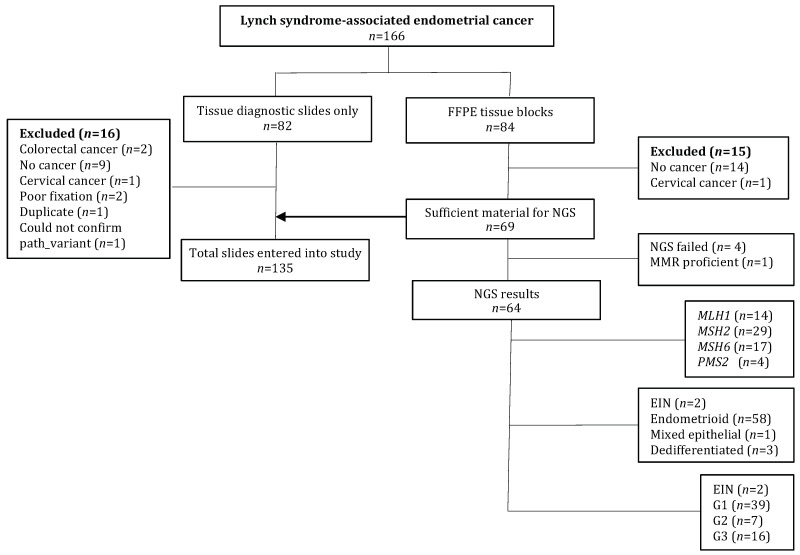
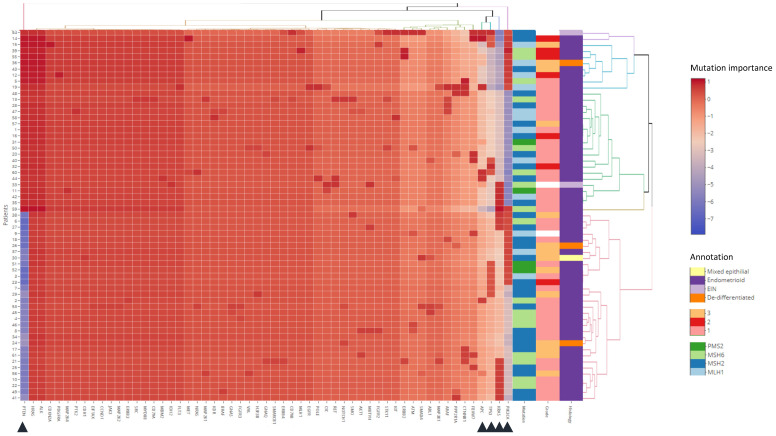
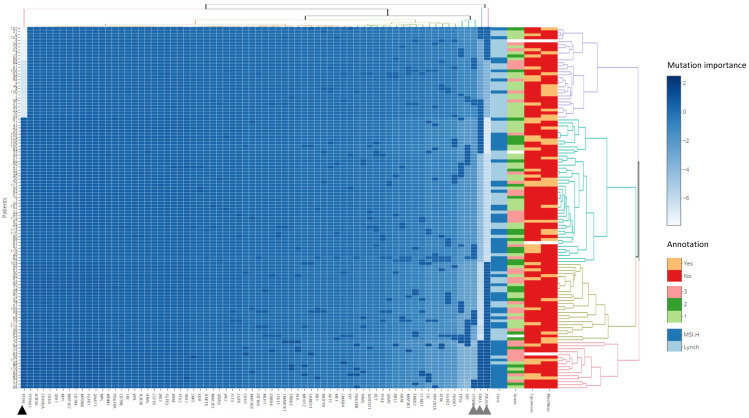
Clinically annotated LS-EC were collected. Histological slide review was performed centrally by two specialist gynaecological pathologists. Mutational analysis was by a bespoke 75- gene next-generation sequencing panel. Comparisons were made with sporadic MMRd EC. Multiple correspondence analysis was used to explore similarities and differences between the cohorts.
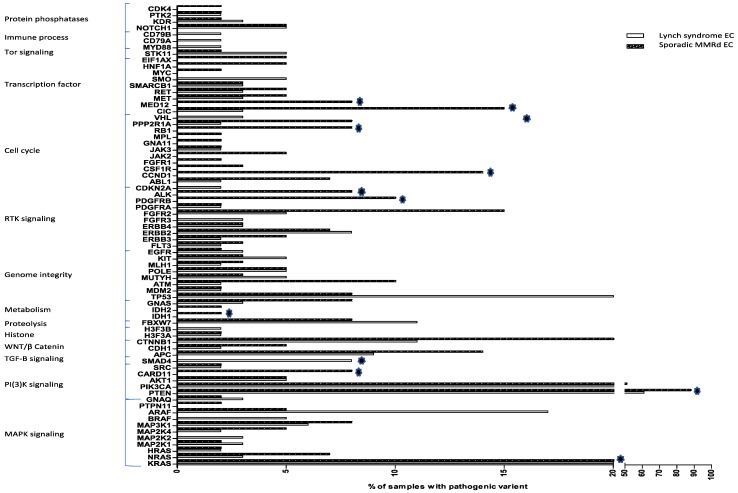
After exclusions, 135 LS-EC underwent independent histological review, and 64 underwent mutational analysis. Comparisons were made with 59 sporadic MMRd EC. Most tumours were of endometrioid histological subtype (92% LS-EC and 100% sporadic MMRd EC, respectively, = NS). Sporadic MMRd tumours had significantly fewer tumour infiltrating lymphocytes ( ≤ 0.0001) and showed more squamous/mucinous differentiation than LS-EC ( = 0.04/ = 0.05). mutations were found in 88% sporadic MMRd and 61% LS-EC, respectively ( < 0.001). Sporadic MMRd tumours had significantly more mutations in , , , , , , , , and , while LS-EC showed more mutations affecting and . LS-EC showed a propensity for TGF-β signalling disruption. Cluster analysis found that wild type associates predominantly with LS-EC, whilst co-occurring mutations in , and predict sporadic MMRd EC.
Whilst MMRd EC of hereditary and sporadic aetiology may be difficult to distinguish by histology alone, differences in infiltrating immune cell counts and mutational profile may predict heterogenous responses to novel targeted therapies and warrant further study.
错配修复缺陷(MMRd)肿瘤可能源于致癌过程中获得的体细胞事件,或发生在林奇综合征(LS)的背景下,林奇综合征是一种由种系MMR致病变异引起的遗传性癌症易感性疾病。我们的目的是探讨散发性和遗传性MMRd子宫内膜癌(EC)是否表现出独特的肿瘤生物学特性。
收集临床注释的LS-EC。由两名专业妇科病理学家集中进行组织学玻片复查。通过定制的75基因下一代测序 panel进行突变分析。与散发性MMRd EC进行比较。采用多重对应分析来探索队列之间的异同。
排除后,135例LS-EC接受了独立的组织学检查,64例进行了突变分析。与59例散发性MMRd EC进行比较。大多数肿瘤为子宫内膜样组织学亚型(分别为92%的LS-EC和100%的散发性MMRd EC,P = 无显著性差异)。散发性MMRd肿瘤的肿瘤浸润淋巴细胞明显较少(P≤0.0001),且与LS-EC相比,表现出更多的鳞状/粘液样分化(P = 0.04/P = 0.05)。分别在88%的散发性MMRd和61%的LS-EC中发现了KRAS突变(P<0.001)。散发性MMRd肿瘤在KRAS、NRAS、BRAF、PIK3CA、PTEN、ARID1A、FBXW7、PPP2R1A、CTNNB1和TP53中有明显更多的突变,而LS-EC显示出更多影响MLH1和MSH2的突变。LS-EC显示出TGF-β信号通路破坏的倾向。聚类分析发现野生型MLH1主要与LS-EC相关,而KRAS、NRAS和BRAF的共发突变预测散发性MMRd EC。
虽然遗传性和散发性病因的MMRd EC仅通过组织学可能难以区分,但浸润免疫细胞计数和突变谱的差异可能预测对新型靶向治疗的异质性反应,值得进一步研究。