Cesaroni Carlo Alberto, Pruccoli Jacopo, Bergonzini Luca, Quatrosi Giuseppe, Vetri Luigi, Roccella Michele, Parmeggiani Antonia
U.O. di Neuropsichiatria dell'Età Pediatrica, Centro Regionale per i Disturbi della Nutrizione e dell'Alimentazione in Età Evolutiva, IRCCS Istituto delle Scienze Neurologiche di Bologna, 40138 Bologna, Italy.
Dipartimento di Scienze Mediche e Chirurgiche (DIMEC), Università di Bologna, 40138 Bologna, Italy.
Brain Sci. 2021 Sep 21;11(9):1252. doi: 10.3390/brainsci11091252.
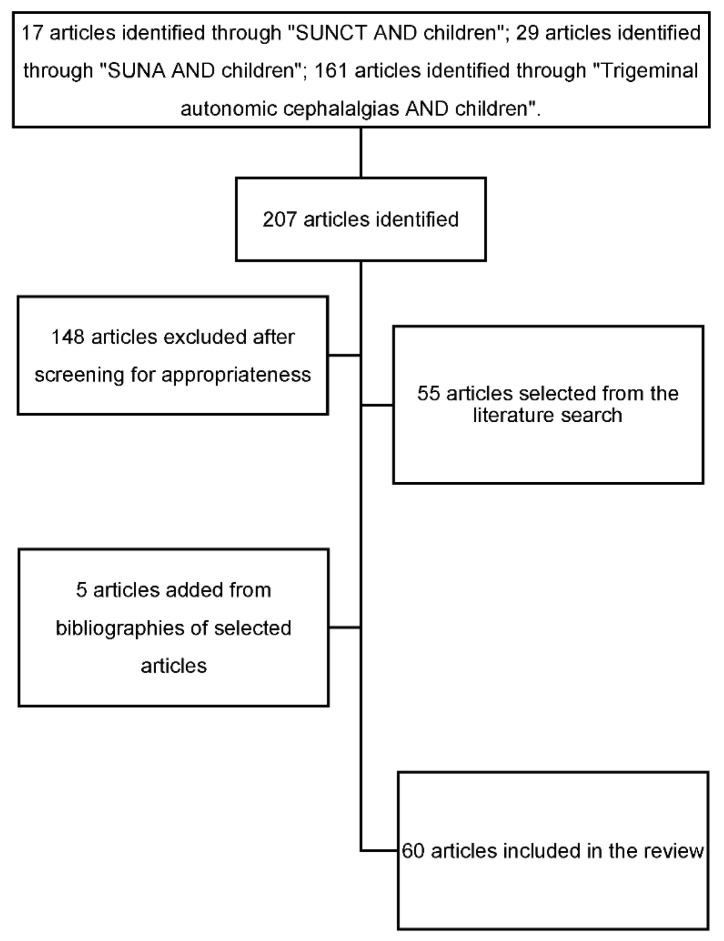
The International Classification of Headache Disorders, 3rd edition (ICHD3) defines Short-lasting Unilateral Neuralgiform Headache Attacks (SUNHA) as attacks of moderate or severe, strictly unilateral head pain lasting from seconds to minutes, occurring at least once a day and usually associated with prominent lacrimation and redness of the ipsilateral eye. Two subtypes of SUNHA are identified: Short-lasting Unilateral Neuralgiform headache attacks with Conjunctival injection and Tearing (SUNCT) and Short-lasting Unilateral Neuralgiform headache attacks with cranial Autonomic symptoms (SUNA). These pathologies are infrequent in children and difficult to diagnose. The authors reviewed the existing literature on SUNCT and SUNA, especially in the developmental age, which describes the pathophysiology in detail and focuses on the therapeutic options available to date. SUNHA-type headaches must be considered on the one hand, for the possibility of the onset of forms secondary to underlying pathologies even of a neoplastic nature, and on the other hand, for the negative impact they can have on an individual's quality of life, particularly in young patients. Until now, published cases suggest that no chronic variants occur in childhood and adolescents. In light of this evidence, the authors offer a review that may serve as a source to be drawn upon in the implementation of suitable treatments in children and adolescents suffering from these headaches, focusing on therapies that are non-invasive and as risk-free as possible for pediatric patients.
《国际头痛疾病分类》第三版(ICHD3)将短暂性单侧神经痛样头痛发作(SUNHA)定义为中度或重度、严格单侧的头痛发作,持续数秒至数分钟,每天至少发作一次,通常伴有同侧眼睛明显流泪和发红。SUNHA可分为两种亚型:伴有结膜充血和流泪的短暂性单侧神经痛样头痛发作(SUNCT)以及伴有颅自主神经症状的短暂性单侧神经痛样头痛发作(SUNA)。这些病症在儿童中较为罕见且难以诊断。作者回顾了关于SUNCT和SUNA的现有文献,特别是在发育年龄阶段的文献,这些文献详细描述了其病理生理学,并聚焦于目前可用的治疗选择。一方面,必须考虑SUNHA型头痛,因为即使是肿瘤性质的潜在疾病也可能引发继发性头痛,另一方面,它们会对个人生活质量产生负面影响,尤其是对年轻患者。到目前为止,已发表的病例表明儿童和青少年不会出现慢性变异型。鉴于此证据,作者提供了一篇综述,可为患有这些头痛的儿童和青少年实施合适治疗提供参考依据,重点关注对儿科患者无创且尽可能无风险的治疗方法。