Peterson Maria, Gauvin Mary, Pillai Sambhu, Jones Amanda, McFadden Katelyn, Cameron Katelynn, Reed Sarah, Zinn Steven, Govoni Kristen
Department of Fisheries, Animal and Veterinary Science, University of Rhode Island, Kingston, RI 02891, USA.
Department of Animal Science, University of Connecticut, Storrs, CT 06289, USA.
Animals (Basel). 2021 Aug 28;11(9):2531. doi: 10.3390/ani11092531.
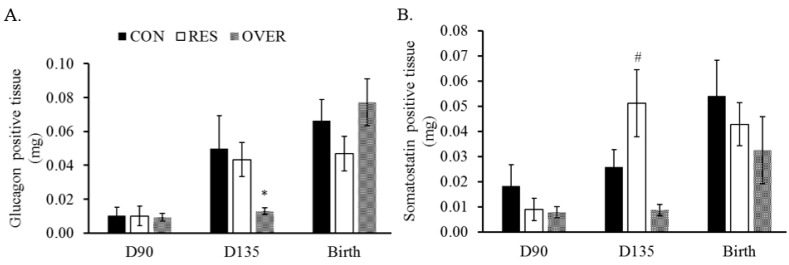
The mechanisms by which fetal programming predisposes offspring to reduced β-cell function later in life are poorly understood. We hypothesized that maternal under- and over-nutrition during gestation would negatively affect offspring pancreas development and alter DNA methylation patterns. Pregnant ewes ( = 78) were fed 100, 60, or 140% of NRC requirements beginning at d 30.2 ± 0.2 of gestation. The fetuses are referred to as CON, RES, and OVER, respectively. Fetal pancreas tissue was collected at d 90 or 135 of gestation or within 24 h of birth. Tissue was preserved for histological ( = 8 to 9 offspring per treatment per time point) and DNA methylation analyses ( = 3 to 4 fetuses per treatment per sex). At d 135, OVER exhibited an increased islet size, reduced islet number, and greater insulin positive area compared with CON ( ≤ 0.03). An increased islet size was also observed at d 135 in RES ( ≤ 0.03) compared with CON. Cellular proliferation was reduced at birth in OVER vs. CON ( = 0.01). In the RES vs. CON females, 62% of the differentially methylated regions (DMRs) were hypomethylated ( ≤ 0.001). In the RES vs. CON males, 93% of the DMRs were hypermethylated ( ≤ 0.001). In OVER, 66 and 80% of the DMRs were hypermethylated in the female and male offspring compared with CON ( ≤ 0.001). In conclusion, changes to maternal diet during pregnancy affects the islet hypertrophy and cellular proliferation of the offspring at early post-natal time points. Additionally, changes in DNA methylation patterns appear to be in a diet-specific and sex-dependent manner.
胎儿编程使后代在生命后期易出现β细胞功能降低的机制目前尚不清楚。我们推测,孕期母体营养不足和营养过剩会对后代胰腺发育产生负面影响,并改变DNA甲基化模式。从妊娠第30.2±0.2天开始,给78只怀孕母羊分别饲喂NRC需求量的100%、60%或140%。这些胎儿分别被称为对照组(CON)、限饲组(RES)和超饲组(OVER)。在妊娠第90天或135天或出生后24小时内采集胎儿胰腺组织。组织被保存用于组织学分析(每个处理每个时间点8至9只后代)和DNA甲基化分析(每个处理每个性别3至4只胎儿)。在第135天,与对照组相比,超饲组胰岛大小增加、胰岛数量减少且胰岛素阳性面积更大(P≤0.03)。与对照组相比,限饲组在第135天也观察到胰岛大小增加(P≤0.03)。与对照组相比,超饲组出生时细胞增殖减少(P = 0.01)。在限饲组与对照组的雌性中,62%的差异甲基化区域(DMR)发生低甲基化(P≤0.001)。在限饲组与对照组的雄性中,93%的DMR发生高甲基化(P≤0.001)。与对照组相比,超饲组雌性和雄性后代中分别有66%和80%的DMR发生高甲基化(P≤0.001)。总之,孕期母体饮食的改变会影响产后早期后代的胰岛肥大和细胞增殖。此外,DNA甲基化模式的变化似乎具有饮食特异性和性别依赖性。